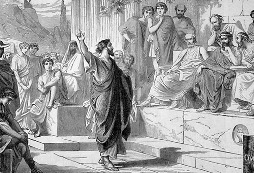
Power Preaching

With so many preachers with their “hot” sermons all trying to make an impression across the western world one could get quite confused about what makes a powerful message.

In view of that, let me take you back to basics and get you looking at what the Apostle Paul declared was pretty powerful preaching.

The Right to Speak

Paul has the right to tell us what works, since his own preaching was claimed to have “turned the world upside down”.  Paul was hunted from city to city through sheer hatred from those who knew the power of his preaching and who didn’t like what he was achieving.

Paul seemed to have a way of getting his message through in city after city and culture after culture. He was able to birth church after church in places where he simply preached his basic message.

In view of the power of Paul’s preaching we ought to pay attention to what Paul instructs.  And it is worth noting that Paul instructed the early church to imitate him.  I suggest we are well advised to do that in this day, almost two thousand years later.

Paul’s Power Preaching

Paul tells us quite directly that the “Gospel of Christ” is his power message.

“For I am not ashamed of the gospel of Christ: for it is the power of God unto salvation to every one that believes; to the Jew first, and also to the Greek.” Romans 1:16

Paul then explains the two basic truths of his gospel message as he continues his letter to the church in Rome.  Those two basic truths are simply that man is a sinner facing judgment and that faith in Christ saves us.  Paul was not ashamed to declare those truths.

Sinners Facing Judgment

Paul states the first basic principle of the gospel of Christ just two verses after declaring that the gospel is powerful.

“For the wrath of God is revealed from heaven against all ungodliness and unrighteousness of men, who hold the truth in unrighteousness” Romans 1:18

Paul uses the rest of chapter 1 and all of chapter 2 to expand on the fact that man is sinful and thus God’s judgment rests on him.  Several verses that state that truth are well known among Christians.

“As it is written, There is none righteous, no, not one: There is none that understands, there is none that seeks after God. They are all gone out of the way, they are together become unprofitable; there is none that does good, no, not one.” Romans 3:10-12

“For all have sinned, and come short of the glory of God” Romans 3:23

We later have Paul advising that the penalty for our sin is a death sentence from God.

“For the wages of sin is death” Romans 6:23a

Paul did not shrink from revealing to people that they had a sin problem and that sin brought God’s judgment on them.  This is the starting point of Paul’s gospel message.  The good news of Christ (the gospel of Christ) is not good news if you don’t first understand the “bad news” of our sin.

Faith in Christ Saves Us

Having established that all mankind is ruined by sin and that God’s wrath rests on the whole human race because no-one can reach God’s holy standard, Paul then testifies to the wonder of forgiveness and salvation we have through faith in Christ.

“But now the righteousness of God apart from the law is revealed, being witnessed by the law and the prophets; Even the righteousness of God which is by faith of Jesus Christ unto all and upon all them that believe: for there is no difference” Romans 3:21,22

“Being justified freely by his grace through the redemption that is in Christ Jesus” Romans 3:24

“Therefore being justified by faith, we have peace with God through our Lord Jesus Christ: By whom also we have access by faith into this grace wherein we stand, and rejoice in hope of the glory of God.” Romans 5:1,2

It’s a pretty simple message.  Our sin separates us from God and brings God’s judgment upon us.  Our faith in Christ saves us and brings God’s grace upon us.

Ashamed of the Gospel

The way some preachers preach you could think they are “ashamed” of the gospel Paul preached.  Many preachers avoid giving the simple, clear gospel message Paul found so effective.

I talked about this with a Chinese Christian today who admitted that in his youth he heard people preach the simple gospel Paul preached.  But today, he said, he does not hear people preach so directly.

He asked me why I thought that was so, and I suggested that many modern preachers are more interested in pleasing their audience than in pleasing God.  They preach what they think people want to hear, rather than what Paul says will transform the hearers.

Maybe, too, modern preachers don’t want to risk the opposition and challenge Paul received when he preached that simple gospel.

Fear God of Man

The fear of God is the beginning of wisdom but the fear of man brings a snare.

So who you give respect to impacts who and what you are.

This is important for preachers.  If you fear God you will preach God’s truth, no matter whether the audience likes it or not.  Some will reject what you say and others will be transformed by the message.  The gospel of Christ will release the power of God into their lives to save and transform them.

If you fear man, you will preach what people want to hear, but you will have no impact on their lives.  You will also offend God and have none of His blessing and fruit in your ministry.  In fact, you will get trapped (a snare is a trap) and maybe mess up the rest of your life.  That’s what the fear of man does to you.

“The fear of man brings a snare: but whoever puts his trust in the LORD will be safe.” Proverbs 29:25

“The fear of the LORD is the beginning of wisdom: and the knowledge of the holy is understanding.” Proverbs 9:10

Let us hear again the simple gospel that transforms lives.

Epistle of Barnabas Part 1

One of the many non-Biblical texts surviving from Apostolic times is a theological tract which is credited to Barnabas, the man who travelled with the Apostle Paul on Paul’s first missionary journey.

Barnabas is well known from the New Testament, as a Levite from Cyprus who is known as a ‘son of consolation’. His original name was Joses, but he was surnamed Barnabas by the apostles, probably in reference to his character as an encourager (Acts 4:36). It was he who sought out Paul to engage him in helping the Christians at Antioch in Syria.

Barnabas the Apostle

There appears to be several uses of the term ‘apostle’ in the Apostolic age. The term is mostly used to refer to the original disciples of Jesus who became apostles. The term apostle means ‘sent one’ and so it could also be used to refer to what we would now call a missionary. The term is used of other people than the original disciples, but it could be in the sense of missionary or sent ones, rather than as an equivalent term as applied to the twelve.

Paul refers to apostles as a functional appointment within church life, suggesting in Ephesians 4:11,12 that there is an on-going role for apostles in the church.

Barnabas is referred to by Dr Luke as an apostle, along with Paul (see Acts 14:4,14).

The Epistle

The early writers who make mention of the Epistle of Barnabas unanimously recognise Barnabas as the author. This stands in contrast to today’s scholars who hold that question in doubt. Clement affirms Barnabas as the author and so too does Origen, who treats it as equal to scriptural texts.

The original letter was written in Greek and is seen as Alexandrian in its style. The author is not named, nor is the intended recipients.

The opening verses suggest that the writer has a specific and limited audience in mind. “So greatly did the much-desired sight of you astonish me respecting you.”

The text is presented in 21 chapters, though many are very short. Rather than being a letter in the sense of Paul’s letters, it is more like a tract, presenting a set of religious teachings. The very purpose is explained to be “to perfect the knowledge” of his readers.

Date

The letter was written after the fall of Jerusalem in 70AD, but before the rebuilding of the city in 135AD. We know this because the fall is mentioned and yet Barnabas expects the Romans to rebuild the Temple, which expectation would have been nullified by the rebuilding of Jerusalem by Hadrian following the revolt of 132-135AD.

It is commonly thought that the letter was written before the end of the first century, before the Gospels were widely circulated.

Main Emphasis

While claiming to be a gift to the reader, assisting their understanding, the letter effectively spiritualises and allegorises the Old Testament law and other Biblical elements, to support the merits of Christ. However, Barnabas fails to deliver so rousing and glorious a celebration of Christ as we find in Paul’s writings, though he was Paul’s companion.

It seems that the determination to force Christological interpretations out of Old Testament and extra-biblical sources is energised by a desire to denigrate Judaism and separate it from Christianity. The repeated import is that the Jews focused on the tangible expression of their laws, sacrifices and temple, while those things were mere empty types of Christian truth.

Weaknesses

While there are a number of interesting thoughts proposed by Barnabas (or the author) the letter falls well short of a divinely inspired work.

One weakness is in an overwhelming inclination to apply allegorical interpretation. One could wonder if the author took anything to be literal, since the insistence on prescribing allegorical meaning as the superior interpretation is abundant.

Another problem, following that inclination, is the very forced nature of some allegorical interpretation. There is almost a sense of the delusional about the rampant impetus to make a spiritual sounding application of something which may well only be worthy of literal interpretation.

While there is an abundance of Biblical quotation the author is loose with his translations and does not take care to give clear credit to his sources. Several of his quotes are quite free and creative, imposing content into the text which is not there in the Old Testament source.

Spurious sources are also used freely. Some quotations which are presented alongside his Biblical quotes are completely unfamiliar to the Bible student. They may be based on Old Testament passages which were so thoroughly paraphrased as to lose touch with their original source. Or they may be pseudo scriptural content which he has drawn from sources which we do not readily identify.

Much is made of a Jewish tradition related to the scapegoat. That tradition is extra-Biblical, not being prescribed in the Mosaic instructions. So it is unworthy of the place which Barnabas gives it.

Unscientific ideas based on Greek mythology also find place in the letter. Of particular note is the assertion that hyenas change sexuality each year, from male to female and back again. This ridiculous idea can be traced back to Aesop’s fables and were also quoted by Pliny the Elder in his first century AD ‘Natural History’.

In the Epistle of Barnabas we see a preacher of the gospel drawing from cultural notions, rather than divinely revealed truth. In so doing he has compromised his authority and shown that his work was not inspired but simply concocted from popular cultural thought.

Barnabas Offers Much

Despite these and other negatives associated with this epistle, there is still much to gain from it. In particular, it gives us a view of the prevailing times, from outside the New Testament. We also gain insights into the themes and thinking of some New Testament believers.

In Part 2 of this topic I will take you though a review of the Contribution made to us by the Epistle of Barnabas.

Your Soul is in the Way

In a day when psychoanalysis is trendy and just about anyone who is anyone has their own psychologist we can lose sight of the Biblical realities about our inner life. The truth is that your soul gets in the way of your freedom and happiness.

What is the Soul?

Freud dissected the inner workings of the human mind with his Id, Ego and Super-ego. Many others have thrown their own two-pence worth into the ring, hoping to make much more than two-pence out of it. So the water is pretty muddy for anyone trying to understand the mind and man’s inner self.

When I studied first year Psych at Sydney University in the early 1970’s much of the course consisted of learning about competing schools of psychological thought. Each one seemed to make sense in its own right, but none could co-exist in harmony with the other. Psychology was a free-for-all game of eclectic self-determined theories and therapies. Things are even worse with the passage of a generation.

The Bible presents a very workable dissection of the human condition, given by the Apostle Paul in a letter he wrote to one of the churches he established, in Thessaloniki. In his first letter to the Thessalonians he prays that God will preserve their spirit, soul and body.

“… I pray to God that your whole spirit and soul and body be preserved blameless unto the coming of our Lord Jesus Christ” Paul, 1Thessalonians 5:23b

Spirit, Soul and Body

The Spirit of a man is that internal part which enables the man to relate to God. This part is somewhat unfamiliar to us, since westerners do not give particular attention to their spirit. It may be best understood by saying that it is the internal part of us that is not our soul. Man’s conscience is part of his spirit.

The Soul of a man is that internal part which enables the man to relate to the world around him. This includes the mind, emotions and will, or thoughts, feelings and choices.

The Body is the physical and visible person.

Spirit in Control

Man was originally designed to be in intimate fellowship with God, so man was created to live out of his Spirit. The Spirit is meant to be in control of each person’s life. Note that Paul listed man’s components by itemising the spirit first. Mankind is ‘spirit, soul and body’, not ‘body, soul and spirit’. The spirit is supposed to be pre-eminent.

However, when Adam and Eve ate of forbidden fruit in the Garden of Eden, they chose to make their spirit secondary to the soul. They exalted their mind, emotions and will over their conscience.

Soul in Control

What we have now is mankind living out of the soul. Our mind, emotions and will demand to be gratified. We demand to understand things. We react to anything that upsets our feelings. We refuse to yield our will.

The soul is in control in humanity. That’s why the soul is in the way. The soul blocks our ability to live out of our spirit, because it won’t give up its place of executive control over our lives.

For example, consider a person who feels touched by God and who wants to drop their career and dedicate their life to Christian ministry. What are the things that their friends say to them? People will tell them it doesn’t make sense (that’s the Mind issue). People will say they don’t feel right about them throwing away their studies and career (that’ the Emotions). Others will challenge the decision and pressure the person to re-think their decision (that’s related to the Will).

The person will have their own battles with their mind, emotions and will when they sense God leading them to a radical decision.

God Separates Soul and Spirit

The Bible speaks much about our soul and spirit. Just one verse will be sufficient to show that God wants us to separate our mind, emotions and will away from our spirit.

“For the Word of God is living and powerful, and sharper than any two-edged sword, piercing even to the dividing of soul and spirit, and of the joints and marrow, and is a discerner of the thoughts and intents of the heart.” Hebrews 4:12

We are not going to fulfil the perfect will of God by having our soul in command. We will live by faith and please God more, by being led by the Spirit of God.

The book of Hebrews exalts the Bible as being God’s tool for piercing into people’s lives and separating the soul and spirit.

Your highly trained mind will not make you a better Christian. Your strength of emotion or will is not an asset when it comes to living for God. You are much better off learning how to put your soul (mind, emotions and will) in their place, under the Lordship of Christ and out of the way, so they don’t interfere with your life in the Spirit.

Giving Honour

We are to “give honour to whom honour is due” (Romans 13:7). Ha! That is SO un-cool in today’s western culture. Rabid individualism and contempt for authority have bred a culture where it is obnoxious to have to give anyone respect, honour or special place.

This is not to say that it isn’t done and that in various aspects of western society it may be done well, but among many within current western culture it is not done at all. Rebellion, scorn, independence, cynicism and similar attitudes mitigate the ready giving of honour to others.

So let’s take a closer look at what the Apostle Paul instructed us to do:

“Render therefore to all their dues: tribute to whom tribute is due; custom to whom custom; fear to whom fear; honour to whom honour.” Romans 13:7

Christian’s know that one of the Ten Commandments is to honour our mother and father (Exodus 20:12). We also know that there is a blessing which goes along with that commandment.

“Honour your father and your mother: that your days may be long upon the land which the LORD your God gives you.” Exodus 20:12

There is a promise of longevity attached to this commandment to give honour. So ‘giving honour’ is something which demands at least some serious attention.

The Apostle Paul quoted this commandment, giving it special relevance to the behaviour of children. He notes that there is a ‘promise’ attached to the giving of honour in line with this command.

“Children, obey your parents in the Lord: for this is right. Honour your father and mother; (which is the first commandment with promise) That it may be well with you, and you may live long on the earth.” Galatians 6:1-3

Unfortunately for modern Christians Paul’s reiteration of this command has skewed its application toward children, and not to the rest of us.

So I want to re-focus your attention on ‘giving honour’. I think it’s much more important than most western Christians assume it is in their daily lives.

What does giving honour look like? Many years ago when Dr Harold Dewberry was staying in my home, I asked him to pray for some health challenges we were facing. Harold is a remarkably perceptive man, in particular with use of the gift of Word of Knowledge. I have been amazed at times with the profound accuracy and effect of his use of this gift in counselling. However, in praying with us, Harold didn’t seem to get any particular revelation.

Then, after spending a good amount of time praying with us, Harold asked me a question. He asked, “Chris, do you honour your father?”

I was caught off guard. I really did not have any clear reference point on the subject, to understand the giving of honour to my father, and so I could only guess at whether I did or not. I was not conscious of giving my dad honour, nor was I conscious of denying it to him. When I explained my inability to answer clearly Harold advised that he felt prompted to ask the question, but he also did not have any particular wisdom on how to be certain that honour had or had not been given.

As soon as I could after that, I organised a series of meetings for my dad to teach. I guessed that promoting my dad’s ministry was one expression of giving honour.

Now, let me ask YOU the question. Do you give honour to your father? Do you know how to measure the level of honour you give or don’t give? By what evidence can you prove that you do or do not give honour?

My guess is that most western Christians don’t have clear answers to those questions. My guess is you’ll like to know what I am coming to understand on that topic. Keep an eye out for a post I’ll do in the next week or so, where I will share my emerging understanding. By the way – the application of ‘giving honour’ goes beyond how we respect our dad. It impacts how spouses treat each other, how Christians treat each other and how we function in the broader community.

Nobility by Walking in the Spirit

I have pointed out in earlier posts that Nobility is anchored in our creation. Nobility is attached to things based on their birth or some other special quality. There is no more special origin and quality than to be made in the image of Almighty God. We are Imago Dei – made in the image of God.

Thus we are spirit beings, with profound spiritual significance. Our destiny is to express all that God is by our actions and lifestyle. We are to be like God, who is holy, loving, creative, totally faithful, responsible, forgiving, just, and so on. We must also recognize that we are created by a moral God and placed in a moral universe. We are therefore moral beings, accountable to God for what we do with our lives.

At the same time we are ‘flesh’. This means we are made of natural senses that empower us to engage with the natural world in which we have been placed. Those senses can, of themselves, provide us with delight, in taste, touch, sight, sound and so on. Humans, then, can choose to pursue the delight that human senses provide. When they do that they are now living out of their natural, sensual being, rather than their spiritual qualities.

Since nobility is based on our special-ness, when we live out of our spiritual value we have unparalleled nobility. When we live out of our natural senses we lower ourselves to the level of an animal in pursuit of natural experiences.

So, mankind’s nobility is tested by the fact that he is ‘also flesh’, as God described us in Genesis 6:3. Man is not to look out for opportunities to indulge the flesh but is to live by God’s spiritual destiny on his life.

The Apostle Paul put it this way, “do not use freedom as an opportunity to indulge the flesh, but serve one another out of love”, Galatians 5:13 (author’s paraphrase).

The challenge for humans, however, is that their natural senses can become quite obsessed with gratification. This is especially so if those senses have been awakened and indulged.

When the Israelites were fed supernaturally in the wilderness for 40 years they were fed a substance that sustained their bodies, but which did not indulge their appetites. The miracle ‘manna’ would form on the ground each morning and be collected for their sustenance. They made bread and other food from it. The food was physical but its essential quality was spiritual.

The Bible described the manna as “angels food” (Psalm 78:25). Angelic food would be sufficient to feed a spirit being, since angels are spirit beings. It was able to sustain natural bodies because people can be sustained and kept alive by having their spirit fed. Yet spiritual food would do nothing to pander to human appetite, even though it miraculously sustained human life.

As a consequence the people loathed the food, which they called ‘light bread’, and they lusted for meat, onions and other things their taste buds craved (Numbers 11:4-6,21:5). They said “our soul loathes this light bread”. While their body was sustained by manna, their appetites were unsatisfied with it. It did nothing to appease their natural cravings for strong flavours and tickled taste-buds.

The historical experience is metaphorical of the way humanity despises living for spiritual values. In order to walk in the Spirit and live out of our spiritual realities we have to put our flesh to death, dying to natural appetites.

The issue is not staying alive or sustenance, but the human pleasure derived from the natural senses. And therein is the nobility challenge for all humanity. When we turn our focus from the divine to the natural we are the ones who abuse our own nobility and degrade our own existence, selling out our true potential for such temporary and meaningless experiences as the gratification of our human appetites.

Let me put it another way. We are made in the image of God, imago dei. So we have divinity stamped in our being. This is the basis of our highest nobility. Yet we are made with natural senses that can feed appetites of lust and self-gratification. When we bring out body under control, and die to our fleshly appetites, living to fulfill spiritual destiny, we achieve our highest nobility. When we abandon spiritual focus and seek gratification of our appetites we degrade ourselves and can totally destroy any self-worth within us.

The Bible truth of our special creation by a loving God to whom we are accountable, is a solid basis for appreciating our nobility. The lie of evolution, baseless in science, defying proof or even a workable theoretical base, yet pushed as essential dogma for acceptance into many corners of western society, strips humanity of its nobility.

I call you to rise to your true nobility. I call you out of the trough, where the pigs wallow. You are created for much higher destiny and nobility than the pub brawl, seedy back alleys, hollow halls of human vanity, vain and baseless ambitions of self importance, and so on. You are created for the throne room, where your mentor, the Living God, waits to tutor you in eternal authority and global significance.

Fellow noblemen, please stand. Stand in the presence of God. Stand in your created destiny. Stand in your nobility. Stand against evil. Stand in freedom from human appetites. Stand in the glorious liberty of the children of God. Stand, because He has called you to stand for His glory.

Hyman Appelman – little jew with a big Jesus

This is the day that … Hyman Jedediah Appelman was ordained, in 1930.

This remarkable evangelist began life in White Russia on 7 January, 1902, born to an Orthodox Jewish family.  He was reared in the Jewish faith, emigrated with his family to America in 1914, became an outstanding scholar at various schools and universities and eventually (in 1921) was licensed to practise law.

During a holiday in Kansas City a newspaper reporter named Daly witnessed to him concerning the claims of Christ.  The next morning a Mr Garrett invited him to church – the first Protestant service he had ever attended.

It was later that year – now in Denver, Colorado – that Appelman was directed to Dr James Davis of the Central Christian Church.  There the 23 year-old Jew found his Messiah, was baptised the following Sunday, and sent a wire home to his family telling them the news.  His family disowned him, the Jewish law firm dismissed him, and his fiancée broke off their engagement. His father said to him, “When your sides come together from hunger, and you come crawling to my door, I will throw you a crust of bread as I would any other dog.”

But Hyman Appelman never faltered in his new-found faith.  He joined the United States Army, joined the Baptist denomination, and began preaching.

Shortly after his ordination by the Southern Baptists, he married Verna Cook (on 4 September, 1930), and commenced a remarkable evangelistic ministry that took him around the world, including Australia … in 1948. Just as the highly educated Apostle Paul laboured ‘more abundantly’, so too did this modern Jewish convert. It was hard to find a day when he was not ministering. He averaged two weeks at home out of a year.

Appelman looked directly to the Holy Spirit for his enabling. “The all-pervading, all-controlling, all-achieving Holy Spirit is the only Source of power. It is not in our schools, not in our churches, not in our organizations. It is not in our separation, not in our busyness, not in our attractions. It is not in our programs. It is solely the Holy Spirit who gives this power to do exploits for God, to promote the interests of God’s kingdom, to overcome Satan, to win the lost. There is no separating of spiritual power from the Holy Spirit. It is not power; it is the Holy Spirit. You cannot have power without the Holy Spirit. You cannot have the Holy Spirit without being flooded by Heaven’s power.”

Time Magazine once reported: Overflow crowds jammed Detroit’s Convention Hall to hear a sensational evangelist, Dr. Hyman Appelman, who calls himself “the little Jew with a big Jesus.”

This Russian-born Jewish American Baptist died in 1983.

Christ in You the Hope of Manhood (and Womanhood)

One of the challenges men face in entering into their true calling as ‘men’ is to have some level of modelling or mentoring to influence them. I have even coined the term ‘MEN-toring’ in some of my Manhood events. There is real need for leadership in the area of manhood.

However, I find a Bible truth to be very encouraging on this issue. It is the truth that Christ lives within us. The Apostle Paul spoke much about the “in Christ” relationship and he also uses the term ‘Christ in you’. He speaks of ‘Christ in you, the hope of glory’, Colossians 1:27. (see also Romans 8:10). Jesus Christ talked about coming into the believer and making his home there (John 14:23).

Now, just consider that for a moment. Jesus Christ will come inside a person and live there. Jesus Christ will be “in you”. How does that affect a man’s ability to be a true man? If the greatest man that ever lived were living inside you, you would have a good chance of being a better man! If the one by whom all men are measured were to come and live within you, then you would have to be a better man for such an experience!

While Paul says that Christ in you is the “hope of glory”, for men it must also be wonderfully true that Christ in you is the “hope of manhood”. Christian men have incredible advantage in discovering the true meaning of manhood – by being occupied by the perfect man, the man, Christ Jesus.

Jesus Christ is a Real Man – so He can empower me to be a Real Man! Praise God for that. As we submit to His Lordship and rule over our lives, each man is able to access levels of authority, boldness, victory, destiny and purpose that they would not find any other way.

Now, that does not leave the women out. God created womanhood to be directed by godly manhood. A daughter is to be directed by her godly dad and a wife by her godly husband. Jesus Christ is the perfect husband. Every Christian woman, having Christ living within her, has access to the most wonderful ‘husband’ in all the universe. The impact of having internal access to such a holy, loving and powerful input for her womanhood must be truly amazing in her ability to be the kind of woman she would never otherwise be.

When a woman has the Real Man, Christ Jesus, living within her, she is able to access levels of her womanhood that others will never know. When a man has the Real Man, Christ Jesus, living within him he will is able to discover levels of his manhood that were previously unreachable.

Christ in you - the hope of your Manhood and Womanhood. 

The New Dreaming

While Dreamtime and Dreaming are part of Australia’s ancient indigenous mythology the New Dreaming represents today’s departure into fanciful thought and abandonment of facts and reason.

Australian Aboriginals refer to “Dreamtime” as the earliest times, when spirit beings formed the world. They also refer to the “Dreaming” to identify their localized myths, legends, fairytales and folklore, accounting for formation of animals, geographical features and the like.

What makes these forms of ‘dreaming’ significant is how they give a notion of ‘reality’ to a people group. Dreamtime is a mythological and magical time in which amazing supernatural processes took place to form natural phenomena. Dreaming, then, continues the process of applying imagined forces to validate current tangible reality and to assert personal value in the broader context.

It could be said that ‘dreaming’ represents the chosen beliefs of a group of people from which they gain their identify and validate their place in the world. It does not matter if the ‘dream’ is ridiculous or practical, because its role is not scientific, but personal. It often defies logic, but it speaks to the heart of a people, conferring on them a sense of identity and shared values.

So now, enter the New Dreaming. Today otherwise perfectly rational and logical people abandon their common sense to embrace a whole new set of ideas and values, without regard for reality. We live in a generation where people embrace personal and group beliefs with the fervour of a tribal community. People now find identity in their chosen mythology, even to the point of alienation from those who do not share their folklore.

Populist causes abound and are asserted and defended with zeal. Ideas have become tenets of faith. Things that defy definition and proof are taken as gospel – from big bangs, to black holes and impossible evolutionary miracles. If a mind such as that of Hawkins conceives a thing, then many take the resultant idea to be as good as proven. Meanwhile world leaders and popular figures have become high priests of ideas that informed scientists decry as folly.

Of the many reasons for such a state, one is that people have chosen to ‘dream’ rather than to live reality. “To Sleep, Perchance to Dream”, has become the option of choice for the children of yesterday’s thinking populace. It is as if logic and empirical realities are deliberately abandoned in an intellectual protest movement. Intellectual suicide is the sport of the nations and a fad of compelling proportions. So allow me to make a few observations about this state of affairs.

Dreaming has never created reality. Sweet as the dream may be, we wake to the cold light of day. Those who seek the dream must lose their life to do so, for they cannot live in today’s reality and also live their dream. Reality does not bow to silly notions. Even if the entire world were to believe nonsense, that cannot make the idiot idea real. Gravity will still be gravity, human life will still be mortal and God is still God.

What makes Dreaming a matter of concern, is that the world has taken to it with enthusiasm. Those who see clearly find many around them walking in a dream. Vain people are building their lives on holographic images projected before them by people intent on beguiling the gullible. The populace has become fodder for the peddlers of peculiar ideas.

We came to this place by abandoning foundations. People have long followed the piper’s tune, lured from logic and even common sense. Now, lost in the woods of competing and un-provable notions, they have forgotten that there ever were foundations on which to stand. They apply the dream to their strained situation, as salve and solace to insecure souls.

Three millennia ago the Psalmist asked, “If the foundations be destroyed, what will the righteous do?” Today we might well ask, if the foundations are abandoned, just how far from reality can we go?

Two thousand years ago the Christian zealot, Paul the Apostle, spoke of a spiritual reality causing this very problem. He said that the God of this world, a fallen angel we call the devil, has blinded people’s minds. Paul was commissioned through a divine visitation from the resurrected Jesus Christ, to turn people from demonic blindness to the truth. The need to continue that endeavour is as real today as it has ever been.

Dreaming is a demonic seduction. It is not the next step in our evolutionary journey, but a step back to the dark ages, fostered by a spirit being that is keen to steal man’s freedom and kill our potential. Thank God Jesus has defeated the devil and Christians have authority to resist him.

In the name of Jesus Christ of Nazareth, the Son of the Living God, I take authority over the lying and seducing spirits which pull today’s world into the stupor of dreaming sleep. I bind the power of the lie and it’s anaesthesia and I break its right to exalt itself in the nations. I declare that Jesus is the Christ, the Son of the Living God, and I exalt Him over the nations. I release the glorious light of the gospel over the nations of the earth and I banish all that beguiles and deceives. I break the power of the lie and I exalt the one who is the Truth, in and of His own being.

I invite you to join me in rescuing the nations of the earth from sleep walking toward the abyss. The truth sets people free, so let us proclaim it and turn people back from the brink.