Cracks in Australia

Following my article “Cracks in the Public World” I point now to several cracks in the public world that we know of as Australia.

Recognising and challenging these cracks is important for those who are being attacked by wrongful use of authority or by the unlawful intrusion of the public world into the private lives of people.

I write these thoughts to assist the many Aussies who have contacted me regarding abuse they are suffering at the hands of the courts and corporations in Australia, often in connection with bank lending.

By What Authority

Anyone claiming the right to exercise authority over you must be able to certify their authority.  So a basic question for anyone doing anything is “By what authority are you acting?”

Authority issues are usually much more complex than we might initially think.  But they are vital nonetheless.  Just because someone “claims” to have does not mean they truly have that authority.  A suit and badge do not assure authority.  A title does not prove authority.

And authority can be conferred by one person to another, when they do not have the right to transfer that authority.  So sorting out the issues of authority, or jurisdiction, is important.

In courts, the moment jurisdiction is challenged it must be clarified and certified.  While this fact is not always followed (as I found when I challenged jurisdiction before Associate Justice Nemeer Mukhtar in the Supreme Court of Victoria in 2010 and he denied my challenge), it is a matter of law that jurisdiction, or the authority employed by those asserting to have it, must be validated.

Original Authority in Australia

White Australians trace their claim over Australia back to Captain Arthur Phillip, who raised the British flag at Sydney Cove in Sydney Harbour back in 1788, claiming Australia for England.

However that original claim is subject to some doubt.

A limitation on making that claim was that land could only be claimed if no previous claim existed.  The principle of Terra Nullis applies.  Yet England was advised that the natives around Sydney did have a system of recognising land ownership or rights.  So Australia did not truly qualify as terra nullis.

Then we have the problem which Mark McMurtrie points out about the Crown being refused permission to claim any lands in the Pacific, which is where Australia is located.

Is the original claim on behalf of England a lawful claim?  There are serious questions about that.  That suggests some serious cracks in the public world of Australia.

Australian Constitution

The Australian public voted to create a Commonwealth of Australia governed by an Australian Constitution.  So the basic legal authority for Australia as a Commonwealth is the Australian Constitution.

All officials and processes in Australia are bound by the Constitution.  Yet today most of the government and judicial processes in Australia are in contradiction to that Constitution.  This is a gaping crack in the public world of Australia.

Whitlam and the 1973 Styles Act

In 1973 Prime Minister Gough Whitlam foisted on Australians the Royal Styles & Titles Act 1973 (Cth) which cleverly undermined the Australian Constitution by unlawfully replacing the lawful elements of our existence as a Commonwealth with a set of token elements that have no lawful basis.

The Australian public created a Commonwealth of Australia, under the Crown of the United Kingdom, governed by a Parliament of the Commonwealth of Australia, with a head of state being the Governor General of the Commonwealth of Australia.

Those entities cannot be changed without the majority of Aussies in all states agreeing to make changes.  Yet Mr Whitlam unlawfully replaced those things with Australia, the Queen of Australia, the Parliament of Australia and the Governor General of Australia.

While those new names sound fine, they have no lawful authority.  And by that switcheroo (substituting an unlawful non-entity for the real Commonwealth of Australia) a de-facto, illegal corporate reality has stolen Australia from us Aussies.

For more on this check out my summary at Your Stolen Wealth Exposed, http://chrisfieldblog.com/2011/05/07/stolen-wealth

The abduction of our Constitution and the imposition of unlawful corporations is a gaping crack in the public world of Australia.

Australia Act

In 1986 Prime Minister Bob Hawke presided over another shock wave through the public world of Australia, known as the Australia Act.

The Australia Act seems to be little understood but its significance is dramatic.  Simply stated, the Australia Act 1986 dissolves the States and brings all government under the central Federal government.

While the full implications have never been tested in court, and most politicians are unwilling to go anywhere near explaining the true implications of this act, it is quite reasonable to argue that everything in Australia which springs from any State or Territory government is null and void.

That means the corporations registered in any state and the orders of any state court, as well as the state officials and registration of all lawyers are without lawful authority.

Thus the Australia Act has created some gaping cracks in the public world of Australia.

Powerless Local Councils

A further problem is that supposed authority has been given to parts of the Australian government system without lawful right.  So our local councils now act as if they have the right to tax people, through rate charges, and to regulate people’s activity, when the Australian Constitution and the Australian public have denied those rights to councils.

So here we have an example of authority exceeded.  And the same is true for police giving you an on the spot fine.  That is unlawful.  And the traffic courts in Australia provide fines in abuse of the correct judicial processes defined in the Constitution.

These various processes are ultra-vires (outside of true authority) and they are gaping cracks in the public world of Australia.

Complicit Treason

When you and I try to challenge some of these aberrations and cracks in the public world we come up against courts and politicians intent on maintaining these unlawful processes.  Thus we have treason going on.  And various parties are agreeing to work together to maintain and protect the things that are wrong.

Note that the negative impact of the 1973 Royal Styles & Titles Act has never been corrected, by politicians of any persuasion.  Courts act as if all is perfectly fine.  Our current Governor General and Prime Minister were not sworn in by the lawful oaths, and so they are not even holding true office.  Yet no one with power do anything about it seems to care.

And note that the implications of the Australia Act 1986 have not been properly investigated or the Australian public asked to pass new laws to clarify how we want our nation to operate.

Instead it is as if those in power, the “powers that be”, want us to give them freedom to do as they please, no matter how far it is from lawful authority.

What to Do

In view of what is going on in Australia, allow me to repeat what I advised at the end of the previous post on this topic, “Cracks in the Public World”.

Don’t allow any public official or public process to operate outside authority.  Don’t allow any public office or public process to abuse due process.

In a democratic society, the public world is accountable to the people.  So it is up to the people to keep an eye on their public servants and keep them in line with the limits of their authority and the lawful processes they are to follow.

Find the Cracks

Your best defence against abusive public officials or intrusive public process is to challenge the cracks in the public world.  It is easy for the public world to get out of step with its authority and the due process of its system.

All such failure of the public system invalidates its actions and the officials who are out of authority or abusive of due process.

It is an absolute must that you keep the public world to its own limits.  Otherwise the system will abuse you.

Cracks in the Public World

You are a private individual.  That’s how God made you.  We are all private individuals.

But social structures can’t be “private”, since they are designed to represent and serve many different private individuals.  So society is “public”.

You then live your private life and you likely interact with the public society around you as well.

Private Business

If you loan me $10, that is a private arrangement.  The deal is between you and me, privately.

Your family is private.  Your marriage is private.  And your group of friends is private too.  You can enjoy a whole bunch of group activities, with many other private individuals, without being in the “public world”.

All of those interactions are your private business.  You don’t have to report on it or give account for it.  Your family, friends and private arrangements are your own business.

The Public World

When people group together to create a social entity, such as a government, legal system or business enterprise, that entity is “public”, as part of the “public world”.

So our public world includes our governments, courts, police, corporations, social structures and all things that have to be regulated or reported in the public world.

A driver’s licence and car registration are part of the “public” world.  So too is citizenship, a birth certificate, property title, company incorporation document, death certificate, tax return and public notice.

If it needs to be registered or recorded somewhere in the public system it is part of the public world.

Invasion by the Public

Once bureaucratic systems are set up they tend to self perpetuate and to spread their influence beyond the original boundaries.  This tendency to control and regulate things means the public world tends to invade the private world.

By invading the private world the public world can impose controls over private processes and private individuals that it should not have.

For example, marriage was given to mankind back at the beginning of human history.  It is not something created by societies, but something private individuals have entered into for millennia.

Today, however, we are all expected to register our marriage.  In some countries you even need to have a permit to marry.  The “public” world of government regulation has invaded the private world of marriage relationships and imposed controls over that private process.

At the end of the 1800’s most births, deaths and marriages were recorded by local churches.  Anyone who has searched their family history in England or America knows that they have to go back to church records to get the information they seek.  Yet in the early 1900’s governments took over collection and collation of that information.  Births, deaths and marriages were brought into the “public” world and now the public world exercises increasing control over private individuals.

Remaining Private

Without going more deeply into the distinction, suffice it to say that a growing number of people recognise the dangers of being controlled by the public world and are intent on remaining as private individuals.  They want to enjoy their private existence without interference and control by institutions.

Remaining “private” is becoming increasingly more difficult as the centralised public systems seem more intent on extending control over our private lives.

To help those who want to tackle the public world and challenge its legitimacy I point out that that the modern public world does not recognise or respect your privacy.  So demanding your privacy may not be the best way to remain private.

A better way may be to challenge the gaping cracks that beset the public world.

Creating a Public World

A public world needs several elements to operate successfully.  It must have sufficient authority to be established and maintained, such as a conquering king imposing his authority over the people.

The public world must also have order and process.  There will be delegated authorities who have to perform certain tasks and report to their superiors.  There will be rules and processes that maintain the order of the public world.  Courts need consistent laws.  Records need consistent form.  Delegated authorities need verification of the scope and limits of their jurisdiction.

The Commonwealth of Australia, for example, takes its authority from the will of the people, who voted to adopt a specific set of governing rules, called the Australian Constitution.  The people declared, through their constitution what they would rely on, who they operate under and what processes will manage the public world of the Commonwealth.

Australians chose to acknowledge their reliance on Almighty God for blessing and their reliance on the Crown of the United Kingdom for a legal and political heritage.

However, even with the care taken to create the Australian Constitution, many of the public processes taking place in Australia today are out of order.  There are gaping cracks in the public world.

Authority Needed

The ultimate authority for any society is Almighty God, who created all, who sustains life and who will judge the living and the dead at the end of the world.  All other authorities are subordinate to the authority of Almighty God.

Humans, however, have a lust for power.  Those with delegated authority or with the power to grab control that they are not authorised to have, often compromise the authority under which they act.  Many of the cracks in the public world result from failure to establish correct authority to hold office or to impose restrictions on the private world.

Clarifying the authority relied upon by a public official or for a public process often exposes the cracks in the public world.

Due Process

Authority must work through authorised processes and those processes must be correctly followed according to policy.  However, the weaknesses in human nature mean that people often abuse due process or seek to shortcut the system in some way.  Such actions create cracks in the public world.

Often various related parties conspire to circumvent due process, so they can get more power, more money, or some other gain.  Lawyers and courts may agree to abandon lawful constraints, in order to expedite the outcome they both seek.

Whenever due process is abused, and it often is, the public world develops serious cracks.

Hold the Public World to Account

If your rights and freedoms are being invaded or abused by the public world call the public world to account for its actions.

Don’t allow any public official or public process to operate outside authority.  Don’t allow any public office or public process to abuse due process.

In a democratic society, the public world is accountable to the people.  So it is up to the people to keep an eye on their public servants and keep them in line with the limits of their authority and the lawful processes they are to follow.

Find the Cracks

Your best defence against abusive public officials or intrusive public process is to challenge the cracks in the public world.  You will probably find that the public world is on pretty shaky ground.  It is easy for the public world to get out of step with its authority and the due process of its system.

All such failure of the public system invalidates its actions and the officials who are out of authority or abusive of due process.

This is not a cheap way of cheating the system.  It is an absolute must that you keep the public world to its own limits.  Otherwise it is the system that is cheating.  And the system will be abusing you.

Words That Control Us 2

We saw in the first article in this series that people can use words to control us.

This lesson looks at some of the various “words” that impact us and helps us assess which ones we should heed.

Words Control

If someone shouts a command at you and you obey that command then a significant social transaction has taken place.  You show yourself to be under their authority.

Now, someone might call out, “Watch Out!” to warn you of a danger.  Responding to that call does not put you under their authority.  But someone who demands that you do something as they prescribe, such as “Stop!” or “Come Here!” is bringing you under their control by their words.

I recall reading about a man who was driving in city traffic when a police officer called out to him, “Pull over here!” The man simply replied through his open window, “Is there some problem, officer?”

The officer called to him several more times but he did not obey, but simply repeated his question, “Is there some problem, officer?”

The officer soon tired of this and called to someone else, who did pull over.  The officer then commandeered the vehicle.

The man had honourably resisted the control exerted by the policeman.  The driver of the other vehicle did not resist and so came under the officer’s control.

Words Are All I Have

Back in 1968 the Bee Gees released a hit song with the line, “It’s Only Words and Words Are All I Have to Take Your Heart Away”.

And words can at times be all we have.  Yet words are very powerful, as the saying penned in Bulwer-Lytton’s 1839 play puts it, “The Pen is Mightier Than the Sword”.  But this idea traces back to the fourth century Greek poet Euripides who said, “The tongue is mightier than the blade”.

So, while words may seem very lame at times, they are also one of the most powerful tools, or weapons, available to man.  Consider how readily people use them in scoring points against each other, from the children’s playground to the halls of power.

Some Can Speak

I have pointed out in earlier essays on Jurisdiction that God has the ultimate right to speak.  As creator He is immediately and powerfully authorised to speak whatever He will over His creation.  And so the words of God, God’s laws, rule our lives like none other.

Not only can God speak over us, but He gets to identify others who have the right to speak.  God says that husbands speak as the head of the home and that children must obey their parents.  Those who God authenticates are thus able to speak with authority, in fact, with God’s authority, so long as they honour God in what they say.

The schoolyard bully, however, does not have authority.  But then, neither does the teacher!

The teacher does not have inherent, god-given authority.  Nowhere in God’s Word, the Bible, are we told to obey all teachers.  It is up to each student enrolling in the class to submit to the teacher.  If they choose not to do so they will probably be removed from the class.

So, some can speak with inherent, god-given authority (so long as they honour God in their use of that authority), and others have authority because we confer that upon them for the convenience of our circumstances.

Consider, for example, how a child is under the teacher’s authority in the class, but the teacher cannot then invade the family home and usurp the parents’ authority.  The parents have inherent god-given authority, while the teacher has limited authority conferred by the student’s willingness to submit, and limited to a specific place and set of circumstances.

The Toothpick Story

I saw a report of a chap who went to court and defied the court’s assertions of authority.  He had several questions to ask the court which deflected the court’s claim of jurisdiction.  However the chap came undone because of a toothpick. You can find the full account at 1215.org.

“One guy went up there was chewing a toothpick. He knew how to ask the three questions, and he was cruising through them and he got down to the end and then looked a little bit confused as to where to go from there. At that point the judge from the bench said “Take that toothpick out of your mouth”. And the guy reached up with his fingers, took the toothpick out of his mouth, and the judge immediately yelled at the bailiff, “sieze that man and throw him in jail for ten days for contempt”. When he followed the orders of the judge, the judge became the head and he became the tail. What he should have done was continue to chew the toothpick and say, “Do you have a claim against me?”

This toothpick story illustrates the point that when we submit to someone else’s words we acknowledge their authority over us.  If the one speaking has authority then we are being lawfully and duly submissive.  But if the one speaking does not have authority and is trying to exert authority, we are best to deflect the words and not submit to them, or we could be oppressed by their abuse of authority over us.

Responding to Words

A person who is the “head” and not the tail would respond to the attempted impositions from others in a particular way.  They would be free from the imposition.

One way to be free from attempted impositions is to ignore them.

Recall the account of Mary Slessor, the missionary in West Africa who sent a home-made cloth document to two warring factions, instructing them not to fight until she had arrived to explain the significant message contained on the document.  Mary was asserting her intervention.

The warring parties could well have rejected her imposition.  They could have thrown her cloth into the fire or sent it back to her.  It had no inherent power of itself.  The only reason it had influence over them was because they allowed it to have such influence.  And, of course, there was the moral conscience of the men and Mary’s prayers for them.

Similarly for Gladys Aylward, the wild-eyed murderer could easily have cut her to pieces.  Her presence awakened the conscience and brought God’s grace into an otherwise godless situation.

Your Responses

In the next lesson I will explore the options you have in responding to the imposition of words into your life.  You may be rejecting words that you should heed.  And you may also be responding to words that you should ignore.

Words That Control Us 1

Those who control us do so by “Words”.

This series of articles walks you through an understanding of the Words that Control Us and what we can do about it.

This first lesson looks at the fact that Words impact us.

A Shout

The Deputy Headmaster at my high school (St Marys High – not a Catholic Girls School as some thought) was Jack Curry and he loved to catch people off guard with his shouted cry “You Boy!”

Just about everybody in earshot would freeze when they heard that distinctive, commanding call.  We would all turn around to see if “Curry”, as he was called by the boys out of earshot, was calling to us or someone else.  It was always a relief to realise he had someone else in his sights.

Occasionally the senior boys would mimic the “You Boy!” call, first creating a shock, then a chuckle as people realised it wasn’t Mr Curry.

Jack Curry was promoted to Headmaster at a nearby school and we were spared his intimidating call.

Getting Your Attention

If someone calls loudly near us we usually turn around to see if someone is trying to get our attention.

Someone may be calling to us, or to someone else.  So unless we check the matter out we won’t know.

They may be warning us of an approaching car or similar danger.  They may want to get our attention so they can sell us something, as happens when westerners visit some tourist destinations and the sellers want to hawk their wares.  There may be some official wanting our attention, or someone who simply wants to say “Hi!”

When people call for our attention we tend to naturally look in their direction and then assess the situation from there.  We can stop and listen, or walk on and ignore them.  We can heed the warning and adjust our actions as we see fit.  Or we can be completely dominated by the demands of the other person.  It is up to us to decide how to react to someone wanting our attention.

Speaking With Authority

While most of the voices we hear around us are just those of other people with no authority over us, it is possible that the person speaking has some right to be demanding our attention.

We use the term Jurisdiction to describe the right to speak word (diction) that have authority (juris).  The Deputy Headmaster of a school has a lot of authority and speaks with Jurisdiction.  But one of the junior students can be ignored, because they are without authority.

Yet at times a junior student would turn up in a class with a message demanding that some student report to the office.  That demand did not come in the name of the junior student, who was without authority, but usually came in the name of the Headmaster.  If the junior student was ignored then the Headmaster who sent that student was also being ignored, and that was a serious matter.

Someone doesn’t have to possess personal authority to speak with authority, if they are speaking under the authority of someone else.

When I Say “Jump”

Speaking with someone else’s authority is clearly illustrated in the words of a Roman Centurion who history records meeting with Jesus of Nazareth, 2,000 years ago.

The Centurion described his authority as follows:

“For I am a man under authority, having soldiers under me: and I say to this man, Go, and he goes; and to another, Come, and he comes; and to my servant, Do this, and he does it.” Matthew 8:9

The Centurion’s men did exactly what he told them to do, but only because the Centurion was “a man under authority”.  When the Centurion said “Jump” the men jumped.  But that is because when the Centurion’s bosses said “Jump”, HE jumped.

So some voices that call for our attention will be voices with delegated authority, giving them jurisdiction.

Imposing Our Words Onto Others

It is interesting to note that people tend to defer to those who are assertive.  If someone starts to assert their authority or speak in a compelling manner it is likely that a good percentage of people will at least pay attention.

Those of us who are trained in civility, to honour others, do as we are told, respect authority and so on, are highly likely to pay attention to someone who appears to have authority making assertions.

This is the process of imposing words onto others.  Most people do that, even in casual conversation.  Mostly it is an innocent negotiation for the attention and interest of others.

In official matters, however, it is a serious subject demanding our understanding.

Mary Slessor and Words

An amazing example of a person imposing their words on others comes from the legendary English missionary lady Mary Slessor who went to the remote tribes of Nigeria where no white man or woman had been before.

From 1888 she worked with the godless Okoyong tribe which delighted in bloodshed.  She often stood between war parties to stop them killing each other.

Her methodology was to call the leaders of the two fighting groups to account to her the reasons for their arguments.  She would set herself up in the shade of a tree with her knitting, and listen as each side put its case.  Her aim was to keep them talking until they had cooled off or it was too late in the day to do the fighting.  By this means she saved many lives, and did a great deal of knitting.

On one occasion she learned of a fight about to take place at some distance from her.  She cut out a piece of cloth and quickly made various ink markings on it.  She then rolled it up and closed it with a wax seal, giving it the appearance of something very important.  She sent it off by a man who ran to the scene of the fight and presented it to the leaders, saying that the white woman would be along soon to explain the meaning of the mysterious, and obviously important document.

When Mary arrived she unwrapped the cloth and made up her explanation of the random symbols, and thus averted the bloodshed that would otherwise have occurred.

Gladys Aylward and Words

Another feisty English lass who went to remote places was Gladys Aylward who ended up in the mountains of northern China.  On one occasion she was called to deal with a bloody riot in the local prison.  The local mayor and prison commander were terrified and so they demanded that she go into the jail and stop the riot.

She was pushed through a small door which was hastily locked behind her.  She then walked through a darkened tunnel to emerge into the courtyard where dismembered bodies lay about.  A huge man with a blood soaked meat cleaver stood nearby, his chest heaving.  Others were fleeing, crying in pain, or lying dead.

In what became her typical fashion, Gladys scolded the man for his bad behaviour and demanded that the man give her the cleaver, which he did.  Her unexpected appearance and forthright manner quelled the whole drama in a matter of moments.

Yet all Gladys had on her side, apart from her faith in God, was a forthright manner and a bunch of words.

Gladys later used the same demanding manner and calls to people to rally a village to deal with the aftermath of a deadly strike by Japanese war planes.

Imposing Words

In the examples of both these ladies we see the use of words which imposed something over the audience.

Asserting authority and using words enabled both of these godly women to bring about a positive change.  Yet what they were doing involved imposing their will onto others, by their resolute demeanour and their commanding words.

We too are impacted by those around us who use those techniques.  And those techniques are not always used for our good.

People in uniforms or with official positions, using their fancy words on fancy paper, or shouting their commands with an air of authority, can quickly herd people into the responses those people impose.  Yet, like the cloth sent by Mary Slessor, the documents and apparent significance can be completely fictional and of no real substance.

Under Control

You are already under the control of others who have used nothing more than assertion and words to impose their will onto you.

Some of those may have the right to speak.  They may have true “jurisdiction”.  But others may have assumed and asserted control that they do not have.

The purpose of this series is to explore the impact of other people’s words over you and the control they assert, so you can make your own decision about how you respond.

Speaking With Authority

I saw something sweetly tantalising in a familiar Bible text on Sunday. It has to do with Authority which is a bit of a thing with me over the past year or so, linked in to such things as Jurisdiction, personal sovereignty and such like.

What I saw is that authority is directly linked to speaking authoritatively, so that things happen as a result.

Now, guess where I found that in the Bible. It is in a passage that is often quoted in reference to authority – the comments by the Roman Centurion to explain why he was confident that Jesus could heal the centurion’s servant simply by speaking the word.

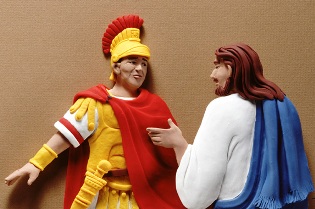
ClayDetailCenturian

“And when Jesus entered Capernaum, a centurion came to him, begging him, And saying, Lord, my servant lies at home paralysed, grievously tormented. And Jesus said to him, I will come and heal him. The centurion answered and said, Lord, I am not worthy that you should come under my roof: but speak the word only, and my servant will be healed. For I am a man under authority, having soldiers under me: and I say to this man, Go, and he goes; and to another, Come, and he comes; and to my servant, Do this, and he does it. When Jesus heard it, he marveled, and said to those that followed, Truly I tell you, I have not found so great faith, no, not in Israel.” Matthew 8:5-10

Now, in case you missed the salient point let me remind you that this dialogue is about Authority. The centurion is absolutely confident that Jesus has the Authority to heal the sick servant. And that confidence about authority is directly linked in the Centurion’s mind to speaking.

The Centurion is saying, “I know how authority works. When you have authority all you have to do is give a command and it is obeyed. Jesus, I know you have authority so all you really have to do is give the command and the healing will be done.”

As you explore your own authority remember that it is directly linked to your words. When dad gives an instruction to his children or says “No” to their request there is great power in that expression of his authority. When a person who has authority speaks up in a meeting, to raise a question or press a point, the words have effect.

People who don’t have authority are ignored, shouted down, disregarded and silenced. If that is you, then you need to talk with God about what you have to do to recover your personal authority, or the authority of your place (as parent, husband, leader or whatever).

Another key from that passage about the Centurion is that a person has authority not inherently of themself, but because they are “under authority”. The Centurion said “I am a man under authority, and so I am able to tell others what to do.” If you have lost your authority it may be that you need to repent of having rejected the authorities which God has placed over you (your parents, husband, boss, leaders, etc).

I encourage you to discover the authority God has given you, reclaim and heal it if it has been damaged or lost in some way, and then Speak Up! Speak as one with authority, so you can release that authority into those you are responsible for.

The image of Jesus with the Centurion, above is “A Centurion’s Plea” from Clay Illustrations by Georgia Cawley

Giving Up Sovereignty

In recent posts about going to Court I noted that people have power they do not realise they have. We are bluffed and deceived into giving up our authority, or, worse still, handing our authority over to others who then use it against us.

If you are irrational, unstable and otherwise a danger to yourself and others then you will be treated as a child and put under the authority of carers. If you are a mature, responsible adult, then you do not need to be treated as a ‘ward of the state’. However, those in power like you to let them act as your parent or guardian, so they can use your authority to advance the things they want to do.

Governments and courts want you to acquiesce, submit and let them do whatever they think best. While governments and courts are there to serve us (remember the term “public servant”) and we appreciate their positive contribution, they have no right to take our sovereignty from us or to treat us like children when we are responsible adults capable of determining what is best for us.

I hope that is a reasonable description of you, Hmmmm?

Just Give Up

defeated

Those who want to rule us unlawfully and impose statutes, rules, limitation, etc which we do not want or need, want us to just give up our freedom and give in to their demands. That is why official processes are often presented in a way to intimidate or bluff us into just giving up.

A man researched the laws in his country and realised he was completely within his rights to register his vehicle privately, instead of with the Government agency. When he wrote to the police about this a legal adviser for the police wrote back telling the man to give up and yield!

“The vast majority of your fellow subjects accept that their use of vehicles, carriages, conveyances etc, must be regulated and have acquiesced.”

Acquiescing

Regulation of our lives is all about our giving up our rights and acquiescing. Note in the quote above that the police adviser referred to “subjects”, not sovereigns. The authorities want us to see ourselves as subject to them.

The letter also uses the words “accept” and “acquiesced”, showing that it is up to the individual to agree. Many government regulations are not lawfully enforceable, but are just statutes that must be accepted by each person in order to hold sway.

Statutes do not have authority but the sovereign individual does! When a sovereign individual chooses to give authority to something, such as a statute, an official or a court, then those created entities can exert some influence over him, but only to the degree that he admits.

A statute is a rule or regulation “given the force of law” by those who choose to accept it as such, but, therefore, not having any innate lawful right to impose itself upon those who do not give it such force of law.

Come Under My Power

The courts and those who serve the State, those who serve statutory reality, often wish to trick sovereign individuals into yielding, acquiescing and giving the force of law to their statutory realities. When an individual man or woman yields to the demands made upon them they are stepping onto the “sticky paper” of the official or court process.

Governments and courts like to entangle us in a web of contracts and controls. Have you ever noticed how you are always asked to sign forms, make applications, fill out registration documents, sign here and sign there. You are asked to give your full name and expected to answer all questions. And so it goes. Each of these processes is part of getting you to stand on their sticky paper. Once you have stepped onto it you are stuck and entangled in their control mechanisms.

In the Bible the idea of “sticky paper” is presented in an extreme case as a Spider’s Web to snare the unwary. When evil prevails and justice and truth have been removed things get pretty ugly.

“None calls for justice, nor any pleads for truth: they trust in vanity, and speak lies; they conceive mischief, and bring forth iniquity. They hatch cockatrice’ eggs, and weave the spider’s web: he that eats of their eggs dies, and that which is crushed breaks out into a viper.” Isaiah 59:4,5

Invitations

Believe it or not many of the things you see as official orders which you cannot ignore are just invitations, needing you to acquiesce or give in so some authority can take power over you. For example, a summons is an invitation. Instructions from an official, court orders and government regulations are an “invitation” to a sovereign individual to yield their rights and give the force of law to the statutory context.

A notice is an offer. A notice of summons is an offer of an invitation. However, individuals are carefully trained to readily give the “force of law” to the entire statutory realm and all government appointees. Thus those individuals fall immediately under the power of the statutory realm, by their unthinking acquiescence.

Now you are welcome to accept an invitation. But you are also welcome to decline. You don’t have to go to every party you get invited to. When a bully invites you to a fight you don’t have to turn up.

Give Honour

The best way to decline an invitation or offer is to do so without dishonour. Dishonour involves rejecting the one making the offer. When you reject an invitation or offer the person making it could feel offended, as if you are rejecting them.

So the best way to decline an offer is to give it “conditional acceptance”. That is where we accept the other party’s offer or claim, conditional upon them providing some additional qualification. That might be, for example, proving their right to that claim.

A variation of this conditional acceptance is to seek further information and clarification, which is your right to do. In such a case you are not rejecting the offer but requiring sufficient further information to be sure the offer is valid and beneficial to you.

Protect Your Assets

You have a right to protect what is yours. And one of the most valuable things you have to protect, for yourself and your family, is your freedom. You have the right to protect your freedom.

If people want to bring you under their power and authority it is reasonable to stop and question if they have the right to do so. To what degree do you need to cooperate? What power do they really have if you decline their invitations or demands? Do they have the right to make the demands they want to make?

I expect that investigating these things will be a long and interesting process. You may not have enough interest to bother. But please be cautioned. If you do not determine to protect your freedom you can be sure that it will be taken from you and compromised in some way. You may already have lost most of the freedoms God gave you.

Do you know how to get them back?

Leading with Authority

I have often seen people struggle to exercise appropriate authority in their leadership roles. Parents, foremen, teachers, kids club leaders, committee chairmen, pastors and the like can each struggle to establish their authority at times.

This lesson is designed to prompt you toward a correct understanding and application of your authority as leader. You might gain particular help from realising your wrong notions of what leadership is, that block your correct use of authority in your leadership positions.

Bad Examples

I have seen school teachers in complete disarray as they struggle with their class. I have seen young leaders get exasperated, shouting and making a scene to gain control over the group they were trying to lead. I have seen parents get to the end of their energies trying to negotiate with their child.

There is no shortage of bad examples and we have all seen people handle their position of authority poorly. So take a moment to reflect on some of those you have seen. What were they doing wrong? What could they have done differently to handle the situation better?

controlOften poor leaders end up being removed. Once someone is in a fix in their leadership there is often little hope of easy recovery. Their superiors have to step in and a leadership reshuffle may well result, to give everyone a fresh start.

Wrong Leadership Notions

Many of those who fail in leadership are beset with poor ideas about what gives them their authority. It is easy to believe or assume something to be true, without any real knowledge or basis by which to test the assumption. People often act out things they believe to be true, without ever reflecting on their beliefs and modifying them.

Leadership by Personality

I have seen leaders who believe that people will follow them because of the quality of their personality. The thought process may go something like this: “I’m chosen as a leader because I am an ideal choice. Therefore people will follow my instructions automatically, because I’m an ideal leader.”

This naïve notion is soon challenged by the failed response of those being led. Lack of cooperation will cause the leader to feel that they are being put down personally, and that their qualities are being insulted. The leader will then have internal emotional issues to deal with as they try to lead. Things can get personal and messy in that situation.

Notions of Superiority

Some people carry pride about their self importance. This is akin to class distinction where one person assumes that all “lesser” people are to serve them. When a leader carries notions of personal superiority those under their leadership will feel the impact of the leader’s pride putting them down.

A leader with illusions of their own superiority will tend to talk down to those they lead. Note the condescending tone in this following instruction from a “superior”. “You’ll be a good dear and fix that for me, won’t you?”

Along with condescension will come demands that are unreasonable or inconsiderate. The leader will be constantly walking over those in their service, expecting their total obedience as a matter of proof of the leader’s place.

Intimidation

Some leaders think they can only get cooperation by intimidation. These leaders resort to shouting, threats, bullying, taunts and the like. They do not carry authority in themselves and so try to generate the effect of authority by lording over those under them.

Some employers use threats of sacking to get their employees to do what is asked. The “stick” of punishment is seen by some leaders as their only effective tool for getting things done.

Note here that Biblical use of the “rod of correction” is not coercive. Parents are not told to use the rod to get action or obedience. They use the rod of correction only temporarily, in order to create a heart change in their child. Once “foolishness” has been driven from the child’s heart by the “rod of correction” (not the rod of abuse or anger) then the rod becomes redundant. So adult leaders who think they have a Biblical clearance for the use of force and threats are misguided.

Position of Power

I have seen leaders who only comprehend leadership in terms of “power”. These leaders do not “lead” those under them, but “control” them because they have “power over them”. This is a complete distortion of leadership.

Leadership speaks of purpose. Leaders lead others to a place or outcome. Power, however, lacks purpose and outcome. Power is an end in itself. And it’s a “Dead End”! When leaders think of themselves in terms of power they lose something of their responsibility and role as one who directs for a purposeful outcome.

Positive Leadership

Many leaders do an excellent job, as parents, teachers, bosses and so on. Reflections on poor leadership should not create the impression that most leaders are inept. So, let me now turn your attention to issues of positive leadership which you can gain from.

Leadership and Authority

Leadership is a place of authority. Authority is delegated to us. So leadership involves the fulfilment of a responsibility on behalf of those who have entrusted or empowered us.

Of course, those who run their own business or project will have authority over their staff or members, without having had that authority obviously given to them by a superior. Yet those people have been entrusted with that opportunity by God and are accountable to Him, and they have been entrusted with authority by those who have agreed to submit to them. Thus there are serious responsibilities that must be kept in mind, even in the case of a business owner.

Authority and leadership are assigned, delegated and conferred from above and they are also assigned, delegated and conferred from below. When people agree to submit to another, authority and leadership is conferred on them. This happens when people chose to appoint one of their peers to lead them in a committee or activity.

Leadership in Practice

Good leadership can be packaged in various forms. It is not a cookie-cutter model that has to be followed religiously. Instead, it has much to do with principle and engendering cooperation and productivity from those being led.

king richardAmong the various expressions of leadership, I like to see good delegation, productive purpose and enthusing and rewarding of those involved.

Delegation

All those being led are effectively being “delegated” to positions and responsibilities by their leader. A good leader confers authority to those under him and empowers them to fulfil meaningful functions within the group or process.

Even the lowest position in the pecking order, if there is one, is a delegated position.

Good delegation finds the best person for the role, clarifies the processes and objectives, then motivates people to perform their responsible function in the most effective way, and keeps an eye on the on-going performance, and managing appropriately.

Honour and Purpose

Demoralisation of a team or staff has drastic impact on productivity and output. Whole organisations and projects have collapsed due to people losing heart for their role or project.

Giving honour and clarifying purpose are two important parts of keeping people motivated and focused. Honour is intangible and it costs little, except thought, intent and effort. Yet each of us has gone the extra mile because of the intangible reward of personal or publicly recognised honour.

And when we know what our purposes are we are able to endure difficulties to get the required outcome. When purpose is blurred inactivity and wasted time and resources will result.

Rallying Cry

Honour and Purpose are brought into clear focus in examples of a team being rallied to a purposeful moment. A great example is the St Crispin’s Day Speech from Shakespeare’s Henry V. Before going to battle in Agincourt, France, Henry rallied his men with an inspirational call to do their very best.

I enjoyed the 1989 Kenneth Branagh version and commend it to you as an excellent example of how people can be aroused and enthused by the conviction and purpose of their leader.

My rallying call to you is….

“You don’t need special gifts or personal superiority to be a great leader! Once you have had leadership conferred on you, your challenge is to handle that authority wisely, by truly leading those under you care. Delegate thoughtfully, give honour where it is due, maintain everyone’s focus on their purpose and the team’s overall objective, and rally them to the task. You can do it! You have the right to do it! And as you do it well, you will be respected and loved for it! The world needs more great leaders, so become one of them for the good of us all!”

Basis of Human Law Part 7

We have finally arrived at the place where we first see humans given authority to practice law over one another. It comes just after Noah’s flood and, simple as it is, it is the important beginning of what has blossomed into an overwhelming legal minefield.

To better navigate that minefield I’m helping you think about a bunch of foundational principles which combine to be the basis of human law. That starts with God’s law. That’s why I have started in the Holy Bible. We have already seen a bunch of stuff (to use an American expression) out of just a handful of chapters from the first book in the Bible, Genesis. So, let’s press on.

Man Judging Man

In Genesis 4 we find that Cain was punished by God for murdering his brother, Abel, but was not to be punished by man. A special mark was placed on Cain to make sure people knew not to kill him. In those days people lived for up to 900 years, so there would have been many people who would come across Cain’s path in the centuries of his life. None of them was to prosecute human punishment upon Cain.

Prior to the flood of Noah’s day there was no authority given to men to make judgement of other men. The result of that situation was that everyone did what they wanted and what they wanted to do was evil.

“And GOD saw that the wickedness of man was great in the earth, and that every imagination of the thoughts of his heart was only evil continually.” Genesis 6:5

It may well be that a form of human court and legal process might have restrained the behaviour of the people. We will never know. But we do know that God gave permission to mankind to punish evil, after Noah’s flood.

Murder Prohibited

Among the various things said by God after the flood are comments about the sanctity of human life. Human blood was not to be shed. People were not to be killed, by animal or by humans.

“And surely your blood of your lives will I require; at the hand of every beast will I require it, and at the hand of man; at the hand of every man’s brother will I require the life of man.” Genesis 9:5

Note that God had the right and authority to kill mankind. He had just done so in the global flood which wiped out probably millions of evil people. Death as a result of judgement is legitimate. Death by any other means was forbidden.

Capital Punishment

The very first legal power given to mankind was to exercise capital punishment. Mankind was authorised by God to kill a person who has killed someone else.

Whoever sheds man’s blood, by man shall his blood be shed: for in the image of God made he man.” Genesis 9:6

Now, that might sound like a contradiction, like a policeman breaking the speed limit to chase someone who is breaking the speed limit. But it’s a legitimate process. It is authorised by none other than God, Himself.

Capital punishment is an offence to the minds of some people today. So, it is important to at least pay attention to what God has revealed to us in the Bible. The very first legal power given to man was capital punishment.

Relationship With God Re-established

After the flood all those who had broken fellowship with God were gone. God was now in open relationship with all the people on earth – all eight of them. Once again mankind would be tempted to indulge the sinful inclinations of his heart and come under the power of sin, as Cain and others had done. But now there was a check to man’s behaviour. People had the power to prosecute those who went so far as to kill another person.

God’s Law in Man’s Hands

The only legal authority given to man was to exercise the law set down by God. Man could not make up his own laws. Man could not create whatever law he so chose. Law was only that ‘moral law’ which God established as man’s requirement.

God’s law was placed in the hands of men, in a limited way. And so it is today. Man acts as God’s agent when he prosecutes someone for breaking God’s moral commandments.

The first legal processes passed to man were to uphold Moral Law. Man was not given authority to prosecute another based on commerce, contracts or the like, but only on moral principle.

Law was not originally a social construct. It was a divine reality, based on man’s moral accountability to his holy creator God. When we come to consider the many forms of law which make demands of us today, we need to keep in mind the moral laws of God, as separate and special in our considerations.

Action Not Attitude

Man’s authority to hold other men accountable to God’s law was an ‘after the fact’ authority. Man was given no right to prosecute someone based on the attitudes of their heart. While hatred is a moral evil, which God will judge, man cannot prosecute someone for hatred. If the hatred becomes murder, then man has the right to step into the picture.

We saw previously that the people in Noah’s day were engaged in evil actions and also had evil imaginations in their hearts. That second area was retained by God, as His domain.

Punishment is not Crime

As noted earlier, to punish a person for killing someone, by killing them, seems to be a contradiction. If killing someone is wrong, then how can the killer be killed? The answer to this conundrum is that punishment is not a crime.

When a person is punished, that is a moral process. If the punishment is to kill them, then that action is of a different quality to the act of killing someone other than as punishment.

It is criminal to imprison someone, unless the person is a prisoner under punishment. It is criminal to inflict pain on someone, unless the person is an offender receiving their just punishment. It is criminal to kill someone, unless the person is under death sentence as punishment for their crimes.

Note, however, that we are still talking here about punishment as prescribed by God. Our investigation has not yet moved to that area where men make up their own laws and punishments.

Human Society

We have already seen what happens in a human society where everyone does as they please. Our next exploration is of human society under some regulation. That’s coming up in the next post in this series.

Authority Confusion

Recent discussion about whether present day Governments can legislate away our long-term rights and such things as our Common Law rights prompts me to discuss “Authority Confusion”, or, better put, “Jurisdictional Confusion”.

An analogy or two might be helpful, to open the subject.

Analogy 1 – The Military Commander

Imagine a Military Commander who instructs his army to invade a particular region and take the cities. In the process a young soldier realises that the region they are invading belongs to the broader realm of the King he serves. He asks his Sergeant to explain what is going on. The soldier is told that the Military Commander decided to bring that region under military control, instead of the King’s control.

The soldier eventually challenges the Military Commander. “Sir, how can we invade our own land and violate our own nation and King?”

The Military Commander explains that the King gave him the right to rule the army and so he is doing with it what seems best to him.

Jurisdictional Confusion

Do you see the Authority confusion there? Can you see the Jurisdictional confusion?

The Military Commander draws his authority from the King who appointed him. He has jurisdiction over the army, on behalf of the King, not independently of the King. The Military Commander violates his own authority, abandoning the right to hold it, once he attacks the very authority who gave him his position and jurisdiction.

Analogy 2 – The McDonald’s Manager

Imagine a man who is promoted to Manager of a McDonald’s hamburger outlet. Once in that position he chooses to change the recipe for the burgers, give free burgers to his friends and add a few home cooked products from his mum.

When the customers and staff ask him why he is doing it he explains that he is the manager now and can do what he likes.

That is ridiculous, because he only has authority as a manager because he is in the employ of the company. Once he mocks the company by abusing the position of responsibility and trust they have given him, he disqualifies himself from the role of manager. He will be sacked.

Conferring Authority

Authority is conferred. The authority of the Australian Government, for example, has been conferred upon it. Centuries of British legal and cultural heritage, with Christianity, the Holy Bible, Common Law, application of Natural and Divine Law, the Westminster System, Imperial Decrees, Maritime Law, and so on, have conferred on the present Government the responsibilities they currently hold. The people of Australia hold authority as the “electors’ parliament” and need to confer their personal vote to a government in order for that government to have authority to govern.

Captain James Cook, operating under Maritime Law, subject to the Crown of England and the British Parliament, anchored in Common Law, based on Natural Law and Divine Law, based upon the Person, Place and Values of Almighty God as expressed in the Imperial Document the Holy Bible (King James Version), provided the basis for today’s Government of Australia.

When a Government violates and rejects the principles upon which that very Government has been established it invalidates itself.

No Government or Parliamentary System can destroy its own foundations, violate the principles on which it stands, or revoke the rights, responsibilities and privileges upon which it is established without making a mockery of its own existence.

Subverting Authority

However “power corrupts” and so politicians and legislators are not above the temptation to distort reality, arrogate privileges to themselves and violate the rights of others. What is happening in modern societies is the assertion of the exclusive rights of the present forms of Government, independently of the basis on which they stand.

High Court rulings, Statute Laws and University text books notwithstanding, reality has not changed. A wrong decision does not dictate a new reality. Foolishness does not destroy wisdom. Lies do not render the truth powerless.

Powerful People

People, who are free indeed, by Divine Law, Natural Law, Common Law and their cultural and legal heritage, should not be fooled by those who tell them that they no longer possess that freedom.

In Australia we also have the Australian Constitution to further affirm our personal freedoms.

And notice what happens each time we are asked to vote. Our politicians come to us hat-in-hand at each election asking us to confer upon them the authority which we hold as Australians. Without our permission they cannot hold office.

We are not pawns of the Parliament, but they are our servants, as their repeated appeals for our votes affirm.

True Freedom

Parliamentarians do not determine our freedoms. Those freedoms are ours from creation and through history. Parliamentarians and legislators can only operate within a narrow margin of function. Any intention on their part to cross those boundaries reveals that they are unworthy of the trust placed in them and are ready to violate the very authority on which they stand.

Authority and Speech

The link between authority and the right to speak is clearly stated for us in the Roman centurion’s encounter with Jesus (Matthew 8:6-13). In that encounter the centurion asked Jesus to heal his sick servant. Jesus immediately offered to go with the centurion to effect the healing.

The centurion’s responded by telling Jesus that all He had to do was speak the word: “speak the word only, and my servant will be healed” (Matthew 8:8).

The centurion had great faith in Jesus’ ability to speak healing, rather than minister it by physical process, such as putting his hands on the sick person. The reason for this expectation is then given by the centurion, in a speech about authority and words.

“For I am a man under authority, having soldiers under me: and I say to this man, Go, and he goes; and to another, Come, and he comes; and to my servant, Do this, and he does it.” Matthew 8:9

Under Authority

The centurion was a man “under authority”. This means he was in an authority hierarchy. People with greater authority than him (his commanding officers) conferred authority upon him. That enabled him, as a centurion, to have people “under” him. Those under him included soldiers and his servant.

Authority is not negotiated, but delegated. Authority is not given to us by those under us, but by those we are under.

Some people have strange ideas about authority. I have heard people explain that husbands only have authority when their wives willingly submit to them. This misguided idea probably represents a broader western misunderstanding of authority. In light of our highly autonomous and democratic society we do not properly understand the reality of authority. Authority is conferred. It is not a gift from our subordinates.

Husbands have authority from God. If the wife refuses to acknowledge it then the man does not lose his authority. God still holds the wife accountable for her rebellion against God’s will. She has not dissolved the authority, because it is outside her power. If the husband gives it up, he is held accountable by God for his rebellion against God’s will.

Commands

The centurion was under authority and so he was able to give commands. When he spoke the word that word was obeyed by those who were his subordinates. His soldiers came and went at his command and his servant did what he instructed.

The giving of commands was directly linked to authority. The centurion’s sentence included reference to his place in an authority hierarchy, and his ability to speak instructions which are obeyed.

Authority confers the ‘right to speak’ upon those who have it.

If a stranger arrived and tried to command the soldiers or the servant there would be no compliance. The soldiers and servant obeyed the centurion because of his rank, not because of his tone of voice, good looks, or winsome ways.

Faith in Christ

The centurion’s speech confirmed he was convinced Jesus was the Christ and had authority from God. The centurion did not believe that Christ was relying on some supernatural ability which was picked up accidentally, or owned by some fluke of nature. He believed that Jesus had His power because He was appointed by God, under God’s authority.

Therefore the centurion was confident that Jesus had the authority to speak to sickness and demonic work. Being in a place of authority gave Christ the right to speak and have His words obeyed, even by nature.

Jesus was amazed at this high level of faith, and He told the audience that this was remarkable. He then sent the centurion on his way, with the word of healing. The servant was healed that very hour.

Power Words

Do you have the ability to speak power words? Or are you ignored?

The way to give your words more power is to be under greater authority. The higher the authority you are under and the greater the delegated authority given you, the more power your words have. If your words are falling to the floor and are impotent, then your place under divine authority needs to be upgraded.

Moses went to Egypt’s Pharaoh with the power words, “Let my people go!” There was a tussle over the words and some protracted opposition and negotiation, but Moses’ words prevailed. They were power words.

Speaking in Faith

I recall a humorous testimony Virgil Johnson gave of his conversion. As he headed out to a night of indulgence his mother challenged him that she knew his plans and would pray to stop them. He denied her accusations, but she persisted that if he tried to drive his car across the bridge to the bad part of town he would not be able to make it. She would pray that his car not be able to get across.

He denied her accusations and dismissed her claims, then drove straight toward the bridge. As soon as his car pulled onto the bridge it broke down. Despite all his attempts to get it started he finally had to give up and get the car towed home.

When he walked back inside his mother told him she knew exactly what had happened, because she had prayed. She then grabbed him, and sat on him, while she and her sister prayed for him until he was gloriously saved.

Virgil’s mother spoke words of faith. She did so in the authority of her God. She did so as a spirit-filled child of God, moving in faith. She claimed a level of authority in her words, directly from God. And God honoured her words.

You don’t have to be a President to speak words of power. Being under God’s authority is greater than being under human leaders and constitutions.