Can a Lawnmower Have a Demon

mower

You know how it goes… You roll out the trusty old machine and push it purposefully toward the jungle that was once your yard. You prime it and pump it, pat it and position it. Then you pull the cord, full of hope and expectation.

You prime the thing again, shake it, move it a few inches, and pull again. And again. And again!

Expectation yields to frustration. You prime again, filling the air with vapour.

Your wife, who has never pulled the cord in her life breezes past and advises, “You’ve flooded it!” This invigorates your fervour and you pitch yourself against the infernal beast yet again, pulling with a vengeance not seen since your high-school athletics class.

Images dance in your mind. You recall that smooth-talking chap with the lisp, at the Diabolical Machine Company. His smooth and hypnotic tone promised your transcendence. You were meant for better things. Just one push would open your eyes to new landscaping possibilities. “Great snakes! You’ll mow like the gods, turning forest into lawn.”

You saw it was pleasant to the eyes and a machine to be desired. So you took it home.

But it cost you your paradise. In the sweat of your brow you pull the damnable cord to no avail. Occasional sputters have you leaping to the throttle, coughing in a cloud of smoke.

Heart thumping in your chest, you sense that two “stroke” has a deeper meaning.

You eye your neighbour’s shiny grass-chomping champion, purring over his billiard-table lawn. But you dare not ask again, since he guards it with a flaming tongue that turns in every direction.

Surely there’s a demon in your mower!

So, how does this kind come out? You’ve tried swear and cursing. You’ve laid on hands. You’ve uttered tongues over it.

…… So, my theological friends, what wisdom doth proceed from thee?

Canst thou enlighten those that do huff and puff?

We await your pontifications with hand on the pull-cord.

Rejection 22 – The User

Another type of person who can emerge from the experience of rejection is the “user”. This is a person who is very good at “looking after Number One”. They have set their life direction to the compass of taking advantage of anyone and any situation to suit their own ends.

Rejection is not the only reason a person takes on this lifestyle, but I am linking it to this study of rejection because I have met people whose response to rejection is to become a user of others.

Dead on the Inside

A user is someone who has put aside natural affection and expectations of happy relationships with others. Instead of enjoying normal friendships and bonds of affection, they devalue such things in place of personal advantage.

Rather than warmth and affection, trust, respect, mutual cooperation and other positive social concepts, the user, prefers simple opportunism.

Reject 22 User

To be able to do this they have become “dead” on the inside. Things that they should be alive to, such as warm affection with family and friends, mean next to nothing to them.

Rejection sufferers can easily enter this lifestyle, since their own experience of rejection and pain has hardened or deadened them to expectations of loving friendships and positive relationships.

Bright and Bubbly

A “user” can present as a very friendly, bubbly and bright person to have around. They can become good at “selling” their apparent friendship to others. However, they do not enter into true relationships of trust and mutual respect, but simply into relationships of convenience.

Life is evaluated by a user in terms of “What’s in it for me?” They don’t know how to be selfless, sacrificial, caring or thoughtful toward others, except to win their favour and openness.

Most people have self-interest as a high value in their lives, avoiding what they don’t like and attracted to what they think will be good for them. Western culture, with its diminishing stock of Judeo-Christian values in the hearts and minds of the populace, is becoming increasingly self-serving.

You Owe Me

Part of the user value system, for a rejected person, can be the feeling that society owes them a debt. They have been robbed, cheated and denied the affection they long for, so they see that as justification for taking advantage of others.

Their morality is based on a “Me” perspective. If something is good for them, then it is a good thing to do. Using people is good for them, so it is morally acceptable. Being able to further justify their attitudes and actions by feeling that others “owe” them something makes their lifestyle all the more legitimate in their thinking.

My Mission is Me

One young mum who had this problem explained that she took up a user, “Me” focused lifestyle when she was very young. After her parents separated she became a pawn in the parents’ tensions with each other and she realised that neither her mum nor her dad was committed to loving her and looking after her. So she decided, “I will look after myself!”

That decision, practical and simple as it may seem, became a curse in her life. As an adult she made friends easily with her bright personality. But the friendships became strained as others realised that she was always taking advantage of people.

A ‘user’ sees that their mission in life is to look after their own interests. Everything else comes second to that.

Give and Take

Normal relationships involve plenty of give and take. But they also involve commitment and self-sacrifice. When we care about others we will let our own comfort and priorities be displaced in our efforts to bless those others.

But for the user, life becomes much more of a balance sheet. And they must come out in front all the time. Any imposition must have a good payout, or they won’t suffer it.

Relationships are reduced to cold, calculated “cost/benefit” analysis. They will choose friends based on people’s ability to help them fulfil their personal ambitions. Once someone has past their usefulness the friendship can be easily tossed aside.

The user does not like give and take, preferring “take and more take”!

No Investment

The Bible warns us that we reap what we sow. If we are a giving person, we will receive much in return. If we are a user, we have no investment from which to gain a return.

“Be not deceived; God is not mocked: for whatever a man sows is what he will also reap.” Galatians 6:7

Give, and it will be given to you; good measure, pressed down, and shaken together, and running over, will men give into your bosom. For with the same measure that you measure out it will be measured to you again.” Luke 6:38

Users set themselves up for an empty life. They are not sowing genuine friendship. They are not sowing love. They are not giving of themselves. So there will be no harvest of the very things their heart most craves. They will receive no affection in return for their investment of care and love into others.

Self as God

When a person sets their own “self” us as god in their life, they think they can invest their skills in making themself happy. But they limit their potential happiness to only that which they can give to themself.

Having self as “god” is a most miserable place. I have desperately needed the super-abundance, awesome love and grace of God. I would be most miserable if I had set my horizon to the scope of what I could give myself.

The user, having their own “self” as the principal idol in their life, ends up empty at every turn. They have no investment from which to reap a harvest, and the best they will ever know in life is what their miserable self can give to their miserable self. How pitiful!

The God Connection

Our only hope as humans is in God. God’s love and blessing far surpass everything your family, culture, friends and nation can give you. You can lose all of them and be richer than them all.

You need a powerful connection with God. The eternal, Almighty God, creator of the universe and all that it contains, is the most important ally you can ever know.

Stop being a user. Give in and fall at God’s feet. Humble yourself and repent. Let God be GOD in your life. Let Him heal and direct you. You will be so much richer in every way when you do.

Rejection 21 – Rejection Addicts

Strange as it sounds, some rejection sufferers become rejection addicts. They live their whole life as if they need more rejection.

Now, that sounds totally absurd and you would think that no-one would be silly enough to want to be rejected. Yet I have observed this in people through the years and I declare that it is so.

Familiar Ground

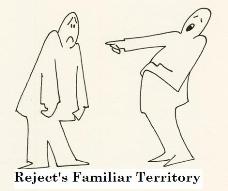
People who have only known rejection all their life find that they only truly feel comfortable in a context of rejection. When they receive affection and affirmation they feel insecure. While they long to be loved, they find that love is foreign to them, while rejection is the familiar ground on which they feel safe.

Reject 21 Rejection Addict

Rejected people have been known to offend those who show love to them, and otherwise do things to prompt the affirmation giver to reject them. At times rejected people can be downright obnoxious and offensive, biting the hand that feeds them. They can be arrogant, surly, distrustful, abusive, cruel and violent, to those who reach out to them in love.

Testing the Love

One explanation for this bizarre behaviour is that the rejected person does not trust expressions of love. They expect the person reaching out to them to let them down, hurt them or even abuse them. So they test the character of the love offered them, by rejecting it.

If a person persists in offering love, the reject can increase their negative reaction, looking for the point where the carer walks away. When people give up on them they feel morbidly satisfied that they have proven to themselves that those people did not really care about them.

The Abused as Abuser

In this process the abused becomes an abuser. I have been verbally attacked, falsely accused and actively rejected by those I have reached out to. At times the rejection has had quite a sting to it, revealing how toxic the poison in the rejected person has become.

The Bible warns that when we take up a “root of bitterness” we defile many others. And that is what these rejected people seem to be doing.

“Looking diligently lest any man fail of the grace of God; lest any root of bitterness springing up trouble you, and thereby many be defiled” Hebrews 12:15

Abusing Their Family

Another tragic way in which a deeply rejected person rejects others is in the way they treat their spouse and children. I have seen cases where the rejected person has set up their own family members for rejection, especially their spouse and children.

I think of a deeply rejected man I met years ago who showed no grace to his children. He insisted on cutting their hair by putting a pan over their heads and cutting around the edges. The result made the children look stupid and made others taunt them. But the father was resolute. This is how he had been treated and so he would treat his own children that way.

This is the process of denying others a chance for the things the rejected person missed out on. It is as if they are saying, “If I had to suffer rejection, then you will have to too!”

Insecurity at Play

Part of the explanation for a rejected person rejecting others is the issue of insecurity. Rejection sufferers feel insecure. Being presented with the new experience of affection and care awakens those insecurities. They will then reject those overtures, as much for their own comfort and stability, as for any other reason.

“Better the devil you know, than the one you don’t know” seems to be the unconscious rationale for staying on the familiar ground of rejection, even though it is toxic ground.

Rejection as a Lifestyle

Many of the things I have identified so far as reactions and responses to rejection are expressions of rejection toward others. Distrust, isolation, cutting people out of their life, putting up barriers, keeping people at a distance, being false with others, being rebellious and escaping into self-pity are all actions which offend or put a demand on others.

Thus the rejected person can spend their whole life orbiting around their rejection, being rejected and offending and rejecting others.

Captives

The Bible has much to say about setting the captives free. People are described as being in prison and being bound by the enemy. Evil spirits are shown to dog people’s lives and bring about adverse things in their lives.

All of these expressions can be related to the rejection sufferer. They are caught in a trap which they cannot escape from. Their rejection is a prison, and a prison in which they are happy to remain enslaved.

The spirits of rejection, fear, distrust and insecurity become their familiar ‘friends’ to which they remain chained through their life.

But, Praise God! Jesus came to set the captives Free! Jesus came with an anointing that opens prison doors and lets the prisoners go free.

Pray for the Addicts

If you have loved ones and family members who are addicted and enslaved to rejection, please pray for them. Jesus sets the captives free. Jesus opens prison doors. Pray that God completely release them from that which holds them in the muck and keeps them from their precious divine destiny in the “glorious liberty of the children of God”!

“The Spirit of the Lord GOD is on me; because the LORD has anointed me to preach good tidings to the meek; he has sent me to bind up the broken-hearted, to proclaim liberty to the captives, and the opening of the prison to them that are bound; To proclaim the acceptable year of the LORD, and the day of vengeance of our God; to comfort all that mourn; To appoint unto them that mourn in Zion, to give unto them beauty for ashes, the oil of joy for mourning, the garment of praise for the spirit of heaviness; that they might be called trees of righteousness, the planting of the LORD, that he might be glorified.” Isaiah 61:1-3

Rejection 20 – Rebellion

My focus so far in this series has drawn attention to the impact of rejection and the tendency of rejection to promote such responses as self-pity and extroversion, to buy love.

In contrast to those tendencies is the response of Rebellion. This is the response from those who choose to “go on the offensive”, since, to them, a good offence is the best defence.

Rebel With A Cause

Many people who are rebellious, in personal life or in the broader cultural setting, are carrying inner hurts. People who are offended readily take up an offence against those who hurt them. That offence can stir retaliatory, vengeful and hateful attitudes. And so, a rebel can be born.

Reject 20 Rebellion

While not all rebels are the product of personal hurts there are many families stung by the pain of a rebellious child who feels they are fighting for a “cause”. The cause is their sense of offence. Thus rejection can be the seedbed for rebellion.

Other Rebels

Not all rebels are the product of rejection. We know that the devil rebelled against God when God, who is perfect and holy, gave him no occasion for feeling “rejected”.

Some rebels are inspired by their selfishness. Others are caught in lust and greed for gain. Some have other forms of evil in their heart, such as violence, thirst for power, hatred toward good, and so on.

Yet, while there are various prompts for a person to become rebellious, it is possible that they have been moved in that direction, or pushed along a path they were already inclined to go along, by their feelings of being rejected and hurt.

Equal Reaction

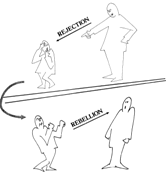
Newton’s third law of motion gave science the maxim that “for every action there is an equal and opposite reaction”. And this reflects what happens with some people who are rejected. They experience the offence of being rejected, falsely accused, neglected or abused by those who should love them, and so they respond by issuing an offence back toward them.

Reject 20a Rebellion

The “equal and opposite reaction” is their rebellion. They respond as if they are saying, “You think you can hurt me, well I can hurt you too!”

Sin is Sin

I need to point out here that “pain does not justify sin”. There is a popular notion promoted in western culture today that people do wrong things because they were virtually forced to do so by the bad treatment they received.

It is as if offenders are not to be seen as “guilty” any more, but as victims of circumstances.

But please be aware that “sin is Sin!” If someone experiences rejection, that is never a justification for sin. Rebellion is “as the sin of witchcraft” to God.

“For rebellion is as the sin of witchcraft, and stubbornness is as iniquity and idolatry.” 1Samuel 15:23a

No matter what any of us go through we have no alternative but to live in the fear of God and to be holy, as our God is holy. Our experiences are never an excuse for sin.

Rebellion Road

Some rebels develop into that course by first feeling hurt by parents or those who should love them. This breaks their relationship with their parents and promotes their desire to hurt others and to rebel against authority. Their initial rebellion may be passive, simply being tardy in doing what they are told to do. They may sit down on the outside, but be standing up on the inside, so to speak.

This passive rebellion will develop into stubbornness and ultimately into open rebellion. The rebel will also be attracted to others with a similar spirit and they will associate with others who lead them into greater rebellion.

A child rarely becomes a rebel because they fell in with the wrong crowd. It is more likely that the attitudes of their heart predisposed them to associate with “birds of a feather” whch flock together.

When a parent says, “My child fell in with the wrong crowd and they are leading him into rebellion”, it is most likely that the child has been carrying a chip on his shoulder and was attracted to that crowd by his own heart.

Break the Foundation

If a child is rebellious because of their feelings of hurt and rejection, then a powerful strategy can be to neutralise or break the foundation of the child’s attitudes and actions.

Craig Hill tells in his Family Foundations course the account of parents of an openly rebellious teenager who got on their knees before him and begged him to forgive them for their rejection and their failure to be the parents he needed them to be. The boy was wonderfully transformed.

In the case of such repentance on the part of the parents, the child’s justification for their wrong behaviour is removed. If the child continues to be rebellious then you can be sure that they are simply choosing to do wrong.

The Heart Cry

You will recall from the earliest lessons in this series that God designed each of us to be loved. We are love receptors and our heart cry is to be loved. We want to be loved unconditionally.

This is just as true for the rebel. Each rebel seeks to be loved, just as much as you do. Whatever has prompted them to rebel against authority or to embrace a lifestyle that offends and confronts others they are just as much in need of God’s love as anyone else.

They need the love of God poured into their heart, just as much as anyone else. However, they may have become hardened against it and be very hard to reach.

If you have a loved one who is trapped in rebellion, prayerfully seek to find ways to bring the love of God into their heart.

No Reward for Rebellion

Tragically for the rebel their rebellion brings them no relief from their inner pain. Hurting someone else does not remove our own wound. Retaliation does not pour oil into our wounds or soothe our soul.

And revenge and retaliation are God’s property. When a rebel takes up the cause of repaying or hurting those they believe have wronged them, they steal from God. God says that vengeance belongs to Him. When people take up that right they invoke God’s wrath against themselves.

“Dearly beloved, do not avenge yourselves, but rather give place unto wrath: for it is written, Vengeance is mine; I will repay, says the Lord.” Romans 12:19

Break the Witchcraft

We saw earlier, from 1Samuel 15:23, that “rebellion is as the sin of witchcraft”. That has several significant applications.

The rebel is unprotected from God’s grace. They have stepped into the devil’s domain and are outside of the grace which God has for their life.

They are also practicing witchcraft against those they are rebelling against. It is as if there is a witch practicing witchcraft in their parents’ home.

So, parents and those confronting the rebellious, take time to break the power of the witchcraft being exercised against you.

Sex Before Marriage

People who engage in sexual activity before marriage set themselves up for serious moral compromise. I have met various couples over the years to discuss their coming wedding and addressed this issue with them. I found most are blind to the significance of their sexual decisions.

The Obvious Statement

When individuals decide to engage in sexual activity before they are married they make some clear declarations about who and what they are. I have had some couples protest what I tell them, but see for yourself.

A person who engages in sex before marriage clearly asserts that sex does not belong exclusively in marriage. If they believed that sex was meant only for marriage they would testify to that by reserving their sexual activities to marriage.

When people engage in sexual activity outside of marriage they declare that they accept the idea that sex is not exclusively reserved for marriage. (I know that’s not rocket science, but you’d be surprised how many people refuse to admit that. The “Moral” implications of this confront them and they switch into denial).

Before and Outside

Let’s clear up some English Vocabulary here. If a person accepts the idea of Sex Before Marriage, they also accept the idea of Sex Outside Marriage! Before marriage is “outside” of marriage!

Don’t look at me like that! This isn’t rocket science!

When a young couple become emotionally entangled and fall into lustful intimacy before marriage they are revealing that they would have no moral reason not to do the same thing with someone “outside” of marriage. Their regard for the place of sex has clearly been demonstrated. It has no special place at all!

Now and Then

If a couple will engage in sex outside marriage ‘before’ they are married, what should stop them engaging in sex ‘outside’ marriage, ‘after’ they are married? What is so different between the “now” and “then”?

Couples believe they are totally committed to each other and would never hurt the other by being “unfaithful”. But those same couples have no problem offending God, being “unfaithful” to His holy standards for their life. So, if they can abuse God, how much more readily can they abuse a human?

Your Signals

Think about what you signal about yourself if you accept the idea of Sex Before Marriage. You signal that you have no Fear of God. So, there is now no moral basis for your existence. You will not make choices based on God’s holy standards.

You are a law to yourself. You make the rules about your life and actions. Whatever you choose at any time in the future is what you will do. When it suits you to be faithful, you will be. If you become bitterly disappointed with your spouse and sorely tempted by an alternative, what is there to stop you choosing to be unfaithful to your spouse?

You also signal that you are lord of your own universe. Therefore you are not tapped in to God. You are not able to access all the provisions He has for you, which you will need during your life. You are the fountainhead of your own existence and the moral reference point for your life. This cuts you off from the vitally important resources that only God can give. You and your spouse will be denied so much that you need to successfully navigate and encounter life in the years ahead.

But We’re In Love

Now, how pathetic is this? I have had couples say to me, as they clasp each other’s hands, “But we’re in love!” You’d think the orchestra is supposed to strike up on the spot!

Emotions and decisions are two separate things. The rationale people use for their decisions is irrelevant. The decisions themselves have powerful moral consequences. Killing a man in a moment of anger, a moment of thoughtlessness, or after a lifetime of hatred, makes no real different to the dead man. He is dead which ever way you came to it.

Choosing to mock God is a decision with profound moral consequences. Whether you are “in love” or “in lust”, stupid, irresponsible, selfish, opportunistic or deceived by your culture, you have chosen to mock God and reject His holy standard for your life! Don’t give me that, “We’re in love!” stuff.

What am I supposed to expect from you when you discover one day that you are in love with someone other than your spouse? You are clearly signalling that if you “fall in love” with someone after you are married, you will have sex with them!

Protection

God does not restrict sex to marriage because He wants you frustrated. He is protecting you from moral harm. Sexual sin is a sin against your own body. It creates a huge gap in the moral fence around your life. It brings you under the power of demons of lust, immorality, uncleanness, adultery, perversion, shame and the like.

Sex outside of marriage, including sex before marriage, seriously damages your ability to enjoy the intimacy which God created for you. It is proverbial that couples who engage in sex before marriage find their sexual activity after their wedding to be less than they hoped. Something has been damaged by their foolish and selfish choices.

Sexualised Society

Western culture is highly sexualised. People are sexually damaged while they are still virgins. We are violated by what is shown to us and by the immoral sexual attitudes in our culture.

Despite all of that, you are a fool to go with the flow of today’s sexual tide. Your only viable option for joy, satisfaction, peace, fulfilment and blessing is to live in the fear of God and to find His power to do so.

I call you out, from among our sexualised society, to live in the holiness for which you were created. If you have been so foolish as to become sexually compromised and damaged, then follow my Steps to Release, which you will find on the ChrisFieldBlog.com website.

A Holy Nation

You are a chosen generation and a “holy” nation. It is time to live your destiny. It is time to walk out of the morass of sexual pollution and lust, and to breathe the rarefied air of freedom and God’s presence.

I call you forth, out of the muck and into the glorious liberty of the children of God. That glorious liberty includes being set free from all immorality and uncleanness, and all the damage you have done to yourself or others have done to you.

Rise and be healed. Step forward into freedom. Rejoice in the Lord who delivers you from this evil generation!

Emotional Stability

A young lady fell into depression in her late teenage years and spent a decade of her life buried in murky feelings that consumed her life. Yet today, despite her temptation to revisit those unhappy feelings, she is able to get on with life.

Something changed for her. And what changed involves a lesson that everyone needs to learn along the way. So, whether you are given to emotional instability or depression, or not, this discussion may be very important for your overall wellbeing.

I Feel Bad

One of the challenges of adolescence is the awakening of our emotional faculties. In our younger years emotions are dormant and we face life with its good and bad with the ability to be practical about what comes our way. We shed our tears, feel our upsets and face our challenges, in the matter-of-fact way that children can.

However, during our teenage years emotions begin to stir within us. We begin to encounter feelings which can sweep with the force of ocean tides over our life. We discover that we can feel bad, for no apparent reason. We can feel euphoric, for as little good reason. We are able to rise to new heights and plumb new depths, like never before.

It Feels So Real

Our challenge, during this new season of our lives, is to discern what is really going on. If we do not have adult counsel from people who have been there and done that and worked out what is going on, we can be quite confused and destabilized by these emotional surges.

Our new-found feelings “feel so real” to us. They demand our attention and present themselves as tangible expressions of something of substance.

When people “feel” something, that feeling is completely real to them. It may be irrational and unreasonable, but it will be “real” to the one feeling those emotions.

Controlled By Vapour

Feelings have the capacity to activate just about any kind of sensation at whim. We can be having a perfectly happy time and then suddenly “feel” sad, or lonely, or unresolved. We can be in the middle of a serious situation and suddenly “feel” irrationally happy.

Those feelings are vaporous. They are not the product of real experiences and they may not reflect the correct response to the present set of circumstances. They can be completely irrational and persist in the face of hard evidence that they are out of place.

Thus, if we allow our feelings to control us we will be controlled by vapour. But to us the vaporous feelings will “feel so real”. And that is where we can end up bogged in an emotional quagmire.

Emotions Out of Control

If we do not realise what is happening we will be inclined to believe our feelings. Since they “feel so real” we could assume that they are a clue to what is really going on. We might think, “I feel really bad, so something must be wrong.” We might then go looking for some justification for our feelings.

If we wake up one day feeling as if no-one loves us or cares about us, we can then look for evidence to explain why we think and feel that way. Since we have all been neglected to some degree, a person could assume that their feelings genuinely spring from the treatment they have experienced.

Rather than control their emotions, seeing them as a faculty that needs to be tamed, many people allow the wild emotions to run freely, assuming they are some genuine response to the real world.

In such situations it is possible for a person to step into adulthood, with their emotions out of control. Thus, their life becomes “out of control” too. They will be controlled by the vaporous feelings which “feel so real”. They may never question those feelings or recognise that they are being fooled by their emotions.

Break-In The Bronco

Each new colt has to be broken in. All the energy, strength and majesty of a powerful steed must be brought under control if ever the horse is going to be useful and successful. And that’s how it is with our emotions. They must be broken in.

If you allow a horse to run wild, the process of breaking it in will be much more difficult. And so it is with our emotions. If we allow them free reign in our lives, it will be much more difficult to bring them under control when we need to.

Emotional Maturity

Part of emotional maturity is to achieve the place where emotions are our “servant” not our “master”. When we can tell our emotions to stop interfering with our life we can live a much more stable life, but also call upon our emotions in appropriate ways.

Professionals must learn to harness their emotions and put them out of the equation, so they can do what they have to do consistently and without inappropriate reaction. Doctors, police, emergency services, officials, ministers and many others are required to have emotional maturity. If they “lose it”, getting upset, venting their frustrations, acting on prejudice, or the like, they will be disciplined and may lose their job.

Emotional Journey

The young lady I mentioned in the opening paragraph has been on an emotional journey. In her younger years her emotions swamped her. Feelings of depression commandeered her life and cut short her studies and her career aspirations. Her health, physique, personal disciplines, relationships, self-worth, hopes and dreams, friendships, and more were damaged by her emotional spiral.

Since her emotions were out of control she could not bring herself back to normal. She burned most of the bridges in her life and became increasingly depressed. She abandoned the values she was raised to respect.

She is now moving out of that mess. I credit her recovery to her dad, who is praying for her on a daily basis, although she doesn’t know he is doing so.

Somehow she has come to her senses. She is not free of the tendency to be depressed. She still faces most of the challenges which have grown around her over the years. Yet she has changed her attitude.

Can’t Afford to Be Depressed

She recently told her parents, “I can’t afford to be depressed!” The bills don’t go away just because she is having a bad day. The problems don’t get solved by her having a pity-party.

Now, despite the fact that her emotions are just as real, her resolve has changed. Rather than indulging her emotions, she is resisting them. Instead of going with the flow of her feelings she is telling her feelings to “Shut Up!” She thinks her feelings are real, but she has become pragmatic enough to realise she can’t afford to indulge them.

Maturity Emerging

What is happening in her life is that maturity is emerging. She is gaining emotional maturity, not by giving in to her emotions, but by resisting them. She is finally learning to do what she could have done as a young teenager.

And that process is just as real for you. Your emotions will present themselves to you, as “real”. They will demand that you serve them. But you must learn to put them in their place and get on with life. If you give in to them they will rule you. If you resist them, they will serve you.

Making New Friends

The bow felt strange in Anatoli’s hands. The arrow refused to line up against the string. He tried twice to lift the loaded weapon before him but each time the arrow slipped out of place. Exasperated he turned a pleading expression to his tutor.

“You have been shown time enough. You must do as I have told until you master it.” The wizened face of the instructor bore the expression of one who had seen it all too many times before. He had interminable patience for the task.

Anatoli fiddled with the arrow and string again. Lined up the shaft and slowly lifted the bow before him. The arrow slipped and Anatoli cursed under his breath. When he turned to see his instructor the man was busy watching a bird fly to its nest in a nearby tree. The youth returned to his morning task.

archer

This was now the third day since he had arrived. He was given modest quarters near the stables, befitting a junior employee. Since then he had not seen the master at all, but had been placed under a number of men whose task it was to fit him for his career. Why in the world archery was included in the lessons Anatoli could not understand. And why the lessons began at dawn was also a mystery. Possibly it was that the days were already so full. He had to brush the horses, tend the plant nursery, work in the store room and study numbers, all at different times of the day.

Anatoli finally let the arrow fly, if fly be an accurate description. The shaft wobbled its way forward like a wounded animal and fell lifeless to the ground mockingly close at hand.

Just then the master approached on horse back. He was dressed for business in some nearby town and came to pass a quick greeting.

“How is it going, lad?” He asked as his dismounted, but his gaze went to the old instructor who took the reins and flashed a glance heavenward as if to say, “This is a hopeless cause.”

“Are you getting the hang of it?” The master asked with energy.

“What a stupid thing it is!” Anatoli let burst. “I cannot for the life of me see why a wealthy man must learn to shoot an arrow!”

“There are many things you will not see, lad. Many, many things. Some you will feel, some you will never understand. Some you will miss so completely you will go to the grave in ignorance of them. Yours is not always to SEE but to learn the lessons in the doing.”

The master took the bow from Anatoli, fixed a shaft against it and let it fly heavenward in a glorious sunlit arch. “It is as simple as that.”

The lad shook his head.

“The lesson here,” the master confided, “is not to become an archer, but to become familiar. This bow is an unfamiliar thing to you. The arrow is the same. But in time both will be your friends and companions.” He handed Anatoli the bow.

“In time many things will become your friends. Numbers and ships and lands and lenders. Houses and servants and bags of coin. They cannot be your friend while you are a stranger to them. Handle these things and make them your friend, for you shall want them at your side for many years to come. The bow is a friend I wish to introduce to you. Be kind to him. Get to know him. He may one day save your life.”

With that the master swung upon his steed, nodded and galloped away.

Anatoli watched him ride off then looked at the huge curved wood in his hand. He stroked it for a moment then plucked the string. “Good morning, my new friend.” He spoke to himself. Then taking his stance and drawing an arrow he tried yet again to become acquainted with the bow.

* This is excerpted from a story by Chris Field (Copyright CGF) and shows the attitude we need to have toward new challenges. Many of the things we struggle to learn are to be viewed as our “friends” and the process is simply that of getting acquainted.

Most of us remember our school days when new skills seemed impossible to master. Now, in our adult years, those skills are just an everyday part of our lives.

So, have a look around at the “friends” you need to get to know. Approach those skills and the drill and practice sessions as a simple matter of getting acquainted and expanding your set of “friends”.

Evolution of Government – part 2

In part 1 of this series I pointed out that government starts with God and His principles. Human government historically anchored in a ruler or king. Over the past one thousand years parliamentary and representative forms of government have prevailed over monarchs in the western nations.

Yet there is a new governmental player in the field who is making an impact on how each of us is governed.

Enter the Corporation

Over the past few centuries a new type of player has emerged to distort the traditional forms of government. This new form is “government by corporation”.

What happens is that people of influence, outside of a nation, gain control of the nation, usually through debt. International bankers began this process, striking deals with national rulers who needed funds for their various wars or exploits.

By this process the assets and sovereignty of nations have become the property of entities to which the nations owe debts. Thus the new governments whatever their election promises, must do whatever they are told to do by forces outside the country.

Consequently national assets are being sold to corporations (what we call “privatisation”) and people are increasingly subjected to fines, regulations and other impositions placed on them by multi-national corporations.

Selling Out

By the process of privatisation whole nations are being sold out to foreign entities. What had been the birthright of a nations population now belongs to foreigners. The “children’s bread” has been given away, and in some situations the children are enslaved.

Consider how much of your nation is now owned and controlled by foreign corporations. How much of what your parents considered as community property (electricity supply, roads, rail, postal service, phone services, etc) is now owned by faceless foreign corporations?

Corporatisation Mania

What is also happening with governments is the progressive corporatisation (incorporation as registered companies) of government entities. Check out your own local situation and you will probably find that the local councils, various government departments, national and regional governments and more are now registered as companies.

Government is becoming a corporate matter, instead of one centred on God, king, principle or parliament. The future of government will involve the progressive take-over of nations into corporate folds. Multi-national companies will buy out nations, in the same way they have bought out sporting teams.

Corporate entities can be bought and sold, merged and dissolved, in ways that are foreign to communities, parliaments and monarchies.

Summary

Government should be that of God ruling over the hearts and lives of individuals and communities. God does this either by people revering Him directly or by their application of His laws and principles. Monarchs are to rule their people on God’s behalf, by His laws and principles.

Parliaments and elected leaders are to similarly rule the people they represent by God’s laws and principles.

What has happened, however, is that kings have displaced God, parliaments have displaced kings, and now corporations are displacing parliaments. The end result will be that nations will become corporate property, part of corporate franchises, where the people will be ruled by international corporate entities.

Turn Back the Clock

There are those who wish to turn back the clock and go back to what they think were the “good old days”. The only way to successfully turn back the clock is to return to God’s sovereignty over human lives. Any other reversion will not reinstate our true rights and freedoms, since only God can truly set us free.

Are You Living Yet

I have noted before that young adults seem to be delaying life, not getting established in family and community life until many years beyond when their grandparents did so. At the same time there is another process that stops people from entering into life, even when they have engaged with such things as family and social responsibilities.

Extended Youth

Many people seem to be caught in a pattern of extended youth, unable to commit to the responsibilities attendant to adult life. They may still be uncertain about career, experimental in their relationships, unsure of their place and in an “on-hold” pattern, waiting for life to truly begin.

This may be encouraged by the ever expanding academic journey, or by the natural insecurities of youth not being properly resolved, and by living in a culture where their peers are also unsure and reluctant to step into adulthood.

Some Day When…

Another reason people have their lives on hold is their hope to achieve certain things before they take on new responsibilities. I recall many of my peers talking about delaying parenthood until they had bought their own home, fulfilled their academic dream, gone around the world, or other similar self-determined goal.

“I’ll start a family when ….” “I’m not going think about marriage until after I’ve graduated.” “We want to have our own home before we think about anything else.”

While goals and aspirations are good to have, they can become a barrier to people starting life. The more natural processes of family and social development are delayed, holding the people back from the maturing and authority generating steps which they have put on hold.

In Recovery

Now, here’s the main point that I want to challenge. Many people are not living their own life because they see themselves as in a “recovery” process. They see themselves as if “behind the starting line” and in need of getting back to square one before they can really get started.

anxiety albert kang

This is particularly so for abuse victims, those with major disabilities, and those who have been disadvantaged in some way. The notion seems to be that the ideal starting point for life is that of being confident in our self, well educated and sent out from there.

Many people who have not had that kind of start see themselves, unconsciously, as disadvantaged and needing to resolve inner issues before they can get on with life.

Carrying Baggage

Rather than entering into life many people seem to be looking for therapy. Instead of getting on with their own journey they seem to want a therapist (or some intervention) to help them get back to their notional starting point.

They carry their baggage around with them, always conscious that they are unable to get on with life and expect the kind of deal that other “normal” people might get. They are trying to make do with what they can get, as “damaged” people.

The culture sells us on the image of an ideal person. They are confident, attractive, articulate, resourceful, backed up by friends and family, and so on. Many people do not fit that kind of stereotype, especially in our day of so much tragic family breakdown.

So, people perceive themselves as not fitting the model, and become distracted with their own “recovery”, rather than realising they can get on with life from where they are.

Practical Wisdom

Get the help you need. Don’t go to the culture that created the problem. Go to the much more powerful source of power and wisdom that has served every culture and proven itself through millennia of impact in lives and families. Go to the Bible. Establish yourself on what the Bible teaches, not what the TV preaches.

Hey, that’s a catchy way to say it: Live by what the Bible Teaches, not what the TV preaches! The Bible teaches and the Culture preaches. Choose wisely between them.

Your culture is robbing you. So put the culture in its place, as a servant to your life, not a master. Let God master your life and guide you into the freedom and purpose He has for you.

Start Right Here and Right Now

You don’t need a house debt free, or a millionaire dad, post-graduate degree, 10 year plan, plastic surgery, or showcase life in order to live your destiny.

You simply need to start “life” right now. Step out, holding God’s hand, into the wonderful destiny He has created for you. God took timid Gideon and made him national leader. God took loud-mouth Peter and made him an anchor. God took Saul with his inferiority complex and made him king. Rahab was a prostitute who became a hero of faith in the lineage of Jesus Christ. Ruth was a “foreigner” widow living in poverty who became wife to a wealthy man and grandmother to King David.

There is no reason why you can’t step into a glorious future from your inglorious starting point. The key is to let God escort you on the journey and to live for Him, not the distortions of your culture.

Stand on Your Disability

God delights in taking those things which do not qualify and using them to surprise those who have all the qualifications. That doesn’t mean we should abandon our gifts and capabilities but it does give hope to those who are up against many challenges.

If you let God into your situation to empower you to overcome your disability (social, personal, financial, etc) then you will have turned your limitation into a platform on which to stand. You will have become a ministry to all those others who struggle with what is dogging you, because you can show them the path to freedom.

Take Your Life Off “Hold”

Get connected with life. Step one is to get connected with God. Spend time in His presence, telling Him about your mess and asking Him to lead you out of it all. Get to know Him. Praise Him. Study the Bible and put your faith in Him.

As God breathes fresh new life into you, not only will you be set free, but you will already have momentum in that amazing journey we call “life”. Take your life of the “hold” pattern and get on with your walk with God. As you engage with Him you will discover what Jesus promised you, “Life more abundant”.

Reject the Fake

Many of those who have the nice car, nice house, nice family, nice career, etc, are living fake lives. The reason their lives are fake is that they are not connected with God. Their lives are mono-dimensional. They have the appearance and trappings of a nice life, but they do not have God’s power, truth, love, grace, favour and blessing flowing through them.

When you, the messed up one, plug into God, you will end up with a much richer and more wonderful life than those who have the culture’s trappings but an empty life.

Don’t buy in to your culture’s ideas about what is successful, happy or ideal. Let God show you what He can do. You will be much more satisfied with “life more abundant” than with the model life your peers are striving for.

And may God richly bless you as you walk with Him.

Evolution of Government – Part 1

Different forms of Government have been evident through history. This study reviews the main forms of government and suggests where the current direction is taking us.

Sonship

The highest form of government is “Sonship”. This is where you are governed by God and live a disciplined life in obedience to Him, living in the Fear of God.

No government will be so good to you as the Government of God. God not only establishes the highest moral standards, because He is “holy”, He is also the most generous ruler. God causes His rain to fall on the just and the unjust. He gives life to all. He lets His sunshine fall on the evil and the good.

King David was given the choice of being punished by his enemies or by God and he immediately chose to be disciplined by God, because he knew that God was gracious. And Psalm 107 tells us that God even gives His loving-kindness to fools.

A weakness of this form of government is that evil people are not immediately punished by God. So it is possible for evil people to abuse, oppress and exploit others and there not be any recourse for the oppressed. The victims should cry out to God and find His protection and deliverance, but not all people prove willing to submit to God’s authority and humble themselves before Him.

Law and Principle

Next to God’s government is that form of government based on law and principle, especially those laws prescribed by God. God is not capricious and He does not change. His ways are challenging, but they are consistent. When God’s laws are put in place nations can be successfully governed by being held to account by God’s standards.

A weakness of this form of government is that the very judicial and priestly system which is established to administer the laws and principles is subject to abuse by the individuals employed in the process. Justice can be perverted by bribes, lies and intimidation.

Religious and legal systems can become devoted to their own existence and ends. Position, privilege and power can corrupt the very systems instituted to uphold law and principle.

Kings and Rulers

henry 8

Historically one of the earliest forms of human government was that of rulers, kings and patriarchs. Men set up families, villages and communities under their protection and care. Thus they became the king of those communities. Others then deposed those rulers to either spoil and destroy their “kingdom” or to add kingdoms together into a larger kingdom. The ancient Summerian King List suggests that from the very beginning of human history there have been rulers (kings) who were progressively deposed or defeated by competing kings who displaced them.

A weakness of rulers as a form of government is that each kingdom is dependent on the character of their respective rulers. Despotic and violent rulers would rule their people differently to those who were benevolent and principle oriented.

Variety Among Kingdoms

Kings and kingdoms differed to the degree they gave place to the government of God and the rule of law and godly principles.

Some kingdoms also became a confederacy, rather than being under a supremely dominant ruler. In such cases the individual families and property owners have bargaining power over the ruler, modifying his decisions and powers.

Parliament and Representation

In western history we see the advent of Parliamentary and elected government, emerging from the time of the Magna Carta. The monarchs of England became progressively limited in their rulership by the constraints of landed gentry (Lords) and elected representatives (Parliament).

This process has developed into what we now call “Democracy”. The concept is that the general populace elects people to represent them in the government of their lives. A large group of elected people, representing geographic communities, contend with each other to come to a consensus about the appropriate governmental processes to apply to the overall population.

A weakness of representative government is that those in office become the political elite and may work toward their own agendas, not those of the population they represent. They may also become much distracted by the challenge to stay in office, rather than to govern well. The ability to manipulate or appeal to the masses becomes the basis on which people become elected to represent the population.

All Together Now

The Westminster system of Government, developed in England over recent centuries, brings together all of the elements I have outlined so far. A monarch takes oath to rule the people in the Fear of God, for the benefit of the people, according to the principles and divine laws given in the Bible, and bound by the rule of law. The monarch, however, does not make the laws, but simply ratifies them.

Elected parliamentarians create the laws, by democratic process, and submit those laws to the monarch for final approval. The monarch should reject all laws which offend God and not for the good of the people. Thus the monarch and parliament coexist and bring restraint upon each other.

Meanwhile the judiciary stands independent of the monarch and parliament, based on ancient legal traditions distilled from application of God’s laws given in the Bible.

Ideal Function

In a perfect world, which does not exist, a godly priesthood would instil the fear of God in the populace at large, which would then elect godly representatives who would govern the people for the good of the populace, and the rules created by those representatives would be vetted by the godly monarch who would reject all rules which offended God or the people. Meanwhile all the populace would be held accountable to godly laws and thus live lives of restraint that limited their offence of one another.

Where are we Going?

Since western government has moved from monarch to parliament over the past centuries, it is able to move to new places from here. In fact, I believe we are already part way through a very serious transition of government, away from government by God, principle or parliament. I’ll discuss what the future might hold in Evolution of Government – part 2.