If Only You Knew Me

Someone sent me an email with the following images and I thought it would be a blessing. So I am posting it here as a permanent place to find it.

Consider these “If”s in your life….

If you never felt pain, Then how would you know that I am a Healer?

1

If you never had to pray, How would you know that I am a Deliverer?

2

If you never had a trial, How could you become an overcomer?

3

If you never felt sadness, How would you know that I am a Comforter?

4

If you never had a problem, How would you know that I can solve them?

5

If you never got stuck, How would you know that I have more for you? 6

If you never were in trouble, How would you know that I will come to your rescue?

7

If you never were lost, Then how would you know that I came to find you?

8

If you never felt guilty, How would you know that I forgive?

9

If you never had any suffering, Then how would you know what I went through?

91

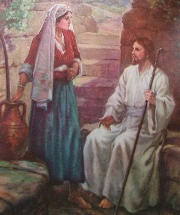
If you never asked, Then how would you know I had the answers?
92

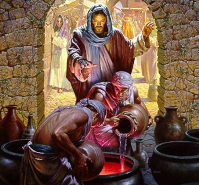
If you never had a need, How could I do a miracle for you?
93

If I never corrected you, How would you know that I love you?

94

If you had all power, Then how would you learn to depend on me?

95

If your life had no struggles, Then what would you need me for?

96

The Big Stick is not the Big Stick

I love it when I see something in a completely new light. Mostly we don’t need to see “new” things, but to see the old things the way they really are. When our brains are told to interpret things one way or another we can be effectively brain-washed by that instruction. Somehow we overlook the evidence and keep interpreting it according to the definition or label we were told to apply to that thing.

Many of the things we “know” are only things we “believe”. We “believe” them to be true, and thus think we “know” them. But, alas, we are deluded, and are even blind to an accurate interpretation because of the pre-programmed beliefs.

Praise God, He sets us free from deception, because Jesus Christ is the “Truth”! Jesus said, “I am the way, the truth and the life!”

“Jesus said to him, I am the way, the truth, and the life: no man comes to the Father, but by me.” John 14:6

Deceptive Labels

Education involves learning to put labels on things. The bigger our set of labels the better educated we are. We are able to discern between things when we have a large enough set of labels to enable us to put different things into different categories. Hoorah for labels!

But, if we are given the wrong label for something, then we have not been truly educated at all. In fact, we have been brain-washed, indoctrinated, deceived and denied insight into the truth.

Notice that socialist economists have influenced much of modern academia on economic themes. I expect that the labels a socialist mind conceived for economic processes put those processes in a different light to a Biblical economist, or a capitalist economist.

The label “prehistoric” is a philosophical statement in itself. Biblically speaking nothing is pre-historic, since the Bible record accounts for human history all the way back to day one. But the label “prehistoric” is deceptive and brainwashes the hearer into thinking that there must have been existence before the historical account began. Thus the term “prehistoric” embodies an attack on the Biblical record. It is a deceptive label.

Carrot and Stick

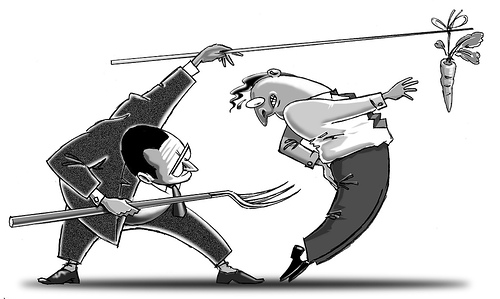
carrot and stick

Let me get toward my point. We have all heard mention of the two forms of motivation, the carrot and the stick. Carrots are positive inducements that prompt people to action. The stick represents negative inducements to action. A carrot might be a bonus for completing a task on time. A stick might be a punitive outcome if the task in not completed on time.

Management theory has addressed the competing tools of the carrot and the stick. And these labels have had a “reductionist” effect on human thinking.

Most people’s first thoughts about motivating themselves or others will orient toward either or both of the carrot and stick. These two categories tend to dominate and thus obliterate perception of alternative possibilities.

Other Possibilities

Many people do what they are asked to do and perform well, simply because that is their choice. They are not motivated by the carrot or the stick, but are simply doing what they have been programmed or trained to do.

Some people make a greater effort out of concern for others who they see under pressure. They pitch in out of social motivation, based on their sense of shared responsibility and their desire to see their friend aided in a difficult situation.

Some people simply love a challenge. They are motivated by realisation of a need and the definition of a clear challenge to overcome that need. The feeling of “We did it!” is all the reward they need.

The Big Stick

Biblical Parenting involves use of the “stick”. King Solomon instructed humanity thousands of years ago to train children by using words and physical discipline. The old English translation, the King James Bible, uses the word “rod of correction” to describe the stick that is used by parents to train their children.

“Foolishness is bound in the heart of a child; but the rod of correction will drive it far from him.” Proverbs 22:15

“The rod and reproof give wisdom: but a child left to himself brings his mother to shame.” Proverbs 29:15

He that spares his rod hates his son: but he that loves him chastens him as required.” Proverbs 13:24

Punitive or Therapeutic?

Influenced by the “carrot and stick” labels, how should we interpret the use of the “rod of correction” by parents? It is seen as a punitive, negative reward. It is seen as the opposite of the more positive encouragement inducement or positive reward option.

In a “carrot and stick” world, use of the “rod of correction” is seen as the ugly choice. Caring, sensitive, compassionate, New Age parents think they can discard the cruel ancient wisdom of Solomon and embrace more advanced and enlightened methods of training their children. Such parents aim to use rewards, coaxing, mature negotiation and other alternatives to the offensive “hit the kid with a stick” option.

The “carrot” triumphs over the “stick” in today’s modern homes.

Back to the Book

The Bible was written long before the more modern discussions about the carrot and the stick. And Solomon’s wisdom needs to be seen for what it is, not what the labels have brainwashed us to think it says.

So, let’s go back to the book and see what is really being said about the “rod of correction”. Let me repeat a verse I quoted earlier…

Foolishness is bound in the heart of a child; but the rod of correction will drive it far from him.” Proverbs 22:15

The use of the “rod of correction” is not punitive in this instruction. It is therapeutic! The rod of correction has a specific and vitally important function, and it has nothing to do with motivating a person to do what mummy tells him to do.

The “rod of correction” has a transformational impact on a child’s heart. It drives “foolishness” far from the child. If that foolishness is not driven away, by the use of the “rod of correction”, then the child will carry foolishness in his heart right through his adult life.

The Good of the Child

The “rod of correction” is for the good of the child. A parent who refuses to do this good to their child is described as hating their child.

He that spares his rod hates his son: but he that loves him chastens him as required.” Proverbs 13:24

The punitive “big stick” is for the good of the manager or the person who wants to get their project done or their will obeyed. The Big Stick is an aid to the teacher, boss, prison warden or similar role where a person in charge demands compliance.

That kind of big stick can lead to abuse and dominance of those under punishment. The “rod of correction” applied for the good of the child cannot be a tool of abuse. It is not an indulgence for the parent, but a blessing to the child.

Quoting Myself

In a recent article on Leadership, titled Leading With Authority, I made an aside about the use of force. I quote myself here….

“Note here that Biblical use of the “rod of correction” is not coercive. Parents are not told to use the rod to get action or obedience. They use the rod of correction only temporarily, in order to create a heart change in their child. Once “foolishness” has been driven from the child’s heart by the “rod of correction” (not the rod of abuse or anger) then the rod becomes redundant. So adult leaders who think they have a Biblical clearance for the use of force and threats are misguided.”

carrot-and-stickBack to the Stick

Parents need to go back to the stick. But the Big Stick is not the Big Stick! The “rod of correction” which godly parents use to train their child is not a “Big Stick” of threat and intimidation to coerce appropriate behaviour. If the stick is used as a “threat” then it is not being properly used.

The “rod of correction” is not of value because of its intimidation and the fear of its use, but by its application and its measured and appropriate use. Godly parents who wisely use the “rod of correction” to remove foolishness from their child can then get on with parenting their child without recourse to the Big Stick. They don’t need to threaten the child, or intimidate the child with the stick waved over the child’s head.

Those two concepts are foreign to each other and have created the kind of confusion that leads some authorities to seek to ban godly discipline. The Rod of Correction is not the Big Stick. It never was and was never meant to be.

It’s time for parents to go back to the “rod of correction”, for the sake of their children. Its application will only be temporary. It is not a punitive and intimidating “negative reinforcement” mechanism. It is a means of delivering the child from foolishness. Once that is done, the rod is put away and your effective parenting continues with those other Biblical training processes you have already been using as well.

Go to it!

Self-Control Without Self

I realised something recently that sounds like a contradiction. Imagine “self-control” without any “self” involved! Is such a thing really possible?

Self-control is a major challenge for people. Many struggle for the whole life to rein in their words, addictions, urges, reactions and so on. Most resolutions that people make are probably focused on gaining some new level of control over their actions, thoughts, words, spending, and so on. Self-control is a major component of personal development and making progress in life.

I Will Succeed

We admire people with strong wills, who can overcome obstacles and achieve things that others cannot win over. Losing weight, getting fit, quitting smoking and slugging through difficult studies are just some of the areas in which people have shown their determination to succeed.

self-controlDetermination and self-control by sheer willpower is seen as a great achievement and a true credit to those who display such things. These are the people held up as examples to us all.

If It Is To Be …

The saying goes, “If it is to be, it is up to me!”

That catch-cry is meant to rally people to improved resolve of will to push ahead and make the changes that need to be made. They are told not to rely on others or to dump their challenge onto some other person, but personally persist, until they get the breakthrough.

It’s great stuff. We applaud those self-reliant people who know that it is up to them to make things happen, and who get off their chair and get things done.

But, In The Bible…

However, despite the popular human notions of self-will and self-reliance, leading to self-control, the Bible has something to say about this stuff. And what the Bible has to say is quite surprising. It is the Bible that suggests to us the idea of Self-Control without “self”.

Let me show you where I get this from. Self-Control is shown to be a “Fruit of the Holy Spirit”.

When the apostle Paul wrote to the church in Galatia, he listed a bunch of things that were the fruit coming from the work of the Holy Spirit in people’s lives. Self-control is listed as one of them.

Fruit of the Spirit

“But the fruit of the Spirit is love, joy, peace, longsuffering, gentleness, goodness, faith, Meekness, self-control: against such there is no law.” Galatians 5:22,23

The King James Bible uses the word “temperance” in that text, while modern translations use the updated term we are more familiar with: self-control.

So, self-control is a “fruit of the Spirit”. Self-Control does not come from “self”, but rather comes from the work of an agent separate to our “self”. It comes from the work of the Holy Spirit of God.

It is Not Up To Me!

Imagine that! If it is to be, it is NOT up to me. If it is to be, it is dependent on God. If self-control is to be part of my life, I am dependent on the work of the Holy Spirit to create that fruit within me!

That does not mean that I am relieved of the responsibility to gain self-control. What it does mean is that the best way to get self-control is not through the determination of my own will, but through yielding to the work of the Holy Spirit in my life.

I have seen many people whose personality and character has been transformed as the Holy Spirit worked in their life. Anger and hardness gave way to joy and peace. Explosive reactions and addictions fell away and a quiet spirit emerged instead. When the Holy Spirit is allowed to work in a life the fruit is really sweet.

Fruit not Sweat

Notice that self-control is listed among the “fruit” of the Holy Spirit. Trees don’t groan and struggle to pop their produce at the end of the limb. You do not get kept awake at night by the sound of fruit trees grunting to grow their fruit. You do not see fruit trees in a lather of sweat as they struggle to be fruitful.

Fruit just grows. It starts small and gradually fills out until it is ripe and ready to be eaten.

And that’s how it is with self-control in our lives. When we yield to the Holy Spirit and allow God to minister into our lives we develop lovely, fresh fruit. There is no sweat or struggle. We don’t curse ourselves and chant encouragements to ourselves to keep pressing on. It just happens naturally and almost unseen on a day to day basis.

Self-control is a Fruit of the Spirit, not a Work of the Flesh.

Worship Will or God

The apostle Paul, writing in a letter to the church in Colosse, used the term “will worship” (Colossians 2:23). He referred to those who become committed to human rules and religious ordinances. They display great discipline in neglecting themselves and maintaining the various rules they have adopted.

People caught up in such things, however, are not living in the freedom purchased for them by Christ. If you have chosen to follow Christ, then you won’t be party to those things and the will worship that goes along with them.

Serving religious duties can cause those with strong wills, who keep the rules most diligently, to look better than others. But all that counts for nothing. We are not to worship our will, but to worship God.

Gain Self-Control

I want you to gain self-control. I want you to have so much of it that you rule your own spirit and are stronger than the mighty ones who capture whole cities.

“He that is slow to anger is better than the mighty; and he that rules his spirit is better than he that takes a city.” Proverbs 16:32

Don’t build up your self-control by reliance on your own self-will. Build self-control by looking outside your “self”. Find it in the work and ministry of the Holy Spirit in your life. Be filled with the Spirit. Be baptised in the Holy Spirit. Be led by the Spirit. Do not quench the Spirit. Soak in Bible truth for it is the sword of the Spirit. Walk in the Spirit every day. Pray in the Spirit and sing in the Spirit. Stay under the anointing of the Holy Spirit.

As you let the Holy Spirit into more and more of your life you will discover that self-control is developing within you, without any demands upon your self-will. And along with it will be “love, joy, peace, longsuffering, gentleness, goodness, meekness and faith”. Now, that’s a pretty good deal, eh?

Do you Indulge Your Child?

My wife, Susan, was praying with a mother recently about the raising of the woman’s children. Susan was prompted to enquire about a particular child. While praying for that child Susan’s mind was quickened to the word “indulgence”. Since this word seemed to be prompted to her, Susan mentioned it to the mum.

Susan asked the mum if she indulged that particular child. The mother did not know what Susan meant. Susan explained that if a child refuses to cooperate or otherwise makes demands and the parent eventually gives in, then the will of the child has been indulged.

With that explanation the mother admitted that she certainly did indulge the child. Susan then cautioned the mother that pandering to the will of the child, especially when the child was seeking to get around the mother’s will, would reap terrible consequences in years to come. Susan then explained to the mum her need to be firm with the daughter and to apply godly wisdom and Biblical child training to the children, so they are freed from foolishness and learn to fear God and live wisely.

Let me ask you again….

Do you indulge your child?

Leading with Authority

I have often seen people struggle to exercise appropriate authority in their leadership roles. Parents, foremen, teachers, kids club leaders, committee chairmen, pastors and the like can each struggle to establish their authority at times.

This lesson is designed to prompt you toward a correct understanding and application of your authority as leader. You might gain particular help from realising your wrong notions of what leadership is, that block your correct use of authority in your leadership positions.

Bad Examples

I have seen school teachers in complete disarray as they struggle with their class. I have seen young leaders get exasperated, shouting and making a scene to gain control over the group they were trying to lead. I have seen parents get to the end of their energies trying to negotiate with their child.

There is no shortage of bad examples and we have all seen people handle their position of authority poorly. So take a moment to reflect on some of those you have seen. What were they doing wrong? What could they have done differently to handle the situation better?

controlOften poor leaders end up being removed. Once someone is in a fix in their leadership there is often little hope of easy recovery. Their superiors have to step in and a leadership reshuffle may well result, to give everyone a fresh start.

Wrong Leadership Notions

Many of those who fail in leadership are beset with poor ideas about what gives them their authority. It is easy to believe or assume something to be true, without any real knowledge or basis by which to test the assumption. People often act out things they believe to be true, without ever reflecting on their beliefs and modifying them.

Leadership by Personality

I have seen leaders who believe that people will follow them because of the quality of their personality. The thought process may go something like this: “I’m chosen as a leader because I am an ideal choice. Therefore people will follow my instructions automatically, because I’m an ideal leader.”

This naïve notion is soon challenged by the failed response of those being led. Lack of cooperation will cause the leader to feel that they are being put down personally, and that their qualities are being insulted. The leader will then have internal emotional issues to deal with as they try to lead. Things can get personal and messy in that situation.

Notions of Superiority

Some people carry pride about their self importance. This is akin to class distinction where one person assumes that all “lesser” people are to serve them. When a leader carries notions of personal superiority those under their leadership will feel the impact of the leader’s pride putting them down.

A leader with illusions of their own superiority will tend to talk down to those they lead. Note the condescending tone in this following instruction from a “superior”. “You’ll be a good dear and fix that for me, won’t you?”

Along with condescension will come demands that are unreasonable or inconsiderate. The leader will be constantly walking over those in their service, expecting their total obedience as a matter of proof of the leader’s place.

Intimidation

Some leaders think they can only get cooperation by intimidation. These leaders resort to shouting, threats, bullying, taunts and the like. They do not carry authority in themselves and so try to generate the effect of authority by lording over those under them.

Some employers use threats of sacking to get their employees to do what is asked. The “stick” of punishment is seen by some leaders as their only effective tool for getting things done.

Note here that Biblical use of the “rod of correction” is not coercive. Parents are not told to use the rod to get action or obedience. They use the rod of correction only temporarily, in order to create a heart change in their child. Once “foolishness” has been driven from the child’s heart by the “rod of correction” (not the rod of abuse or anger) then the rod becomes redundant. So adult leaders who think they have a Biblical clearance for the use of force and threats are misguided.

Position of Power

I have seen leaders who only comprehend leadership in terms of “power”. These leaders do not “lead” those under them, but “control” them because they have “power over them”. This is a complete distortion of leadership.

Leadership speaks of purpose. Leaders lead others to a place or outcome. Power, however, lacks purpose and outcome. Power is an end in itself. And it’s a “Dead End”! When leaders think of themselves in terms of power they lose something of their responsibility and role as one who directs for a purposeful outcome.

Positive Leadership

Many leaders do an excellent job, as parents, teachers, bosses and so on. Reflections on poor leadership should not create the impression that most leaders are inept. So, let me now turn your attention to issues of positive leadership which you can gain from.

Leadership and Authority

Leadership is a place of authority. Authority is delegated to us. So leadership involves the fulfilment of a responsibility on behalf of those who have entrusted or empowered us.

Of course, those who run their own business or project will have authority over their staff or members, without having had that authority obviously given to them by a superior. Yet those people have been entrusted with that opportunity by God and are accountable to Him, and they have been entrusted with authority by those who have agreed to submit to them. Thus there are serious responsibilities that must be kept in mind, even in the case of a business owner.

Authority and leadership are assigned, delegated and conferred from above and they are also assigned, delegated and conferred from below. When people agree to submit to another, authority and leadership is conferred on them. This happens when people chose to appoint one of their peers to lead them in a committee or activity.

Leadership in Practice

Good leadership can be packaged in various forms. It is not a cookie-cutter model that has to be followed religiously. Instead, it has much to do with principle and engendering cooperation and productivity from those being led.

king richardAmong the various expressions of leadership, I like to see good delegation, productive purpose and enthusing and rewarding of those involved.

Delegation

All those being led are effectively being “delegated” to positions and responsibilities by their leader. A good leader confers authority to those under him and empowers them to fulfil meaningful functions within the group or process.

Even the lowest position in the pecking order, if there is one, is a delegated position.

Good delegation finds the best person for the role, clarifies the processes and objectives, then motivates people to perform their responsible function in the most effective way, and keeps an eye on the on-going performance, and managing appropriately.

Honour and Purpose

Demoralisation of a team or staff has drastic impact on productivity and output. Whole organisations and projects have collapsed due to people losing heart for their role or project.

Giving honour and clarifying purpose are two important parts of keeping people motivated and focused. Honour is intangible and it costs little, except thought, intent and effort. Yet each of us has gone the extra mile because of the intangible reward of personal or publicly recognised honour.

And when we know what our purposes are we are able to endure difficulties to get the required outcome. When purpose is blurred inactivity and wasted time and resources will result.

Rallying Cry

Honour and Purpose are brought into clear focus in examples of a team being rallied to a purposeful moment. A great example is the St Crispin’s Day Speech from Shakespeare’s Henry V. Before going to battle in Agincourt, France, Henry rallied his men with an inspirational call to do their very best.

I enjoyed the 1989 Kenneth Branagh version and commend it to you as an excellent example of how people can be aroused and enthused by the conviction and purpose of their leader.

My rallying call to you is….

“You don’t need special gifts or personal superiority to be a great leader! Once you have had leadership conferred on you, your challenge is to handle that authority wisely, by truly leading those under you care. Delegate thoughtfully, give honour where it is due, maintain everyone’s focus on their purpose and the team’s overall objective, and rally them to the task. You can do it! You have the right to do it! And as you do it well, you will be respected and loved for it! The world needs more great leaders, so become one of them for the good of us all!”

Men are From Earth and Women Are Too

If you think you come from Mars or Venus, I’m sorry to have to tell you that you are as earth-bound as they come. You are as human as human can be. Youz aint been nowheres else and youz aint goin’ nowheres else.

Men are from “Earth”. And Women are from …. “Earth”. It’s as simple as that.

space man

In fact, to be technically correct, Men are from Earth and Women are from Men! The account of creation given in the Bible informs us that man was made from the dust of the earth and woman was made from flesh taken from the man’s side.

“And the LORD God formed man of the dust of the ground, and breathed into his nostrils the breath of life; and man became a living soul.” Genesis 2:7

“And the rib, which the LORD God had taken from man, he made into a woman, and brought her to the man.” Genesis 2:22

So, while men and women are different (and the French say “Oui, Oui! Viva la difference!”) they are from the same stock and have all too much in common.

So, let’s not get too excited about aggrandizing the peculiarities of men and women, as if those differences have celestial significance. There are some very earthy things about men and women, and the differences between them are very earthy too.

Earthlings

Earthlings are pretty undesirable creatures. Without wanting to run you down, it can be good to see yourself for who you really are. I’d like to show you some of the things that make earthlings “un-special”.

We are undesirable when compared with God, our Maker. The human heart is full of evil thoughts and intentions. Wealth, provision and education do not save humans from degradation. While we may improve our society and living standards, the ugly issues of hatred, prejudice, vengeance, jealousy, violence, resentment, unforgiveness, selfishness, pride, contempt, intolerance, lust, and the like, still spring from the human heart.

“But those things which proceed out of the mouth come out of the heart; and they defile the man. For out of the heart proceed evil thoughts, murders, adulteries, fornications, thefts, false witness, blasphemies: These are the things which defile a man: but to eat with unwashed hands does not defile a man.” Matthew 15:18-20

So, while earthlings try to elevate themselves socially, politically, economically and academically they are brought down by the desperately wicked things in their human heart.

“The heart is deceitful above all things, and desperately wicked: who can know it?” Jeremiah 17:9

Battle of the Sexes

When old professor Higgins said, “Why can’t a woman be like a man?” he was putting womankind down. And that taunting of one by the other has been a long-standing theme. The “can’t live without ’em and can’t live with ’em” frustration has been celebrated in literature, song and movies.

Terms such as male chauvinism, militant feminism, the superior sex and mere male, reflect something of the sweeping presence of the battle of the sexes.

Even the Men are from Mars and Women are from Venus discussions tend to reflect a pursuit of personal value, to fortify against the sexual put-down that many people confront.

In the face of the “We’re better than you” arguments, allow me to repeat that “earthlings are pretty undesirable creatures”. It is not that men are cretans and women have higher moral value. Nor is it that “it’s a man’s world and women must accept their place”. Both men and women are deeply flawed creatures, significantly limited and eternally doomed.

What is Man?

On two occasions King David wrote in his psalms the question, “What is man that God should pay him any attention?” David acknowledged that humanity has no endearing quality when compared with God.

What is man, that you are mindful of him? And the son of man, that you visit him?” Psalm 8:4

“LORD, what is man, that you take knowledge of him! Or the son of man, that you make account of him!” Psalm 144:3

Humankind is not some wonderful creature, whether male or female. In fact, every human is “undone”, useless, worthless, and hopeless. Man does not have the capacity to save himself, and every man has become totally overpowered by sin. No man or woman is righteous. In our humanness (our flesh) there is nothing of any value.

“As it is written, There is none righteous, no, not one” Romans 3:10

“For I know that in me (that is, in my flesh,) dwells no good thing: for despite my intentions I cannot do the good I want to do.” Romans 7:18

Flawed Relationships

What kind of relationships do flawed people create? They create flawed relationships. Earthlings do not do anything well. And that is just as true for our relationships. Our evil heart reacts to others. Our selfish desires impose on others. Our human weakness fails others.

Wives easily fall into contending with their husbands, like a continually dripping tap. Men easily fall into stubborn resistance. Games such as “No Speaks”, or outbursts and arguments are quickly learned and readily made part of human interaction. Psychologists invent terms such as “co-dependency” and “dysfunctional” to describe the flawed relationships humans create.

Pouting, sulking, manipulating, arguing, rejecting, stonewalling, contending, abusing and neglecting are just some of the typical flaws we see in interpersonal relationships. We even have domestic abuse and violence to further testify to human ability to create flawed relationships.

Hope For Humans

Despite the desperate limitations of earthlings, there is great hope for humans. Millions of homes around the world are largely free from the flaws I have pointed to. This is not because the humans are superior, but because they have drawn upon a superior source.

When hopeless humans call upon the eternal God they are empowered to rise above their own depravity and enjoy the glorious liberty of being a child of God.

Our starting point is that we are hopeless and undone. So then we humble ourselves before God and call on His grace. God then forgives us and creates new life within us. Our “born again” spirit now brings God’s grace, wisdom, fruit and power into our weak and failing lives. As we follow God’s instructions, under His lordship over our lives, our hearts are renewed and our lives transformed.

There is abundant hope for humans. It is not on Venus, or on the earth. It comes from heaven, where our Saviour is seated at the right hand of God, ready to give us salvation, forgiveness and new life.

From Earth to Heaven

Men and Women are from Earth, but they don’t have to stay there. We can’t draw on resources from Mars or Venus, but we can draw on eternal blessings and miracle power from Heaven. When we do that we become children of the God of Heaven. Then, when we have completed this earth-bound journey we will go from here to heaven.

Meanwhile we can bring a little of heaven to earth, in our homes and relationships. But that involves us making a connection with Almighty God in Heaven, through faith in Jesus Christ, His Son, as our Saviour and Lord. And in doing that, there is amazing hope for humans, not only in this life, but in the life to come.

Tensions at Home

When home life becomes sour, husbands and wives tend to fall into predictable patterns. While these are not universal they do have historic and Biblical recognition. So, I want to point out the patterns which you are tempted to fall into and the Biblical solution to wrong responses.

Interpersonal relationship is made difficult by the fact that it is “personal” – inter-personal. We look for close affectional bonds and relationships of mutual respect and trust. We want to be loved, appreciated, valued, empowered, given room to express ourselves and so on. These ideals are anchored deep in our “personal” self.

Stop Being Personal

When someone offends us or strains our relationship with them it is hard not to take that personally. When we take it personally we spiral into predictable patterns and responses.

argument 2

The solution, then, is to stop being “personal” about life. But that’s like saying, “Stop breathing!” We are so distracted by our inner self and our hopes, dreams, insecurities, fears, longings, and so on, that it is hard not to be “personal” about them. In fact, for many people, EVERYTHING is personal!

You stop being “personal” about life, not by numbing or destroying your inner self, but by resolving and releasing your inner self. When you find true love, joy and peace, with wholeness, confidence, trust in God, faith in God’s Word, release from your inner slaveries, and similar spiritual impacts of walking with God, your inner self is realised and released. You can then soar above the regular or even more challenging issues of life, like an eagle soaring high above a storm.

You will “mount up with wings like an eagle”!

Back to Earth

Eagle Shmeagle! What’s the point of this talk about eagles when you live like a Turkey among a bunch of Turkeys?! While soaring above the problems is your ideal and the goal of your life, the reality is that most people can’t even jump, let alone soar above the issues.

Humans are incredibly useless creatures. We are tied up in the things of our “flesh”, such as our pride, lusts, evil heart responses, sin, weakness, selfishness, independence, and so on. Man does not have the key to unlock his problems or the wisdom to plot his own path.

“O LORD, I know that the way of man is not in himself: it is not in man that walks to direct his steps.” Jeremiah 10:23

That’s why New Year’s Resolutions generally don’t work. Those resolutions rely on flawed creatures, who can’t save themselves.

Man’s hope is not in himself. It is not in the strength of will or the force of personality. It is not in controls and regulations. Man needs the input of the Divine to empower him to overcome the limits of the Temporal.

Lead Feet

Your lead feet keep you on the ground. Your lead feet are those things that hold you to the ground and make it impossible for you to fly. And that includes all of your “fleshly” aspects. Your flesh buys into life at the level of your self-interest, lusts, pride and folly.

“And the LORD said, My spirit will not always strive with man, because he is also flesh….” Genesis 6:3a

Your “flesh” is your lead shoes. If you can die to your flesh, you can soar. If you insist on protecting your selfish interests (your fleshly focus) you will never escape your problems and your slavery.

“And they that are Christ’s have crucified the flesh with the affections and lusts.” Galatians 5:24

Personal is Personal

Inter-“personal”- relationships are “personal”. They are ‘person to person’. The more open and honest each person is with the other then the deeper and richer the relationship. A formal relationship is not personal. And when one party is not interested in being open and honest with the other then deep relationship is not really possible.

Now, when an issue gets “personal” it is because it has impacted the personal limitations of one or other of the people. Something is only “personal” because it challenges the “person”. That’s why in some homes and communities certain things are discussed that others will never mention, because those things are too “personal”.

One person may speak openly about their failures while others take their whole life trying to hide any of their failures.

Personal Vulnerabilities

If you are full of personal vulnerabilities then just about everything will be personal to you. Those who are delightfully free on the inside don’t get personal about things that come up. They can face the issues without feeling their inner self compromised or challenged. They don’t have fears or shame to contend with. So the issue is a “light” one to them, while it is unbearably “heavy” to others.

So, the limitations upon interpersonal relationships relate directly to the quality of the persons involved. Tensions in the home result from each member taking things personally, based on their “flesh” perspective on life. The more pride, selfishness and unresolved issues a person has, the more things that come up will be “personal” to them. They will not be able to dismiss things or forgive others as freely as they should.

Predictable Patterns

Because humans are not free from their limitations there are predictable patterns which are repeated over and over again, through history. I will explore these patterns in greater detail in the next posts in this series. Allow me here to point out the predictable patterns which you will clearly recognise.

When women, especially wives, are offended or upset in a relationship, they tackle their husband or those they have taken issue with a tenacity that will not let the matter rest. Women tend to go on the offensive with words and persistence that may drive their husband crazy. He is likely to say, “She won’t let up!”

When men, including husbands, are offended or upset in a relationship, they tend to shut down and withdraw from the offender. If the offence is serious enough a man will erect barriers between himself and the offender. Those barriers can be completely impenetrable. A wife is likely to say, “He just shuts down and locks me out of his life!”

The Solution

The simple solution, and this is a perfectly real solution despite its simplicity, is to become free from “self”. When we live for God, outside our own selfish orientation, we can rise above the demands, foibles and limitations of our humanness and fleshly self.

We are not able to achieve that of our own will. We need God to make that possible for us. Don’t give up by saying, “I could never do that!” You are not supposed to do it. You are supposed to let God do it in you and for you.

So, no matter how much you have messed up your relationships there is a powerful solution. It won’t be easy, but it will be worth it. And it will be wonderfully effective. And all of this will be more fully explained later in this series.

Women With Wise Words part 3

This series is about wives and mums learning how to “share” life with their family, rather than contending with them. The concepts taught here apply to all people connecting with others, but they are crafted to address the challenge many women have, to avoid contending with their husband and family.

Sharing Instead of Contending

Contention comes from pride and is anchored in the notions of “rule” and “judgement”. When a woman contends with her family she is likely being moved by pride and by feelings of her right to rule and judge others.

Contending is adversarial in nature and puts two people at variance. That is why “sharing” is such a powerful way to neutralise the tendency to contend. When a wife and mother takes on the role of a counsellor to her family and “shares” life with them, she will be much less likely to contend with them.

It’s A Challenge

Changing behaviour is challenging. This is just as true for stopping contention. You will need God’s help to control your tongue. So ask for God’s help every time you find yourself in contention.

Learning new behaviour will take practice and commitment. Don’t be discouraged if you struggle. It is worse that you simply give up or don’t realise what you are doing. If you are conscious you are doing things wrong and struggling to change, that is a good sign.

coupleTo help you through this challenge I am giving you some tangible examples of communications which can lead to contention in families. I trust they help you change your own behaviour patterns.

Insult and Injury

What happens when a husband makes an off-hand remark about his wife’s family? Let’s assume he says that he thinks her brother is an idiot. And let’s assume that the wife feels quite stung by this personal remark about her own brother. She feels insulted and injured. Now what does she do?

A contentious woman would dive in and start a fight in defence of her brother. She might say, “You’ve never liked my brother. You’ve always looked down on my family. You’re just an opinionated pig!”

Or she might jump in with her interrogation, spoken with the sting of her hurt feelings. “What’s wrong with my brother? Who are you calling stupid? He could easily say the same thing about you, you know!”

In any of these responses the lines are drawn and husband and wife are on opposite sides of the line.

Stay On The Same Side

Rather than creating a dividing line between you both, the better strategy is to have both of you on the same side. Stay on side with your husband. Stay on the same side.

Now, that doesn’t mean you have to agree with your husband. What it means is that you have to “share” with your husband. Share life with him. Be part of his journey, rather than being separate, judging his journey from a distance.

On-Side Responses

If a wife is stung by her husband’s criticism of her family she first needs to rule her own spirit. She needs to restrain her anger and reactions. She needs to be committed to the marriage, not just to her emotional sense of right and wrong.

An On-Side response could be to play it down. “Is my brother irritating you again?”

Alternatively she could simply investigate what her husband is dealing with, in order to find godly wisdom. “Has he done something to upset you again?” “Tell me what’s bothering you about him.”

Another approach is to be caring to the husband’s inner needs. “I’m sorry he bothers you like that. I’d love you both to get along better.” “Oh dear. You have enough on your plate at the moment without some frustration from my brother.”

Yet another approach is to find a solution, rather than make a reaction. “This seems to be an on-going issue for you. Is there anything we can do to improve things?” “My brother is actually quite a wonderful guy, but you two just never seem to hit if off. What if we talk to someone about this issue, to see if there’s a way to get past this hurdle?”

Diffuse Tension

I have seen many Aussies successfully diffuse difficult situations, and so maybe you could look for ways to achieve that. When you feel aroused and at risk of reacting, first find God’s grace, then look for His wisdom to diffuse the tensions with your spouse.

Susan and I have used a light-hearted humour to diffuse tensions at times. She will look at me with exasperation and say, “You are the most difficult husband I have ever had!” And that’s true because I am the ONLY husband she has had. I may well respond with an equally teasing comment such as, “I have never had a wife who gets me as frustrated as you do!” And that’s true too, since she is the ONLY wife I have ever had.

Because we use this gag from time to time it is an easy way to express frustration, but not make an issue of it. We both recognise that we annoy each other at times, but we know that such is life. No matter who we married we would have the same challenges. So, we acknowledge them and let them pass.

Humour

Humour is tricky. Some people can make a happy moment out of anything, while others turn humour into an ordeal. If you have liberty to use humour it can be a simple way to diffuse tension.

For example, in a situation like the one described above, a wife could try this. Next time she sees an advertisement for a job in Siberia or Antarctica, she could stick the ad on a note that says, “Maybe you should recommend my brother for this job!”

Each time hubby is upset at the brother again, she could say, “I’ve kept that ad, just in case you want to recommend a job to my brother.”

Bottom Line

In all relationships the bottom line is the relationship itself. Whatever the tensions may be, take care to protect the relationship. It’s all about sharing, staying on the same side, rather than putting a dividing line between you.

Contention puts you on separate sides. Sharing keeps you on the same side. So, do all you can to stay together, not on opposite sides.

Repair Mechanism

You will not always get it right. When you get upset, react and contend with your children or husband, use the repair mechanism. The repair mechanism is to repent and apologise.

“I’m sorry honey. I did get upset and I shouldn’t have. Please forgive me.”

At the same time you may need to silently forgive them for upsetting or offending you. Ask God to forgive them, because you are putting off your upset feelings.

When you put right what you have done wrong it makes it easier for you to get it right next time.

And this also keeps the relationship in its rightful place, as the most important thing to protect. Your pride will have to lose out. Your control will have to lose out. Your sense of self-righteousness will have to lose out. But the relationship will win. And that’s fantastic.

Women With Wise Words part 2

In part 1 of this topic I pointed out that women are known historically for being contentious. That means that some women tend to say things that make for argument and strife.

“It is better to dwell in a corner of the housetop, than with a brawling woman in a wide house.” Proverbs 21:9

“A foolish son is the calamity of his father: and the contentions of a wife are a continual dropping.” Proverbs 19:13

I pointed out that the basis for such trouble-making words is “pride” and that it involves a desire to “rule” others and be their “judge”. Insecurity has a part to play in that as well.

bossy2

I won’t repeat the background points made in part 1, but if you missed them I encourage you to go back and brush-up on the points made there.

Wise Words

The point of these articles is to teach women and all who need to know it, to stop contending and start sharing. Wise words do not lead to contention. Hasty, angry, thoughtless words will tend toward strife. So I want to give you some wise counsel about alternative ways to respond, rather than with contentious words and argument.

There are two issues that need to be addressed. One is your heart and intention. If you are given to strife, like the woman I mentioned in part 1, then you will step into strife all the time. That woman ended up in strife with another lady in her church, and she was known as a difficult person to befriend.

The second issue is the appropriate process to follow. Even with the right intentions we need people to give us guidance about the best way to do things.

Let me discuss these two issues with you, to point you in the right direction.

The Heart of the Matter

If you are contending with your husband, your children or others, there will be something going on in your heart that prompts you to do so. You may be wrestling with disappointment, that your family and marriage are not what you want them to be. You may be wrestling with unforgiveness for offences they have brought upon you. You may be frustrated because you have not been able to achieve some personal ambition, which may even go back to your childhood.

Whatever the issue that is gnawing at your heart, you need to resolve it and give it to God. You are to cast all of your cares upon Him because He cares for you.

Casting all your care upon him; for he cares for you.” 1Peter 5:7

Stop looking to people to deliver you from your challenges. Trust those issues to God. Your husband, children, family, friends, career and social connections cannot do for you what God is meant to do. If you trust in people to be your saviour you bring a curse upon yourself.

“The LORD says; A curse on the man that trusts in man, and makes flesh his arm, and whose heart departs from the LORD. For he will be like the heath in the desert, and will not see when good comes; but will inhabit the parched places in the wilderness, in an uninhabited salt land.” Jeremiah 17:5,6

Determine to trust God, and not to carry heart issues toward people who let you down. People are imperfect and only God can be your deliverer.

Control Your Speech

As you deal with your heart attitudes also take steps to control your speech. Hasty, impulsive, reactionary words will keep you in the unhappy cycle of contention. Stop contending and start sharing.

When your husband or child says something that you want to react to, stop yourself immediately. Don’t leap into the automatic response that you are urged to offer. Bite your tongue and hold yourself until you can find a wise and honouring response.

It is not easy to tame the tongue. The Apostle James warned us of that.

“But no man can tame the tongue; it is an unruly evil, full of deadly poison.” James 3:8

We cannot do it in our own strength and so we need God’s grace and power to master our verbal responses. Start by trying to hold your tongue. And call out for God’s help at the same time.

Wise Counselor

Stop taking the position of ruler and judge and take on the role of wise counsellor to your husband and children. Stop violating their will, by being demanding, argumentative, emotionally charged and manipulative. You are not their king or judge, so drop that role. Take on the much more valuable role of being a godly counsellor to your family.

Compare the Roles

In one home the children are about to head off to school. As they do so the mother calls after them with a bunch of questions, like, “Did you remember your book?” “You’ll need something warmer than that!” “Don’t dawdle on the way home.” And so on.

The children are not really paying attention, because they know that if they have forgotten something their mum will take up the issue for them. They are just mindlessly running out the door as they always do.

In a nearby home the children have all gathered to their mum before heading off to school. She will pray with them, but not until they can account for all the things they need that day, to show they are properly prepared.

When she sees that one of them has forgotten something she wisely asks, “Now, isn’t there something else you said you had to take to school today?” Thus she prompts her children to remember. When they are all fully prepared she blesses them and sends them off with a hug.

The second mum is coaching and counselling her children as she shares her life with them. The first mum is acting like their ruler and judge, apart from their life, rather that sharing it with them.

Helping Hubby

In one home a husband announces that he thinks it’s time to buy a new car. His wife reacts with irritation and scolds him for thinking about a new car when they can’t be sure they have the money for other expenses. He defends by saying he was only thinking about it, but she launches in and gives him the history of all his unwise decisions. She further blasts him for never listening to her, always doing his own thing and making her feel so worthless.

The husband shrinks away, rattled and stung. He finds some excuse to be out of the home and away from the woman who is contending with him. It is better for him to be in the pub, or at work, or anywhere else, than with his wife when she is in that frame of mind.

In another home a husband announces that he thinks it’s time to buy a new car. The wife smiles and affirms her husband. “You do love cars, don’t you? What do you have in mind?” The husband begins to share his thoughts and the wife enjoys them with him.

After a time of happy discussion she asks him how he can possibly afford it at this time, and if there is anything she can do to help make it possible. Together they realise that it is really only a dream, until they can get on top of some other commitments. However they thoroughly enjoyed the dream and will both be delighted when it is realised.

In the second example the wife is sharing life with her husband. They are partners in the process, not adversaries contending over an issue.

Getting the Picture?

Can you see how dropping the role of ruler and judge takes the contention out of the discussion? Sharing life together is much more rewarding for you and your family, than becoming an adversary to your loved ones. I hope you are getting the picture that even disagreements can be worked through, rather than turned into a stand-up fight.

I want to give you more examples of “sharing” instead of contending. I want you to feel comfortable with changing the way you relate and speak to one another. I’ll give you those examples in part 3 of Women With Wise Words.

To go directly to Part 3 of this series click this link:
http://chrisfieldblog.com/?p=1193

Rejection 27 – God Loves the Real You

An amazing aspect of God’s love is that He loves us just as we are. The Bible tells us that “God so loved the world that He gave His only begotten Son”. That love is not a poetic notion. It is not just a happy thought. It is the tangible power of God’s compassion released into human lives.

And God’s love for the world is not based on how lovely and endearing the world is to God. God loves people despite the fact that they are covered in sin and shame.

So this lesson takes you into a deeper appreciation of that great love which God has toward you.

“But God, who is rich in mercy, for his great love wherewith he loved us, Even when we were dead in sins, has quickened us together with Christ, (by grace you are saved;)” Ephesians 2:4,5

Just as I Am

An important step in my revelation of God’s love was to realise that God loves me even though He knows all my sins, weaknesses, vulnerabilities, fears, shame, ignorance, foolishness and so on.

God loves me just the way I really am. He is not fooled by my empty promises. He is not bribed by my negotiations. He is 100% aware of all of my terrible failings. Yet God loves me anyway! Wow!!!

I don’t have to wait until I am good enough for God, for I never will be. I don’t have to make amends for my past before I can come to God. I will never be able to do that.

The only thing I can do is drag the carcase of my stinking self into His presence, with all of my failure and shame naked to His all-seeing gaze. I can make no appeal. I can make no bargain. I am undone. I am spent. I am incapable of impressing Him for a moment.

Yet, as I come to Him, just as I really am, He pours His love on me! That is just SO amazing! And it is SO liberating!

God Loves the Real You

I was so blessed to realise that God actually loved the “real” me. God was not impressed by the image I had created and maintained. He was not attracted to my reputation or the impressions other people had of me. God loved the real, miserable, fearful and insecure me that was hidden behind my mask of popularity and success.

The image I use of this shows God’s love directed down upon the real, hidden person, behind the inflated image that other people see.

Reject 27 - The Real You

God’s love is directed to the “real” you. That miserable, fearful person is the object of God’s love. That is the Real You and that is the “you” that God loves and sent Jesus to die for. God wants the Real You to receive His love and salvation. He wants the Real You to be released into all that He has prepared for you.

Act of the Will

In my journey through all of this I discovered that love is an “act of the will”. That is why God can command us to love Him and to love our neighbour.

“And you shall love the Lord your God with all your heart, and with all your soul, and with all your mind, and with all your strength: this is the first commandment. And the second is similar, namely this, You shall love your neighbour as yourself. There is none other commandment greater than these.” Mark 12:30,31

The revelation that love is an act of the will brought to me a new sense of confidence in God’s love for me and you.

Do you know why God loves you? God loves you because He chooses to love you! It’s an act of God’s will. And so there are no strings attached. God’s love is unconditional. God loves you as an act of His will and He will never change His mind!

Unconditional Love

Because God’s love for you is a matter of His choice to love you, then it is unconditional. It is not based on your age, or your potential. It is not based on your good looks, career path, willingness to serve God, or anything else you can do.

Unconditional love is something you can’t break. If God loved you because you pleased Him, then as soon as you stopped pleasing Him He could stop loving you. But, because there are no conditions, there is nothing you can do to make God stop loving you.

That’s why God describes His love as an “everlasting love”.

“The LORD appeared to me of old, saying, Yea, I have loved you with an everlasting love: therefore with loving-kindness have I drawn you.” Jeremiah 31:3

God Loves YOU

Let me explain it straight for you. God loves you, just the way you REALLY are, failures and all. And God loves you, just he way your really are, because He has chosen to love you. There is nothing you can do that will stop God from loving you. You cannot even FAIL your way out of God’s love!

If you were to become the greatest enemy of God and lead thousands away from faith in God, God will still not stop loving you. If you were to step out for God and then make such as mess of things that God is mocked because of your failure, God will still not stop loving you.

Let me say it again, You cannot even FAIL your way out of God’s love!

Perfect Love Sets You Free

That kind of perfect love casts out fear. It sets people free. And it set me free from my fear, insecurity, shame, inferiority and rejection. I did not have to prove a thing. The opinions and criticisms from people counted for nothing against such overwhelming love.

That’s the love you need to receive. You need to be drenched in that love and soak in it for days. You need it to permeate your mind, emotions, personality, will, spirit, soul and body. Don’t just give God’s love a kindly assent, but press in for it, cry out for it, and make sure you experience it. It truly will set you free!

Let Me Pray For You

I want to pray again that God reveal His love to you.

“Lord, I ask You to reveal Your overwhelming love into the hearts of each person reading this. Let the love of God be shed abroad in each heart, by the Holy Spirit, so that every one of them is set free and transformed to be the people You created them to be. So reveal Your love that it dislodges all the wrong thoughts in their head and heart. Heal them with You love. Impact them with Your love. Transform them with Your love. I ask this in Jesus’ lovely and precious name. Amen.”