Delaying Life

Have you noticed that people don’t start life until very late these days? By the time their grandparents were their age that earlier generation had built a career, raised children, taken responsible roles in church and community and gained maturity from each of those ventures.

Today, however, adults are still locked into the insecurities of youth: uncertain in themselves and non-starters in the journey of life. People today are delaying life, in the hope they can get enough momentum to have a go!

While there have always been people who struggle in life, it is now as if whole generations have fallen into that pattern. They fill their days, but never seem to move forward in the very things they want to do.

Insecurity?

Is the problem insecurity? Youth are normally insecure. They are moving into new territory and changing emotionally, physiologically and socially at the same time. So the insecurity of youth is to be expected. But do we really expect people who have lived half of their natural life to still be in the same condition?

It is as if modern culture, with all its “advanced” thinking and godless concepts, has left whole generations without a foundation for moving forward. The “If it feels good, Do It!” philosophy has produced a much weaker strain of human than the “This is your responsibility, Live up to it!” philosophy.

Self-indulgence and being pandered to by the culture have caused endemic insecurity. And that insecurity also manifests in the ever-growing dependence on psychologists and other props

Religion is a Prop

I recall with a smile those who would taunt Christians with the accusation that “Religion is a prop!” They were suggesting, of course, that they did not need props and were somehow more self-sufficient and complete than Christians.

I like the answer one of my friends gave to that “prop” taunt. He said, “Jesus Christ is not my prop. He’s my Iron Lung! I don’t just lean on Him. I am totally dependent on Him!

I think it is fair to say that faith in Jesus Christ provides a very real additional support to the human heart and our life in general. The Holy Spirit is our ‘parakletos’, meaning the one who is called alongside to help us on our journey. The Angel of the Lord surrounds and protects us. God’s wisdom sustains us. Faith in God gives us peace that passes understanding, provides solutions to heart issues that would otherwise eat holes in our lives, and enables us to be set free from sins that would otherwise totally enslave us.

So, “Yes”, I think it is true to say that Christianity is a much needed support for human existence. I for one certainly would not like to face life without it.

What’s Your Prop?

I have met many non-believers whose whole existence is dominated by something they totally rely on. My neighbour was a drunk. I have met womanisers. I know many ‘workaholics’. Australia has many sports fanatics. I have met ego-maniacs, sex-addicts, political animals, control freaks, entertainment junkies, computer game slaves, food fiends, choc-aholics, academia idolaters, fantasy escapists, gambling addicts, druggies, and the list goes on.

If people do not have the divine means of resolving life’s issues they have to become dependent on weak and beggarly things. Despite their pride in self or confidence in their chosen life focus, they are leaning on a broken stick. Their football final won’t solve the problems in their life. Money won’t buy them happiness. Multiple relationships won’t heal the soul.

But, I digress – let me get back to the delayed life.

Life On Hold

Many of those whose life is in a holding pattern think that it is normal to be where they are. Their peers are probably in much the same boat.

Youth are put on a slow paced and ever expanding academic treadmill. The degree they may achieve in their late 20’s is inferior to what students achieved up to a decade younger, less than 200 years ago. Today’s youth are not “getting an education”, but “getting swallowed up in a system of delay”.

Youth are also distracted with all manner of meaningless and mindless things. Their great achievement in life is to master some intangible and vaporous thing, like a new level in a computer game that will soon be obsolete. Instead of achieving tangible things that will be the foundation for their future, they spend their energies on illusory distractions, thus denying them the maturity that can only come from reality.

In these and many other ways today’s youth are put “on hold” and they can stay in that pattern for much of their life.

Admiral Farragut

A famous American naval officer, during the American Civil War, was Admiral David Farragut. What impressed me about this man is not his achievement in his latter years, but the fact that he was a great achiever as a lad.

Born in 1801, young David became a midshipman by the time he was 10 years old. That role was normally given to young lads from well-to-do families, so they could be trained up in the officer stream. A midshipman was required to learn navigation and other skills in preparation for taking charge of a ship in due course.

At age 10 young David revealed his capabilities, by capturing an English ship. David was given command of his own ship at the age of 12 years!!!!

Now, think about the 10 year olds you know and tell me whether the training processes of our culture have prepared them to capture a ship yet? Think of those who are 12 years old, and tell me whether they have any hope of being made captain of a ship, over a crew of full-grown men.

Cheated

I suggest that today’s youth are being cheated. They are being robbed of their true potential, by a social order that lulls them into complacency, blocks their maturity, eats up their years in dumbed-down processes, distracts them with vaporous illusions, fills them with silly notions, cuts away their foundations, and leaves them to flounder in uncertainty.

Meanwhile the siren song of the media and pop-culture asserts that we have ‘evolved’ to new heights and new levels of self-fulfilment. We have not moved forward, but backwards!

It’s all a “matrix”-like delusion. And the real evidence is the multitude of people who have spent half their life and have nothing to show for it. They are still insecure, holding onto scraps instead of substance. They have filled their life with samples, but never bought the real product.

Sampling Life

Marriage has been replaced with cheap samples of sex, and throw-away relationships, supposedly in preparation for the real thing. Family has been replaced with the age-streamed peer-group. Direction has been replaced with the latest pop-culture fad. Self-actuation has been replaced with addiction.

Responsible leadership has been displaced by illusory status-symbols. Moral character has been displaced by academic learning. True achievement has been displaced by material goods.

Generational integration has been displaced by the drinking buddies. Wisdom has been displaced by information.

All anyone has after a life-time of these fraudulent substitutes, is a bag of samples. They cannot show a family lineage or a life proven by consistency through the decades and against all the storms. They have not developed character or earned things of substance to pass to their descendents. For many there is little connection or care for those ‘descendents’ anyway, since the mess of their life has damaged those ties.

Disclaimer

Now, I am not saying that to be single at 35 means that life has been wasted or that people are lost in insecurity. I know many who have very purposeful lives and who are yet waiting to find a spouse.

What I do see, however, are people who reach that age having been through a series of cheap relationships and half-hearted ventures with silly ideas about themselves and the world in which they live. These are the ones I am concerned for.

Those who seem incapable of doing the things their grandparents had no difficulty achieving are the ones who have been deceived and had their lives stolen from them.

The Solution

At heart, the solution is for people to find their true selves, under God’s direction. The problem is that the cultural messages are so overpowering that God’s truth is filtered and watered down, even as it is received.

There is a corporate blindness which the enemy has blanketed western culture with. It is endemic deception, such as Christ identified to the Apostle Paul in launching that ministry 2,000 years ago.

Jesus appeared to Paul in a vision and told him that Paul was to turn people from the blindness which the devil held them in.

“To open their eyes and turn them from darkness to light, and from the power of Satan to God, so they can receive forgiveness of sins and an inheritance among those who are sanctified by faith that is in me.” Acts 26:18

We need an “eye opening anointing” upon this generation. They are blind and are being led by the blind. Only when people know the truth can the truth set them free. So, please pray with me for deliverance for today’s generations, so people can stop delaying their life and become powerfully effective in the destiny for which they were created.

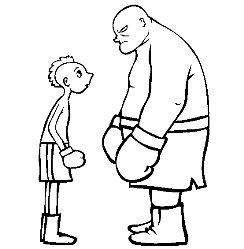
Unworthy Still

The skinny weakling staggered before the hulking thug. After several knock-out blows that had sent the upstart to the hard floor of the ring, it was a miracle the bony stripling could move at all, let alone dance to duck the next lethal blows. The jeering, cheering crowd urged their hero to finally finish the job and mince the lanky fool.

That the weakling had already endured so much beggared belief. It was as if his fragile frame was recreated after each crushing blow smashed it to the floor. Was there no end to this insect dodging around the ring?

boxer

An Allegory

Got the picture? That’s what a faith venture can be like at times. We are totally unqualified for what we believe for. We are totally incapable of bringing even the tiniest portion to reality. Yet we get into the ring, against fears, spiritual foes, oppressive circumstances, medical prognosis, obvious facts, and other belligerent opponents who smash at us with their destructive fists.

At times we are hit and knocked to the ground. The facts, the medical results, the legal opinion, the circumstances turning against us, our own ineptitude – all pound upon our weakling faith and throw us around like a leaf in the wind.

Yet, with nothing more than determination to believe God and His Word, we stagger to our feet again. Somehow new strength surges through our mangled limbs and they straighten again. New energy lifts our feet and we begin to duck and swerve around the obvious, belligerent realities which stand squarely against our faith expectation.

Unworthy Us

Clearly we are unworthy of the fight. We are no match for the foes that arraign themselves against us. We are not able to quench or quell their determined violence. Our only hope is the Lord. Our only ambition is to stay in the ring until the Lord declares us the champion.

boxing 2

We cannot strike a blow. We cannot get the smallest point for our prowess, strategy, footwork, or for laying the least blow upon our enemies. We can only hold on, in desperate hope of survival.

We will not win the fight. Jesus will win it for us. We will not defeat the foes. Jesus has already done that for us. We will not have the strategy. We rely on Him for that. We do not know the way forward. We look to the leading of the Holy Spirit. We bring nothing into the ring but our determination to face the foe with the Lord as our deliverance.

Knocked Down Again

Then another powerful blow knocks us to the ground. The enemy sneers, “What are you doing here? Go home where it’s safe. Only a fool comes here to confront us!”

Our heart is gripped with the realisation that we are getting nowhere. There has been no breakthrough. We still face all of our foes. The facts have not changed. There is no new development to rescue us. Our resources are depleted even more. The taunting voice of the enemy speaks the truth. There is no reasonable excuse for expecting anything to change. We are fools to take up such a venture and attempt so daring a breakthrough.

It’s All About Him!

And then, by God’s grace, a voice reaches us from somewhere and asks, “Were you relying on your own worthiness?” And we realise the answer is, “No!” The battle has never been about us. It has never relied on our ability, our wisdom, our special skills, our divine calling, or anything else of ours. This challenge is not about “us”, but all about “HIM”!

We stagger to our feet again and wave our arms to the crowd. We shout, “I am unworthy! I am undone! It has nothing to do with ME! I stand here today in His name, under His grace, seeking His miracle working power, looking for His Kingdom, according to His will, relying only on Him, and giving all the glory only to His holy name!”

Strength surges through our limbs again. Long, lanky, useless limbs that can barely hold the weight of sweat-drenched gloves begin to move again. We face our foe yet another time. He stares in consternation. How did we rise after his last powerful blow? He cannot figure it, but be moves toward us yet again. We duck and swerve and break into a smile of joy.

Hope to Endure and Win

We are still alive. The battle is not over. We have not been destroyed. We are being sustained. And he who began this good work in us will continue to perform it until it concludes with the revelation of Jesus Christ made flesh in our circumstances! The miracle is on the way! We are being supernaturally sustained. We are taking hold of that which is far beyond us. We will prevail!
And so it is that useless ones, like you and me, move from the pit where we should be to the exalted place where the Lord wants us to be. We do not progress in God’s Kingdom by jumping through the world’s hoops. We don’t get there by natural means. We need “hind’s feet” to reach the high places of God. Colleges can’t get us to Mount Zion. Money, positions, peer approval, government endorsement, big congregations, professional programs and the like will never give us victory in the fight that counts.

It is our insane faith, claiming things that don’t belong to us (in natural terms) as if they are rightfully ours by God’s perfect will and Christ’s perfect sacrifice. That is what teleports us from unworthy to worthy. That’s what makes a sinner a saint. That’s what makes a loser a leader. That’s what makes a has-been a hero again.

Fight the Good Fight of Faith

Fight the good fight of faith. You will get knocked to the floor, but the very fact that you can stand again is testimony to the Lord’s sustaining power. You will learn to rejoice in your unworthiness, not in your natural credentials. You will wave your weakling arms and all heaven will break loose, while those with natural strength watch on in dismay.

To all those who resonate with the call to live by faith I say, “Go for it! Stand to your feet yet again. You won’t win the fight, but you will be declared the victor. The Lord will fight for you. He just needs you to stagger to your feet again and determine that you are useless, but that your weakness is of no consequence.”

Some time soon a champion will step into the arena and tear down the ring in which you have been tormented. He will carry you out on his shoulders and take you to the place of victory you dared lay claim to. So, hang in there, you hopeless thing, you! That’s what I’m doing, and I’m just as hopeless as you are.

It’s a pretty good place to be, this ‘hopeless’ place. Now it’s all about Him! And HE is pretty amazing!

Illegal Laws

In an earlier lesson, Logophile on Law, I explained that there are various types and levels of law which impact us. Not all laws are equal, even though we call them all “laws”, and so it is important to understand the various types of laws and which ones apply to us.

This lesson jumps into the subject of Illegal Laws, showing that just because something is called a “law” and someone asserts, “It’s the Law!” does not mean we are bound to obey it. In fact it may be most appropriate for us to challenge that law, as an Illegal Law.

gavel

Oxymoron

It seems to be a contradiction in terms to say that a law is illegal. Such a contradictory thing is an oxymoron, where the description is too outrageous or inappropriate to be real.

The way a law can be illegal is if it contradicts the higher laws upon which it stands. Since laws are hierarchical, depending on a higher law to give them their authority, it is illegal, yet possible for a lesser law to be created which violates the higher law which it relies on for its authority. In such a case the lower law is invalidated by its own violation of the higher law on which it stands.

A secretary is not officially allowed to boss their boss. A General is not authorised to use the soldiers under his command to attack the Military Commander. A policeman cannot assume the office of President. Similarly, rules made by a sub-committee cannot overturn the rules of the club which the committee serves. Each is subject to the higher rule.

Hierarchy of Law

I contend that the highest law is Divine Law, the laws of God. Since God created us we are all accountable to Him and will be evaluated against His moral order.

In the Australian context, similar to many nations, the human legal basis on which the nation stands is that of Common Law and the Imperial Acts (Laws made by the ruling English monarchs over many centuries). Those laws reflect the application of Biblical Law (the Laws of God as given to us in the Bible).

When Australia was created as a nation, just over a century ago, a Constitution was created to define the new nation and how its government and law is to operate. The Australian Constitution was built upon the foundation of Common Law and the Imperial Acts.

All statutes (what the Government calls “laws”) created by people in authority in Australia are only possible because of the Constitution, and its foundation in Common Law and Imperial Acts. Those government ‘statutes’ are simply the local rules for functioning within Australia. They are much lower in authority than God’s laws and the principles of Common Law and the Imperial Acts.

Statutes

We call statutes “laws”, even though they are significantly inferior to God’s moral law, Common Law (which covers murder, injury, theft and deception) and Imperial Acts, which define the legal principles by which people are to be governed.

Statutes are not ‘laws’, strictly speaking, but are treated as if they are laws by those in the society to which they apply. They are “given the force of law”, even though they are not of the same order of laws as moral law (God’s Law, Common Law and Imperial Acts).

The only reason government agents, parliaments and others in a country can create “statutes” is because they are given some right to do so by the Constitution. And the only reason the Constitution holds any authority is because it is based on Common Law and the Imperial Acts.

Contradictory Laws

If a State or Federal statute (called a ‘law’) is contrary to the Constitution, Common Law or the Imperial Acts, then the statute is invalid. No statute can contradict the authority on which it relies.

Consider a person becoming the Prime Minister of Australia, by normal Constitutional processes, then declaring himself to be the King of Australia. He could argue that, as Prime Minister, he has the authority to elevate himself, but the Constitution does not give him that privilege. He can be Prime Minister, but not take additional, non-legal authority.

As soon as such a leader acts unlawfully he disqualifies himself from holding the authority lawfully entrusted to him. You cannot violate the law on which you stand without violating your right to stand.

Restrictive Laws

A statute from a Government, State or official department within a country can only restrict freedoms. No government has the right to give you freedom to break the law. Governments cannot lawfully make murder, rape, theft or deception legal. They are not able to lawfully declare an illegal action to be legal. So statutes never increase a person’s freedoms. They can only take some right or freedom away – supposedly “for the greater good”.

Our real laws come from God and have been distilled into the Common Law and sealed by Imperial Acts. That is where are true legal position is found (at least in former British Commonwealth nations). Statute laws cannot overturn those primary laws. All statutes can do is further restrict human freedom by regulating what people can do and how and when they can do it within the national setting to which they apply.

Illegal Government Actions

Governments and their officials may find themselves frustrated by the limitations they are under, and choose to go outside the law or their lawful authority (ultra virez) in order to have their way. If they want more money, for example, they may impose taxes or fees which are outside their legal authority to impose.

If getting the citizens to fit in with the government’s agenda proves too difficult for the government it may be tempted to pass a “statute” which demands that people do what they want.

In such situations it is possible for governments to act outside their legal rights and responsibilities. Governments may pass statute laws or make demands of their citizens which contradict the freedoms given to those citizens in Common Law, Imperial Acts or in their Constitution.

Governments have had to repeal (revoke) laws they created but which proved to be illegal. Governments have had to pay compensation to various citizens or entities which were wrongfully treated by the rules, decisions, statutes and actions of the government. This is not a mythical phenomenon, but a reality of human fallibility, ignorance or opportunism.

USA Tax Laws

There is much discussion about the fact that the tax laws in the USA are outside the law. It is claimed that it has been proven in court that there is no law upholding the American taxation regime. Yet the tax office operates with vigour and successfully pursues and penalises American citizens.

Some would argue that the USA Tax Laws are illegal laws, denying American citizens their rights and freedoms. I can’t speak to that subject, but there is an abundance of discussion available for those to whom it may relate.

Illegal On-the-Spot Fines

One of the privileges which Australian citizens enjoy is protection through the historical Imperial Acts of English monarchs. One of those Imperial decrees gives every citizen the right to a trial by a jury of 12 of their peers before they can be determined to be “guilty” and before any penalty can be imposed on them.

Every “on-the-spot fine” and every charge made on a citizen before there has been a legal conviction before a jury in a duly convened court of law is contrary to the legal rights of Australian citizens. Yet most Australians pay those fines, or go to court to fight and only end up with a greater penalty than they started with.

Ignorance is Not Bliss

Ignorance of the law means many people are denied their rightful rights (silly to have to say it like that). Because most citizens are ignorant and are happy to stay that way, they have been duped by populist ideas.

They believe that the more modern laws have superseded the old ones and that society is evolving all the time. They think that something from 100 years ago is really ancient and has lost its significance. They think that the ruling of a magistrate or the interpretation given by a current legal adviser is the final word in legal reality for them. They think that a new law completely eradicates the previous legal reality.

Ignorant citizens do not know what their true position is. They do not know what protections they have. They do not know their rights. They think their legal standing and their rights are gifts from their government, and not from God.

Get Your Own Education

This lesson is a wake-up call. But if you are determined to stay asleep and to live under the control of laws that may not be laws and “laws” that are “illegal”, then I can only wish you well.

It is not my place to live your life for you. It is not my place to save you from your own wilful ignorance. You have a free will given you by God and you have to answer to Him, not to me, for how you use it.

My job is to rattle your cage and shout “Wake Up!”

Now, I’ve finished for the time being.

I think I’ll have a nice cup of tea and leave you to your own future. Happy legalities !!!!

Pagan Christianity Book Review

Pagan Christianity (book review) by Frank Viola and George Barna. 2002 / 2008. Exploring the Roots of our Church Practices

Disclaimer

I skimmed this book in a few hours (Sun August 16, 2009) – and so I have not done the book the service of a thorough scrutiny of all the content. My observations are based on what I did see in the book and what its case presented itself to be to a reader picking up the highlights.

Overview of the Book

Barna & Viola argue, from the perspective of historical review that much of what we take for granted in Church life, including church buildings, denominations, sermons, individual leading pastors, purposes for the offerings and modern forms of worship, have developed from pagan concepts. They further assert that those things stand in the way of the expression of Christianity as it was intended, but which only operated widely for the first century or so.

They support their contentions by describing fellowship groups which operate today which they see as superior to modern churches.

Main Case

Barna and Viola’s principal case against the modern church is that it is “pagan” in origins, and thus, by implication, not what God wants in the church. They assume in their minds that “pagan” means wrong and offensive to God’s purposes. Therefore they suggest that modern churches are wrong, ‘guilty’ by association with the pagan roots of their practices. Their principal non-historical argument is that most modern church meetings are directed and controlled by people and programming (liturgy) which preclude the ordinary member from taking any leadership. They see the pastor/leader model as counter to the expression of the priesthood of all believers. The modern examples they commend involve a relatively un-structured format where no one person is leading the meeting. By this open format all the participants can contribute by sharing something or leading out in a song. The particular quality they extol about this model is that the meetings are “led by Jesus Christ”, not led by a person or by a programmed ritual.
By implication, then, they see that planned meetings, or ones led by only selected people, are likely to exclude Christ from the place of leadership in the church.

Their argument, then, is both historical and perceptual. History provides the incriminating link between modern church practice and ancient pagan practice. Their perception is that modern church services obstruct the personal expression of ordinary members in a way that blocks Jesus Christ from taking leadership moment by moment in the church meetings.

Positives

It is good to review and challenge our practices and to be open to correction and direction. Barna and Viola offer various criticisms of modern church life. Those criticisms are not new. Thoughtful people have addressed these issues and there are many variations of church service and types of church meetings, providing redress to some of the concerns raised. The challenge should remain open and godly wisdom should be prayerfully sought.

Concerns

Barna and Viola have principally resorted to inspection of the “roots”, not inspection of the “fruits” (although they do point out various outcomes). I suspect that both of these men were able to achieve much of their personal spiritual development in the grip of the very church processes which they now challenge. Multitudes of churches and millions of Christians across the globe, from jungles to cities, are successfully bringing people to salvation, discipleship, maturity, and effective ministry, using the very methods and models which Barna and Viola seem set against.

This observation does not negate Barna and Viola’s case, but it reveals that their autopsy on the “roots” generates a different sense for the thing than Christ’s instruction to inspect the “fruits”.

While Barna and Viola include a huge amount of evidence for pagan influence into the church model as we know it, they fail to recognise that those elements are not the intellectual property of pagans. Their case is akin to saying “terrorists use public transport, so public transport is evil”.

Origins of Preachers

While Greek orators can be accused of seeding the modern concept of a preacher, that does not make preaching suspect. Moses preached and taught, as the exclusive voice to his audience. The prophets spoke, instructed, elaborated on their insights and taught followers and the public. Ezra organised preachers who would expound the truth. John the Baptist was a preacher. So too was Jesus Christ.

So to lambaste preaching, because of the connection that can be made to Greek public speaking, belies the issue. Preaching was never the exclusive preserve of Greek orators. Preaching is a form of communication which God commends.

“For after that in the wisdom of God the world by wisdom knew not God, it pleased God by the foolishness of preaching to save them that believe.” 1Corinthians 1:21

“How then shall they call on him in whom they have not believed? and how shall they believe in him of whom they have not heard? and how shall they hear without a preacher?” Romans 10:14

Leadership Responsibility

We also find that, while there is place for all believers to contribute, under the anointing of the Holy Spirit, there are those who are given more specific responsibility. We see Paul on his missionary journeys not holding open “go with the flow” meetings, but specific, long-winded times of serious didactic input from him. He saw himself as one who would ‘impart’ something. He exhorted Timothy to be diligent in such things as preaching, rebuke and exhortation.

“Preach the word; be instant in season, out of season; reprove, rebuke, exhort with all longsuffering and doctrine.” 2Timothy 4:2

This instruction was not to all the members, but to those selected, by Paul the Apostle (not some later generation of bishops), and charged with a more central responsibility.

Along with that Paul expected Timothy to raise up other specialist speakers who would make specific contribution into the life of the church.

“And the things that thou hast heard of me among many witnesses, the same commit thou to faithful men, who shall be able to teach others also.” 2Timothy 2:2

Barna and Viola could be guilty of creating the kind of distortion which they accuse pagan influences of imposing into the church. Barna and Viola seem to be denigrating a Biblical reality (the place of preaching), tarring it with the brush of paganism, and promoting their personally preferred church service model that seems to reduce the place of the preaching which God gave to the church and which the Apostle Paul elevated.

Other Issues

The same doubts about their case could be raised with regard to church buildings, organisational structure, hierarchical leadership, financial administration and so on.

Does the fact that pagan temples influenced early church buildings mean that God does not want churches to have dedicated buildings? Barma and Viola imply that God is opposed to church buildings, especially since they can be linked to pagan meeting places. Yet in old testament history the Jews developed a new building called the Synagogue. It was not prescribed by God, but developed during the captivity and continued thereafter. Although this building concept was not instigated by God it was used by Christ and the Apostle Paul. There is no sense that it was to be rejected because of its origins. So, I contend, Barma and Viola’s criticism of modern church buildings is of little if any consequence, despite the connection to ancient architecture.

The feast of Purim, which the Jewish leaders instituted in honour of the events recorded in the book of Esther, was not ordained by God. Yet there is no suggestion by Christ or the Apostles that it was to be condemned or rejected because of its origins.

Leadership Issues

With regard to church hierarchy and supervision we have the examples from Moses of seventy elders selected to share his leadership burden. We have the appointment of captains over tens and captains over thousands. These various leadership appointments were not always ordained by God, but that did not make them bogus or worthy of rejection. Indeed, the heathen nations doubtless had similar leadership hierarchies to administrate the social, military and religious process of their culture. Any similarity between one administrative set and another does not negate the institution. Yet, to Barma and Viola it seems that such similarities render church leadership as suspect.

Conclusion

My conclusion is that, despite the well researched and scholarly complexity of historical information garnered for their treatise, Barna and Viola have erred in their essential premise. They seem convinced that guilt by association renders the modern church to be little more than a pagan religion, masquerading as true Christianity. The effective practice of modern Christianity, under the weight of this pagan heritage, challenges their most basic assertion.

Their work errs toward the irrelevant, despite its eloquence and the conviction with which they press it upon their readers.

I am concerned that some readers will be beguiled by the scholarly quality of the work, giving it credence as relevant for its sheer weight of detail. I am also concerned that some weak souls will become infected with an allergy toward the modern church, avoiding fellowshipping with the saints or listening to preaching of the Word of God. It is possible that the arguments put forward by Barna and Viola will subvert the soul of some who would otherwise meet with the saints and hear the Word of God. Should that occur, then their contribution is decidedly toxic and not beneficial.

Yet I am sensitive to their concern. They wish to advance discussion on a matter that concerns them. They seek to liberate Christians from slavish servitude to human structures, empty liturgy, man-made agendas, and the like. I fear that they will muddy the waters, by taking such a negative position, on such unworthy grounds for their case.

They Should Promote their Model

I suggest that they could do better by discarding their interest in the pagan roots they perceive in modern church models, and uplifting their alternative model of worship. Christ said that “If I be lifted up I will draw all men to myself”. I suggest that, if the Barna/Viola model is worthy of Christ, then simply lifting it up will produce a drawing effect upon all who see it.

Rather than go down that path Barna and Viola have taken the popular road of attack upon the status quo. They hope to draw followers to their preferred worship model by attacking the current model. I, for one, believe they have damaged their own credibility, by the spiritual murkiness of taking the offensive. Rather than perceive the good, many of their readers will be distracted in the defence of what they have attacked.

Rejection 17 – Self Pity

A Rejection Profile is handled differently by people. So there is no exact image of a rejected person. I suggest that there are several lifestyles which people carrying rejection will be drawn toward. Which one any person settles for depends on their personality and other factors.

This lesson looks at the first of the “stopping points” where a rejected person may end up.

The Defeatist

Some people respond to rejection by simply giving up all hope for a normal life. These people tend to be the defeatists, who take on a self-pity based persona, as their response to what they have suffered. While others may have a strong sense of fight, or be motivated by rage or a desire to be popular, the defeatist seems to wallow in their pain and make it the focus of their life.

Since all rejected people feel at some point that everything is against them, the defeatist succumbs to those impressions and gives up any hope of winning against them.

This does not mean, however, that the person buried in self-pity is not still quite cunning, exploitative, manipulative or the like. Their choice to live in self-pity is, in itself, a survival strategy.

reject-02-heart-cryPity Poor Me

The defeatist takes on the persona of a loser and plays the “Pity Poor Me!” performance. Some are genuinely shattered and unable to find their feet. Others have simply chosen that they have no real chance of winning, so they may as well exploit the sympathies of others around them.

Many people on welfare have taken the “pity poor me” value system, but can be quite demanding and exploitative, despite their helpless position.

Those who are emotionally unstable may be lost in their depression and downcast feelings. Those who are more resilient emotionally may be careful to look out for those they can manipulate to assist them, no the basis of their “pity poor me” situation.

Withdrawal From Life

The ‘loser’ mentality that goes with the Self-pity persona may cause some people to withdraw from life. They have certainly withdrawn from the race and the competitive elements of life. They no longer expect to have the nice things that others have. They expect to live life on other people’s left-overs and charity.

Sadly, many people who go down this road lose their ability to take responsibility. They have withdrawn to the point of refusing to take responsibility when it is appropriate for them to do so.

I have seen second generation welfare recipients refuse to take up opportunities for personal success, since they will then lose their ‘benefits’. They have withdrawn to the point of refusing to re-enter life, even when they are well able to do so. One lady I knew was forced back into employment and excelled at her work, achieving financial freedom. But initially she refused to even try, for fear of losing the benefits she had become addicted to.

Emotional Wreck

Some people become so messed up emotionally that they weep openly and have public displays of emotion which others would avoid doing. Rather than hide their shame, pain and need, they let it all hang out, spilling their mess without any care. They seem to be beyond embarrassment.

They have given up. They have abdicated from life. And in so doing they have lost the ability to hold themselves together or to show appropriate decorum in certain situations.

People in this situation pull at the heart strings of the compassionate, and that leads to the next problem area for the “pity poor me” reject.

Dumping Onto Others

People who have given up usually try to find others to carry them. They need support emotionally and in most other areas of their life. Rather than being able to contribute to relationships and life in general, these people tend to always be making emotional withdrawals, at the expense of others. They dump their problems onto others.

The welfare networks and caring professions are often targets of these people. They look for people who could or should help them and they exploit that help when they can. They may ask others to manage their money, fill out their paperwork, make decisions for them, be there whenever they call, and otherwise become their permanent lifeline.

They usually have an excuse for everything and often have a whining story to tell about their hard-luck background. “I always wanted to play piano, but we were too poor for lessons.” “If only my dad didn’t leave things would have been different.” And so it goes.

Such people are terribly draining and usually wear out or burn out those they rely on. They become a bottomless pit of needs.

Manipulation

Some people in this self-pity mode become experts at wheedling their way into situations, exploiting other people, especially those who have a soft heart, and using people for their own ends.

When a self-pity person is denied any support they can prove to be quite resourceful, but when someone comes along who they can manipulate, they suddenly become “helpless” again.

When there is something to get for nothing, or some opportunity somewhere, the self-pity person can often be the first to line up, expecting to get whatever is available.

Sadly, these people are almost impossible to satisfy. When they are given more, they find some reason to put it down as “not enough”. Their need is not so much real, but perceived from their own internal mess. So, no matter what is done for them they never rise out of the situation they are in.

Irresponsibility

The self-pity mode is one of irresponsibility. The pity-poor-me person has stopped trying to make life work with God’s grace and the responsible use of what they have. Instead, they have chosen to give up and even to make other people carry their load for them.

This position of abandonment undermines their life and leaves them on the ground of complaint, unhappiness, inability to be fulfilled, and so on. They are controlled by the feelings they have given in to.

It can be very difficult to help these people to move into true freedom. Freedom means they will have to accept responsibility shoulder their own load and take their place in society. They will no longer have an excuse or be able to dump their responsibilities onto others. So, they are likely to resist coming into freedom. It takes a work of grace to awaken their hunger for wholeness and their hope in God for glorious liberty.

A Temporary Condition

Many rejection sufferers, however, do not wish to remain in the trap of self-pity. So in the next few lessons I’ll discuss some different outcomes which rejection victims gravitate toward.

Once that is done we can look in detail at how the Lord sets people free and I can share more of my own testimony of coming into freedom.

Social Collapse

It has been said that society is held together by a thin veneer. Recent history reveals that supposedly civilised and sophisticated societies are able to dissolve and disintegrate into social collapse.

So, what is it that causes such social dissolution? What is it that holds societies together, so they don’t collapse? How can we best protect our own society from unravelling under duress?

Outrage and Opportunism

The six days of rioting and looting in Los Angeles, incited by violence against a helpless black American, shocked the world, back in 1992. Images of people looting shops, running rampant in the streets, damaging their own social infrastructure and creating mayhem seemed completely out of place in American society. 13 people were killed in those riots and 192 were injured.

race riots LA

That event and others like it involved two overt elements. The uprising was sparked by outrage. The local community was outraged that one of their own people was treated so badly. Outrage fed opportunism. The emotion that prompted people to react opened for them the opportunity to loot and steal, vent their anger in destructive ways, and indulge their passions without restraint.

While other factors were doubtless involved, the combination of outrage and opportunism, unrestrained reaction and unrestrained greed, quickly prompted social collapse.

Deprivation

We also see examples of deprivation leading to social decline and ultimate collapse. I recently heard a chap from Cuba reflect on the impact of continued and chronic deprivation of the most basic resources. One day he returned home from a store rejoicing that he was actually able to buy toilet paper for the first time in many months. He looked at his purchase, realised how absurd his excitement was and thought, “What have I been reduced to?”

Continued deprivation of basic elements of life “reduces” people to their baser instincts. Competition becomes fiercer. Small gains, which are inconsequential under normal circumstances, become huge personal victories in the distorted thinking of a person under duress.

Societies have dissolved into social jungles where each person relied on their animal instincts and wits to survive. People have betrayed their own family members, distrust has become the norm, exploitation has become the expected thing and there have been no bounds to what one might do to another.

Civility Dissolved

In the Bible, God warned His people that if they rejected Him He would put them under such duress in famine that they would eat their own children. Even the most delicate and inoffensive person would be reduced to lying and murder, without any care for their own children or family.

“And you will eat the flesh of your sons and daughters, in the siege and restriction with which your enemies will distress you: So that the tender and very delicate man among you will have an evil eye toward his brother, wife and his remaining children: So he will not give them any of the flesh of his children whom he will eat.” Deuteronomy 28:53-55

Imagine a situation where perfectly tender and delicate people become jealous and selfish in eating their own children and keeping the flesh from the rest of their family. It is an ugly suggestion. It occurs when all sense of civility is dissolved and people are reduced to animal instincts.

Fear and Betrayal

We have seen under Communist oppression and in situations of despotic rulers, that fear and betrayal have become the rule of daily life. I recall a friend telling me that when they escaped from Albania, many years ago, their mother did not even tell her husband what her plans were, because she could not trust him.

The mother and children escaped across a lake to Macedonia. The father’s ignorance of their plans not only spared them from potential betrayal, but allowed the father to protest to the authorities that he truly had no idea of the plan.

Under situations of political oppression people prove willing to condemn their friends and family. They betray those who care for them. They live in fear of betrayal. Trusted friends become enemies. Social norms dissolve to fearful and treacherous living.

Hierarchy of Needs

Abraham Maslow proposed his hierarchy of needs in 1943, where people who are more provided for are expected to become more thoughtful and altruistic. While this is a nice idea, it reduces people to mere respondents to socio-economic conditions. However, the human heart operates independently of our level of provision.

Maslow Hierarchy of Needs

Rich and well provided for people are perfectly able to act in totally selfish and exploitative fashion. Evil continues to be perpetrated, even in the most well provisioned societies.

Similarly, not all people who are deprived become full of fear or treachery. The matter is not one of provision, but of the heart of the people involved. While deprivation brings out the worst in people, it is not true that all people have evil waiting to surface.

The Resilient Jesus Christ

True nobility of spirit brings us to a place where we do not respond differently, no matter what circumstances we endure. The Apostle Paul said of himself, “I know how to be abased and how to abound”.

I know both how to be abased, and I know how to abound: every where and in all things I am instructed both to be full and to be hungry, both to abound and to suffer need.” Philippians 4:12

Paul’s role model was Jesus Christ. Jesus was persecuted, victimised, tortured, falsely accused and then killed, yet without any dissolving of His person or His divine purpose. When He was reviled He did not respond with a retort.

“….. Christ also suffered for us, leaving us an example, that you should follow his steps ….

Who, when he was reviled, reviled not again; when he suffered, he threatened not; but committed himself to him that judges righteously” 1Peter 2:21,23

Independent of Evil

Sadly, most people come under the power and oppression of the evil that is imposed on them. When people are hurt, they are inclined to hurt others. When people are accused, they are likely to accuse others. When people are deprived, they are likely to be jealous of and evil toward those who have what they want.

Yet the Apostle Paul, the follower of the example of Jesus Christ, taught us to live independently of the evil which is projected against us. We are not to be overcome by evil.

Be not overcome by evil, but overcome evil with good.” Romans 12:21

Having a right heart attitude enables us to be independent of the evil which surrounds us or which is inflicted upon us.

Back of the Bus

I once heard a gracious, elderly black American speaking about the days of discrimination. Some of his friends were agitating out of anger toward the white communities. His response amazed me. He said, “Jesus Christ would have been happy in the back of the bus, so why can’t I be happy there too?”

While some of his friends were being overcome by anger, vengeance and similar passions, feeding into a spirit of rebellion and violence, this man was able to endure the same oppressions without being overcome by the evil.

Purify My Heart

I hardly know the meaning of duress. I live in privilege compared to the situations which confront most others in the world. So I don’t want to sound pious. I have no real idea what true oppression is like for those living under it.

I know that when I am under what we spoilt westerners call duress, being overly tired, having my plans frustrated, being put under performance pressure that is more than normal, then my patience wears thin. I become less tolerant, more frustrated, more selfish for my own needs, and so on.

I expect that evil would overcome me much more readily than I want it to. So I need the Lord to purify my heart. And you need the Lord to purify yours, too.

“Lord, we ask You to purify our hearts, so we can live independent of the evil which is pushed upon us. We are weak, but You are strong. Keep us and preserve us from all that’s wrong. Deliver us from evil. Deliver us from the evil which comes against us from outside ourselves, and deliver us from the evil which springs up within us from time to time. Create in us clean hearts, that will serve and worship You, no matter what. We ask this in Jesus’ powerful name. Amen.”

The World’s Greatest Scam – Video

You have been SCAMMED by the most deadly trick on the planet. And you probably don’t realise what has happened.

This isn’t about Money, or about your career, marriage or self-image. It runs much deeper than that. And it has trapped everyone! Guaranteed!

This short video explains the situation simply, clearly and with authority. So make sure you watch it and send it on to your friends – because they’ve been scammed too!

Ps Chris has written an article about The Greatest Scam which you can read, print and forward to your friends. You’ll find that article at: http://chrisfieldblog.com/ministry/greatest-scam

Lost in the Rush of Life

Here is an interesting account of something that should make you think. It’s about a busker at the Washington DC Metro Station, playing his violin to a rush-hour crowd at around 8am on a Friday morning. The date is January 12, 2007.

The violinist played for about 43 minutes, performing six classical pieces by Bach. A total of almost 1,100 people passed him by during those minutes. Many others would have heard the sound of his playing as it echoed through the subway corridors. They were almost all on their way to work.

joshua bell Washington subway

This is an account of those who paid him any attention. After 3 minutes a middle-aged man noticed there was a musician playing. He slowed his pace and stopped for a few seconds and then hurried to meet his schedule.

4 minutes later the violinist received his first dollar when a woman threw money in the hat and, without stopping, continued to walk. The musician had already placed some money in view, to encourage contributions from others.

Soon after a young man leaned against the wall to listen to him, then looked at his watch and started to walk again.

After 10 minutes, during what was arguably one of the most difficult pieces for a violinist to master, a 3-year old boy stopped but his mother tugged him along hurriedly. The kid stopped again to look at the violinist, but the mother pushed hard and the child continued to walk, turning his head all the time. This response was repeated by several other children. And every parent, without exception, similarly forced their child to move on quickly.

For 43 minutes the musician played continuously, moving from one piece to the next. Only 6 people stopped and listened, and each only for a short while. About 20 gave money but continued to walk at their normal pace. The man collected a total of $32.

When he had finished the normal subway sounds took their usual place of prominence. No one noticed. No one applauded, nor was there any recognition.

What the passers-by did not know was that the violinist was Joshua Bell, one of the greatest musicians in the world. He played one of the most intricate pieces ever written, with a violin valued at $3.5 million dollars. Two days before, Joshua Bell sold out a theatre in Boston where the price of seats averaged $100.

Joshua Bell was a child prodigy. His psychologist parents decided to start formal violin training for their son when he was only four years old. They were prompted to this when they saw that their son had strung rubber bands across his dresser drawers and was replicating classical tunes by ear, moving drawers in and out to vary the pitch.

And “Yes” the subway concert really did happen. It was organised by the Washington Post, as an experiment to see whether people would appreciate the highest quality musical experience if they came upon it unexpectedly. It was part of a social experiment about perception, taste and people’s priorities. Do we perceive beauty when we encounter it in a commonplace context at an inopportune time? If we do come upon it, do we stop to appreciate it?

The response of the Washington crowd prompts the question, “If so many people can so easily ignore such excellence, not even taking a moment to stop and listen to one of the best musicians in the world, playing some of the finest music ever written, with one of the most beautiful instruments ever made, then what else are most of us missing every day?”

If your day is looking a little dull today, take a moment to slow down and smell the roses, feel the breeze, enjoy the sunshine, smile at others, and appreciate the efforts of those around you.

Logophile on Law

Law is a word that fools us. Since law has serious impact on our lives we need to understand the term and how to use it properly. Importantly, we need to be aware of how it is used against us.

Some people come under the penalty of law, when the “law” used against them was not a “law” at all. You are most likely fooled by the use of “law”. So it is important that you understand the word, how it is used and what implications it has in your life.

Law is a Vague Term

Some words are used in multiple applications, with different meanings. A young woman tells her infant brother that she wishes to marry a man because she ‘loves’ him. The infant then replies that he is going to marry chocolate, because he ‘loves’ chocolate.

Love is used so broadly that its technical meaning varies in different situations. You can love sport while sport is not the love of your life. You can love your spouse, but also love getting away on your own.

The ancient Greeks used several different words for our English word ‘love’, differentiating between: attraction to the appearance of a thing; humanitarian or family concern; sexual attraction; and sacrificial commitment for the good of others.

Law is similarly a vague term. It refers to such unchangeable things as the laws of nature, but also to such changeable things as the rules of a club.

It’s the Law

When someone informs you that something “is the Law!” you can be misled as to their meaning. What type of ‘law’ is it? Who made that law? By what is it enforced? What are the consequences of breaking that law? Who is bound by that law?

Many things are the ‘law’ and have profound consequences for some people, yet can be completely ignored by others. Just because something is “the law” doesn’t mean most of us have to give any credence whatsoever. The trick is to know what is ‘law’ and what is ‘law’. That is, we need to differentiate between one law and another.

Others May but I May Not

A police officer is bound by more laws than the average citizen. Anyone who has sworn an oath of office, taking on special responsibility, is under stricter controls than normal citizens. For example, ordinary citizens are not bound by law to give their name to a police officer, but a police officer must give his name to any citizen who asks for it.

Lawyers and Barristers have sworn special allegiance to the courts, in order to be allowed to deal with the special legal matters of the court. So an ordinary citizen has much greater freedom in a court of law than their legal team does.

It is a case of “others may, but I may not”. Others may ignore the instructions or demands of a judge, but a barrister does not have that privilege. Others may ignore the demands of a police officer (under certain circumstances) but a police officer may not ignore the demands made of him or her.

Categories of Laws

Here are some of the various types of law that impact you in your normal life. There is Divine Law, Natural Law, Common Law, Imperial Law, Constitutional Law, Statute Law, Local By-Laws, Club Rules and House Rules. There are also such laws as the Laws of Nature, Maritime Law, Contract Law and International Law.

Divine Law involves mankind’s moral accountability to the Creator, who is the ultimate moral being and who holds all people accountable against His own moral standards. Such laws as the Ten Commandments and the teachings of Jesus Christ convey man’s moral responsibility to God’s Law.

Natural Law involves the natural rights and responsibilities which attend natural existence. Such things as the right to self-defence and the right to maintain and sustain life are included here.

Human Legality

While Divine and Natural Law seem to be the most basic foundation for law, they are not man-made, but spring from either the nature of our existence or the One who created us. So the next areas of ancient law (Common Law and Imperial Law) represent the early expressions of human law which have passed to many nations.

Common Law is the body of laws which developed in England over centuries, where God’s Law, especially as expressed in the Book of Deuteronomy, was applied to situations and codified into a body of rights and responsibilities. Common Law is principally focussed on limiting people’s impact on others (no murder, injury or theft) and making people accountable for their own actions (bound by their promises).

Imperial Law involves all the laws of English monarchs, which further codified Biblical, Natural and Common Law into principles by which due legal process is to be applied. Such documents as the Magna Carta from over 700 years ago are still upheld as foundations for legal practice and principle followed today. Most English speaking and former British Empire nations have ratified their continued reliance on Imperial Law. Imperial Laws have not decayed with time, but are enduring elements of what is law and lawful today.

Modern Law

While all those laws mentioned so far are perfectly modern in their validity, most unlearned citizens think of them as somehow outmoded and not relevant today. Modern people think of their nation’s constitution and the government-enacted laws (statutes) as modern law.

Constitutional Law involves that body of law which is created to define a nation and how it will operate, politically and legally. Many nations have a constitution: that which constitutes (brings together) the nation itself. All of the parts are the constituents. All legal and political practice within the nation has to be based on the law that “constitutes” (or creates) the nation.

Statute Law involves all those “laws” which are created by governments. Once a nation has been constituted (via its Constitution) its elected or appointed officials may need to create the Rules for the effective operation of the nation. Those “laws” are actually “statutes”. They are rules which are given the force of law, and are generally treated as equal to those higher laws upon which the government has been founded. Statutes are binding upon the members of the club or society which created them.

Local Law involves those rules which are created by local councils, regional administrations, clubs (for their members), social organisations, etc. For example: a student at one school is told that he must wear a particular uniform on certain days. But that localised rule, while effectively the “law” for some students, has absolutely no hold over students attending a different school. One local council may prohibit the lighting of fires in people’s yards, while the neighbouring city might encourage such fires. Local laws only apply to those who are bound by them, by membership of some group or other.

Question The Law

Which laws apply to you? If other people create a rule for them and their club, does that have any hold over you? Is the law being applied to you a Divine moral responsibility, or is it simply a statute made up to facilitate social order?

Is the law that is being pressed upon you really a law at all? If a local or statute law is against the higher laws on which they stand, then can it be a lawful law at all?

Can a government morally uphold a law that rejects or breaks God’s Law? Can a local or state government legally create a law that violates that nation’s Constitution?

When someone tells you “It’s the Law”, what do they really mean? It may be “law” for them, but is it law for you? If two laws contradict each other, which law should you obey?

A Lawful Mind

The information and questions in this lesson are to prompt you to know where you stand before the law and how you should respond to the laws you are told to obey. I want you to have a deeper and richer understanding of the law than many of those around you who say, “It’s the Law!”

Give these matters some serious thought and seek to develop a wise and lawful mind.

Rejection 16 – Cut Off Source of Hurt

The fourth response to rejection which I identify in victims is their choice to cut off the source of their hurt. This is an extension of the previous lesson, where rejected people distance themselves from certain people or type of people who have contributed to their pain. This lesson looks at the broader situation where a rejected person will create distance from the process or situation where they previously suffered.

Fight or Flight

If a wild animal hurt you it is natural for you to flee. You must either fight or take flight. Running away from trouble is a logical protective process.

In the same way, people who suffer rejection, at the hands of other people, either have to fight those people or take flight. It is not easy to fight those you want to love you. And it is not possible to fight such things as school systems, family networks or the like.

So the picture I created to represent cutting off the source of hurt shows a young rejected person hurrying away from a collection of things: school, piano, sport and their aunt Sally. I will explain why I chose those items during this lesson.

I’ll Never Do That Again

As a young lad in the school yard I watched a group of boys playing cricket. Unexpectedly one of the boys asked me if I wanted to bowl the ball. I had never played cricket before and may never have seen the game before. My father thought it to be a silly game and never encouraged an interest in sport.

I took the ball and threw it toward the boy holding the bat, as I had just seen others doing.

Immediately one of the other players derided me with his scorning remark, “That’s not a bowl, it’s a chuck!” To translate that, he was saying that I had failed to propel the ball by the approved, stiff-arm, over the shoulder means, known as ‘bowling’ the ball, but had simply propelled it as a child might throw a stone, for which term the colloquial word ‘chuck’ was amply descriptive.

Realising that I had done the wrong thing and had earned unexpected and unwanted scorn from boys I did not even know, I decided that I had insufficient interest in the sport to do anything but walk away. The boys were intent on their game and someone else was found to bowl the ball in the correct cricket manner. Unnoticed, I stepped away and decided, “I’ll never do that again”.

Choices

My childish choice was motivated by a sense of offence and rejection, at the hands of those who deemed themselves qualified to scorn others. My tender, boyish spirit had been offended. I was unprepared for being placed in a position of unwanted scorn. Clearly there was much that I needed to learn to be able to engage in the process of playing cricket without risking further unwanted rebuke, and my level of fascination with the game did not draw me to navigating that level of risk.

Simply put, I was hurt by an attempt to play cricket and so I walked away from the game. I never again took interest in the sport, until my own sons induced me to join in their back-yard game. And guess which part of the process I found the most daunting. Bowling the ball is the one thing which I was most sensitive about.

That is metaphoric of the whole process of cutting off the source of our hurt. When we are offended by some process or other we instinctively choose to avoid it and the unwanted negatives that flow to us from it.

I Hate School

Consider the situation of a child who is embarrassed by a school teacher. Maybe they are asked to answer a question or read out loud, and their wrong answer or some other issue causes the teacher or students to react, snicker, rebuke or otherwise respond in an unwanted manner.

If a child feels offended by their experience at school, either in the classroom or the playground, they can decide that they will avoid it. They may announce to their parents that, “I hate school!” They may tell their mum that they want to stay home. They may cry when taken to school and plead with their parents that they want to stay home. Such reactions are common.

Parents usually assume that they have no alternative but to force their child to go. They also believe that the child dealing with their reluctance is a process of maturity. So, in the main, children who are feeling offended and hurt by school are forced to go back again and again and face their hurt and fears.

Note that many children who skip school, or who miss certain classes, may well be carrying the pain of rejection and wishing to avoid the source of some of that pain.

The Piano and Aunty Sally

Consider the situation where a child who is learning to play the piano is asked to play a piece of music for Aunt Sally, who is visiting. The child, insecure about their talents and unfamiliar with playing for an audience, displays reluctance. The mother, however, wants to show off her child’s progress so she forces little Johnny to play his piece.

Johnny is already off-side, feeling vulnerable and afraid. As he plays his piece he makes a few mistakes and Aunty Sally seems to smile, snicker, or respond in a way that feels like an offence to the boy. He springs from the piano stool and runs out of the room. As he goes he says to himself, “I’ll never let my self get into such a situation again!”

From then on, Johnny loses all heart for playing the piano. It is a source of hurt for him. If he is forced to play he does so as if under sufferance. If he can get out of it, he will. And every time Aunty Sally comes to visit he runs and hides, goes on an errand, visits a friend, or otherwise gets out of the way.

He might even hold deep resentment toward his mum, for forcing him into a situation where he could suffer pain.

In all of that he is cutting off the source of hurt.

Pruning Your Life

Each time someone cuts something off, because it is a source of hurt they wish to avoid, they end up pruning their life. Some people, therefore, have greatly limited their whole life experience.

Some people avoid any situation where they will be asked to speak in public. Others avoid situations where they will be given responsibility. Others cut off any idea of performing in public. Others avoid situations where they must use maths, sing out loud, have the spotlight (even for just a moment or two), display physical strength, compete with anyone, do an exam, and so on.

Some people have remained single after being jilted. Some have dropped out of sport, academics, business, and the like, after a public humiliation. Some people avoid church, because they were made to feel foolish or unwanted there.

What have you pruned out of your life? Imagine how wonderful life could be if you could happily and freely bring back into your experience all those things which you have pruned out of your life.

An Open Door

Your healing from rejection is an open door to new horizons, new opportunities, new experiences, new scope, and the recovery of many things you thought you could never possess in this life.

I encourage you to find the freedom which God has for you, through His love, Christ’s sacrifice and the Holy Spirit’s anointing in your life.

Rise and be healed, in the name of Jesus!