Rejection 18 – Masking

Another Rejection response is to Mask pain and put on a False Front. It’s a self-defence mechanism, to protect our pride.

The Pride of Life is one of three human worldly motivators, along with the Lust of the Flesh and Lust of the Eyes. So people instinctively hide the truth if it will damage their image in the eyes of others.

Denial

The urge to deny our weakness, failings or vulnerabilities is ubiquitous. Little children start young, with “I didn’t do it, Mummy!” I recall seeing one child drop something, pick up the broken pieces and go straight to his Mum saying, “I didn’t break it!” No-one needed to teach the child to deny the unpleasant truth.

The force of denial leads to self-delusion, fantasy thoughts and the like. But for the purposes of our Rejection study denial is the force that prompts people to place a mask over their hurt and failure.

The Cover Up

I recall approaching a house and hearing a heated argument inside. When I knocked all went quiet. The door opened and a smiling face greeted me as if there was nothing wrong.

Have you ever had to answer the phone in the midst of an argument or upset?  People can be shouting in argument, then pick up the phone and speak sweetly to their caller. A mask is placed over the problem or the heated moment, to keep it from others.

Rejected people, despite their personal pain, share that same instinct to cover up their unhappy lot. They learn to put on a smile, project an air of confidence, push down their unhappy feelings and give the impression that all is fine.

The False Front

The cartoon I use to describe masking our pain with a false front is that of a deeply inferior person projecting a different image onto the screen of their life. Rather than letting others see how miserable they feel, they give off the false front of a happy and confident person.
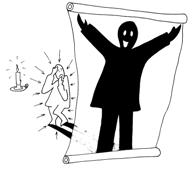
Reject 18 Masking

Sadly, most people live with some degree of masking. In a minimal level it is simply covering up a mistake, overlooking a weakness, or diverting people’s attention from things they don’t want openly known.

At the most extreme level a person can become completely false. Their whole life can become one of living a lie. They can hide just about everything about them.

Professional Front

Keeping up appearances is part of life in some fields. The old saying, “The Show Must Go On!” speaks to how performers must squash down their pain, skip onto stage and perform as if the personal issues that may have just bombarded them don’t exist.

Professionals in business need to maintain a professional front, not showing their despisement of their associates, clients, bosses or company policy. Politicians can argue behind closed doors then emerge as best of buddies, so the cameras convey the desired image.

Doctors, counsellors and others have to maintain a ‘public face’ in dealing with their clients, as part of their professionalism.

The Ministry Smile

Mid last century the idea of giving away a “smile” became popularised in Christian circles. In some churches the “ministry smile” took on Biblical standing as a ministry obligation. While always smiling affirmation at people has a natural sweetness about it, I personally found it quite annoying.

What troubled me was that it became a form of False Front. It was a professional “mask”, which successfully hid the true feelings from others. But it also became a barrier to genuine personal contact. Christians in ministry moved one step further away from those they met, because the Smiling Mask was artificially applied. Rather than people meeting on a more real level, they met as professional and client.

The Ministry Smile mask caused me to feel unsure of the friendly relationships which were offered me. I was sure that so many people could not all be so deliriously happy to meet me. I suspected that some of them might have liked to tell me they disagreed with something I taught, or had personal concerns they needed to discuss. Instead, all I ever met was that blasted smile.

Personal PR Front

An Australian pastor visited a friend in the USA many years ago and complemented his friend on the quality of the church members. The Aussie said, “I wish I had people like this in my church back home.” His American counterpart confided in him, “These people are exactly the same as yours, with exactly the same problems, but they have learned how to put on a front to cover it all up!”

Sadly, image has become a major consideration in life today. People want to have the right “look”. Their “front” or mask is usually much more carefully crafted and maintained than their grandparents ever thought necessary. More expensive beauty enhancements are used. Men now put product in their hair. People now inject botox into their skin, and have plastic surgery, while faking their hair colour.

Is there anyone out there who is not afraid to be who they are?

Glorious Liberty

Christians don’t need masks. People who are free don’t need masks. Why would you put a false front over a beautiful view?

When we enter into our glorious liberty (wonderful freedom) as God’s children we can throw the masks away. Our pain is healed. Joy fills our heart. The smile on our dial beams from a heart that is full and strong.

Then, when we are under pressure, we can be open and honest about it. We don’t need to keep up a PR image. We are not “marketing” ourselves, but simply BEING ourselves. We can share our realness with other people’s reality, and bless them by our inner wholeness.

People with “liberty” are not afraid to go grey, grow old, admit they don’t know something, laugh at their mistakes, publicly share their failures as a lesson for others and live un-intimidated lives.

A Culture in Fear

While I can understand Rejected people feeling great pressure to cover up their pain, why do others feel such pressure to lie about themselves? Who is it that intimidates them so powerfully?

It seems we have a whole culture that has come under the tyranny of fear. The fear of rejection and being put down by the culture itself seems to drive perfectly valuable people to live as if they need others to affirm them.

I pray that God so heal our culture that it celebrates His grace, lives in His presence and radiates the glorious liberty that only comes from Him.
Rejection 7 – Emotional Cripple

When we are rejected we get wounded on the inside. And that leaves most of us with an unresolved, long-term injury, which effectively leaves us as an internal or emotional cripple.

Let me explain how that process works and you can see if you have seen or experienced what I have observed in others.

Call The Doctor

To help you understand what happens to people with a wounded heart, let me use the analogy of a physical wound. Let’s assume that I am visiting you and someone attacks me and stabs a huge knife into my leg.

In such a situation, what help would be available to assist me? Do you know first aid? Do you have bandages, antiseptic and other medications at your home? Is there a nurse, doctor or clinic nearby? Can you get me to a doctor’s surgery or an emergency department quickly? Is there an ambulance service you can call on?

Most of you will have access to a reasonable range of medical support to assist me if I were injured. We take that level of medical help for granted in western countries.

Call Who?

But if I was visiting you and someone attacked me and stabbed my soul, creating an inner wound, such as rejection or inner hurt, what help is available?

While western society has many trained people and prepared resources to aid those who are physically injured there is a great need when it comes to inner injuries of our soul.

Do you have a bandage in your medical cabinet that will bind up a wounded “heart”? Which doctor’s clinic has emergency response supplies for wounded emotions? Does the trauma response department at the local hospital have the solution for an inner wound?

Who are you going to call?

Social Support

Most of us have to get our emotional support from our social network of family, friends and neighbours. In past generations those local, neighbourly friends, along with the caring community leaders, such as ministers, teachers, business people and so on, were a valuable resource for hurting people.

A cup of tea and a long chat with a caring friend has proven to be very valuable in helping people work through their hurts, disappointments and inner pains.

In today’s more fragmented and individualistic society, where social networks have broken down and so too have extended families, more people are left without the social support which assisted previous generations.

I am not saying, however, that social support is always effective. Many people have had plenty of social care from family and friends and yet have not been able to resolve deep personal pain.

Professional therapists have filled the void created by social collapse. But these ‘carers’ usually do not care. They have a profession, not a filial relationship with the client. They give text book and home brewed wisdom, not the loving care of a fellow traveller.

The Cripple

Let’s go back to the example of me with a knife in my leg. If I had been stabbed in my leg and you could not get any help for me, what is likely to happen?

There is a serious risk of infection and possible loss of the leg. Assuming that infection doesn’t set in, it is highly likely that the damaged tendons or whatever would lead to me losing strength in my leg.

What do we call a person who has lost the use of a leg? We call them a cripple.

So, relating that to a person with an un-cured internal injury, an emotional wound, what would become of them?

A person who has received a serious injury to their emotions and who does not get the remedy they need, will likely become a cripple. We could call them an Emotional Cripple.

Now, if I had become a physical cripple that would not affect my other faculties. I could still talk, use my hands, hold down a job, and so on. But when there was a need for someone to carry a physical load, such as moving a piano, I would not be able to assist. In just about every other aspect of life I could ignore my disability. But under certain challenges my weakness would become very obvious.

Similarly, an emotional cripple can get on with life and use their other faculties. As long as they are not confronted with an emotional load they can perform as well as others. However, when they are confronted with an emotional burden they will crumple.

Covering Up

Because the injury to their soul is not physically observable, an emotional cripple can keep smiling, keep talking, and get on with life. They can hide and cover up their weakness and inner vulnerability by putting on a good show on the outside.

This kind of cover up becomes an art-form in itself to some people who suffer from rejection. Many rejection victims become somewhat artificial in their interactions, putting on a good show, to hide their limited internal faculties. This may fool some, but it can also make them feel false and shallow to others.

The cover-up breaks down when the person carrying hidden pain is asked to share someone else’s pain. Someone else’s pain can be an unbearable burden to those who cannot carry their own pain.

Life Lost

An emotional cripple is unable to live life to the full. Their relationships are severely compromised by their own emotional damage. Their marriage, parenting, business relationships, communication with others, social interactions and career are all affected by their internal limitations.

While people can still get on with life and maintain all of the relationships and meet all the normal challenges of life, they cannot enter into the fullness and wonder of those things. This is a loss of the very life which God has given them. It also causes those who are linked to them to miss out on the fuller experience which can be entered into by whole people.

Imagine, then, how whole societies can blossom and enjoy wonderful newness, when unresolved pain, such as shame, fear, grief, insecurity and the like, are dealt with through God’s grace.

Fake People

I will say more about how people become fake in later lessons, but for now let me share what I have seen with some people who were rejection sufferers.

On a ministry stint in New Zealand in 1978 I met a minister who received our small team for a weekend. I was immediately struck with how uptight (now I think that’s a good 1970’s word which I don’t use very often) and fake the minister was. He spoke in ponderous words which he only offered after taking care to think through what he was going to say.

From my own rejection journey it seemed to me that he was feeling very vulnerable, maybe even intimidated, and was working overtime to impress us. But he also seemed very unhappy in himself. He seemed to be a lonely, insecure man, easily threatened, desperate to be loved for who he was, but probably not sure who he was anyway.

At the end of that weekend the man confessed to us that he resented us coming and had put up various obstacles and challenges which he thought would bring us down. Instead, we met the challenges and brought grace to his congregation. He too seemed to receive some of that grace and opened up to confess his actions. I left the place with hope that the minister might eventually blossom into an effective man of God.

Your Rejection is Showing

When my children were young I went to a school concert where students and teachers performed. One young man sang a song, accompanying himself on the guitar. As soon as he began to sing I was overwhelmed with awareness that he was buried in feelings of inferiority.

The man was obviously talented, so there was no reason for him to be projecting to me such a strong sense of his rejection and inner struggle. I have no idea whether anyone else sensed it, but it was like a neon light to me.

When he finished his item, which I struggled through, he came and sat right behind me, with his wife and family. For the rest of the program I wrestled with a strong compulsion to help this man gain freedom, but I did not know him. I decided to blunder right in and either open him to his need or make a mess trying.

When the program ended I turned to him and asked, “How long have you felt like that?” He was caught off guard and asked what I meant. I said, “How long have you struggled with such intense feelings of inferiority?”

That did the job. He opened up and that very night I had the privilege of praying with him and seeing his journey into “the glorious liberty of the children of God” begin.

Abundant Hope

There is awesome hope and blessing for every person strangled by rejection, inferiority, hurt, shame and pain. I have personally come into freedom. I have seen many make the same journey. And what I am sharing with you in this series is all you need to step into the blessings which God has created for you and created you for.

I pray that the God of all Hope give you joy in believing for His best in your life.

“Now the God of hope fill you with all joy and peace in believing, that ye may abound in hope, through the power of the Holy Ghost.” Romans 15:13