Faith Factor 4 – Only Faith

The powerhouse of “faith” gives Christianity a potency and presence that is simply not available in any other religious context. Non-Christian religions rely on the strength of human will or the spiritual capacities of demons. Christians can put their faith directly in the Creator of all things; the most powerful entity in all of eternity.

However, faith is not a toy or some mystical power tool which ignorant people can use, independently of God’s existence or God’s will. Faith, as we have seen in the previous “Faith Factor” posts, is anchored in God and is directly connected with God’s pleasure. I am discuss with you, in yet a later post, the wonderful “Double Delight” which faith brings to bear. But for now, I want to seal with you the primacy of faith.

The Primacy of Faith

The human experience of Christianity is based on faith, and faith alone. Faith is the trump card. Faith is the supreme dimension. Faith is the only platform on which our new life rests.

While that fact is clearly supported in the Bible, people persist in expectation that other things are significant contributing factors.

Of particular natural interest to people is the notion of duty and dedication. Religious duties and acts of devotion seem naturally to be important expressions of spiritual life. And so Christians can easily be distracted by those things, in place of walking in faith.

People tend to think that duty, sacrifice or other religious processes are necessary to please God. They readily expect that people of supreme dedication and sacrifice have attained an elevated place in God’s reference books.

Only Faith

However, what is it that Hebrews 11:6 says about faith? This is my favourite defining text for understanding faith. And Hebrews 11:6 clearly states that ONLY faith pleases God. All other actions will fail to please God unless faith is involved in them.

“But without faith it is impossible to please him (God): for he that comes to God must believe that he is, and that he is a rewarder of them that diligently seek him.” Hebrews 11:6

Only faith pleases God. Sacrifice, duty, dedication and the like will not displace, replace or supersede faith.

Duty and Diligence

Ignatius Loyola, writing back in 1553, extolled the virtues of blind obedience. In his letter he pointed to Abraham’s willingness to offer Isaac as a model for subordinates to blindly follow the instructions of his superior. He parallels Abraham’s obedience with that of an Abbot John who dutifully obeyed when instructed to water a dry stick.

“presuppose and believe that what the Superior enjoins is the command of God our Lord, and His holy Will; and to proceed blindly without enquiry of any kind, to the carrying out of the command, with the prompt impulse of the will desirous of obeying. So it is to be thought Abraham did when commanded to sacrifice his son Isaac; and likewise in the New Testament, some of those holy Fathers, to whom Cassian refers, as the Abbot John, who did not question whether he was commanded was profitable or not, as when with such great labor he watered a dry stick throughout a year

Loyola’s elevation of duty and diligence falls flat against Hebrews 11:6. Only faith will please God, not blind obedience and dogged duty.

Luther’s Faith

As Martin Luther struggled to find peace with God and to reconcile the Bible with what he saw in the Catholic church of his day, he engaged in many acts of devotion and piety. One which the Pope commended was to kiss the 28 marble steps of the Scala Sanctum in Rome. These Holy Stairs are claimed to be the same ones which Jesus ascended when He was sentenced by Pilate. It is claimed that angels magically transported the steps to Rome.

Catholics were encouraged to kiss each of the steps. But as Luther did so he heard the words, “the just shall live by faith”, and that stopped him in his tracks.

“One day, among others, wishing to gain an indulgence which he Pope had promised to every one who should on his knees climb up what is called Pilate’s Stair, the Saxon monk was humbly crawling up the steps, which he was told had been miraculously transported to Rome from Jerusalem. But while he was engaged in this meritorious act, he thought he heard a voice of thunder which cried at the bottom of his heart, as at Wittenberg and Bologna, ‘The just shall live by faith.‘ These words, which had already on two different occasions struck him like the voice of an angel of God, resounded loudly and incessantly within him. He rises up in amazement from the steps along which he was dragging his body. Horrified at himself, and ashamed to see how far superstition had abased him, he flies far from the scene of his folly.”

Duty or Faith

At the moment Luther stood to his feet and walked away from the steps he had been kissing, other devotees would have looked at him and been glad that they were not giving up. To those bound to duty Luther was about to miss his blessing.

Luther would have been seen as the loser and the dutiful as the ones pleasing God. Yet it was the other way around. It is Faith that pleases God, not duty. The just will live by Faith, not diligent duty.

Yet many Christians readily fall into religious duty and routine, forgetting that it is faith and only faith that God is looking for.

Luther pleased God when he stopped kissing the steps and walked away. Those who remained diligent at the task of physical devotion were not pleasing God. The one who walked away and determined to worship God according to the Bible was the one who pleased God. Devotees may embrace any manner of discipline with whole-hearted devotion, but they cannot please God by their religious service.

Hindu Devotees

I have been to the Batu Caves, north of Kuala Lumpur in Malaysia, where Hindu devotees inflict pain upon themselves to prove their devotion to their gods. The tortuous ways in which these devotees show their devotion have become legendary.
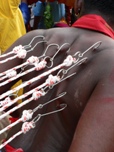
Moslems engaged in their pilgrimage or attending to their fast may think that their religious obedience makes an impression on God.

Yet religious sacrifice and devotion is all in vain. The true and living God is not impressed with acts of physical endurance or personal sacrifice. God is looking for faith, and only faith will please Him.

A tiny child who has faith brings far more delight to God than any acts of devotion. A man who is an invalid and incapable of performing religious acts, can please God more than any other, by his faith, not by his physical achievements.

God Enjoys the Impossible

In Otto Koening‘s message, “God Enjoys the Impossible”, he tells of a young boy who trusts God do restore boiled eggs which have broken open during cooking. The boy’s father, a non-Christian, personally told Otto of the miracle that happened when the boy trusted God to restore the eggs.

That boy, poor and powerless, pleased God. The boy trusted God. The boy walked in faith.

That’s what it’s all about. Faith is the thing. And only faith will please God.

Faith Factor 3 – Pleasure

No world religion empowers its adherents as Christianity does. Christians do much more than follow religious prescriptions, read a holy book and believe in a particular deity. Christians engage the reality of God into their lives with awesome, transforming impact. And the mechanism by which they do that is an on-going process called ‘faith’.

So what is faith and how does it work? What do we have to do to operate in more of it? How is faith built up and how do we see more results from employing it? I am now up to the third part of a series exploring faith and addressing these questions.

God’s Pleasure

I was surprised many years ago to see a particular word attached to the definition of faith that I had never considered before. I am using Hebrews 11:6 as my reference text for a definition of faith and that verse speaks about God’s pleasure.

“But without faith it is impossible to please him (God): for he that comes to God must believe that he is, and that he is a rewarder of them that diligently seek him.” Hebrews 11:6

My initial religious training made me think of man’s need to engage with God for man’s benefit: salvation. My evangelical roots pressed the argument that man needed to be saved and that could only be achieved by having faith in God.

So I was surprised when I actually stopped to take stock of what the Bible said about faith. I subconsciously expected the Bible to say, “without faith it is impossible to be saved”! But instead it said, “without faith it is impossible to please God”!

Wow! That was a complete turn around.

Pleasing God

Somehow I had come to see God’s person and sovereignty as so immense that man was absolutely insignificant to God’s consciousness. I don’t know where that came from, but I imbibed it at a very early age. I concluded that there was nothing man could do to influence God and that man was simply inconsequential in God’s grand scheme of things.

So, to discover that man had the personal power to bring pleasure to God came as a shock to me.

But take a look at what that verse says. “without faith it is IMPOSSIBLE to please God”. Faith not only gives humans the capacity to bring pleasure to God, but operating in faith is the ONLY way man can bring pleasure to God.

When I discovered that, my whole comprehension of what faith is and how mankind relates to God was expanded. I began to see a picture of God eagerly awaiting man’s faith-filled response to Him. Faith was not one-sided, giving man opportunity to enter God’s rescue plan, but a two-way relationship-building connection. Man’s response of faith not only brought benefit to man, but it fulfilled something of God’s wish for mankind, thus causing delight to God.

Win – Win

I began to see faith as a ‘Win-Win’ arrangement for man and God. Faith was no longer the self-seeking arm-twist that man could put on God, for man’s personal benefit. I now understood it as the mutually rewarding completion of a Father-Son interaction.

When I step out in faith I create a Win-Win situation. I win by accessing more of what God has for me. God wins by receiving the pleasure of a Father’s heart, seeing His child step into what He has created for me.

This previously unseen element of God’s pleasure made faith a much friendlier, relational quality within Christianity. It is a joy for me to move in faith, when I know that my faith brings delight to God.

As a child of God I am motivated to exercise faith as my gift to God. I can please Him. But I can only please Him by stepping out in faith.

Failure Pleases God

From the human perspective our actions are measured by the results they produce. If humans were to evaluate each other’s faith they would likely evaluate the ‘outcome’ of the faith. Faith that gets people healed, saved, delivered or otherwise changed in a measurable way gets the big ‘thumbs up’ from man.

But God is not pleased by the ‘output’ of faith or by the ‘results’ which faith generates. God is pleased with faith, pure and simple. When a person steps out in faith God is pleased. When a person chooses to trust God, in the face of all odds, God is pleased.

So, when a person trusts God, but everything falls apart, God is pleased. When a person steps out in faith and fails in all measurable human terms, GOD IS PLEASED! Even failure pleases God!

Now, isn’t that a radical idea?

Exhibit A – Moses

Don’t take my word for it that failure pleases God. Just take a look further on in Hebrews 11, the great ‘faith’ chapter of the Bible.

There we find many people being hailed for their faith. “By faith” this one did that and “By faith” that one did something else. There’s a whole chapter celebrating the heroes of faith.

So, take a look at what Hebrews 11 says about Moses fleeing from Egypt. Moses made a failed attempt to deliver some Israelites. But they rejected him and so Moses fled into the wilderness. Every time I read that account in Exodus 2 the clear impression is that Moses failed. Moses is seen fleeing with his tail between his legs, so to speak.

Yet in Hebrews 11:27 we have the same event described as if it was a triumphant moment of faith.

By faith he forsook Egypt, not fearing the wrath of the king: for he endured, as seeing him who is invisible.” Hebrews 11:27

Man would call that a failure. God calls it faith. And faith pleases God! So, Moses’ failure pleased God.

More Failures that Pleased God

Have a look at these other heroes of faith who ended up in ‘defeat’ in human terms, yet who are listed alongside those who won out in the end.

“And others had trial of cruel mockings and scourgings, yea, moreover of bonds and imprisonment: They were stoned, they were sawn in two, were tempted, were killed with the sword: they wandered about in sheepskins and goatskins; being destitute, afflicted, tormented” Hebrews 11:36,37

Does that sound like prime candidates for Christian Television or cover photos in Christian magazines? Absolutely not! They sound like a bunch of ‘losers’. Yet they are listed among the heroes of faith.

God was pleased with each one of those losers. They did not please God by getting a home run, or by clawing their way back to win the race. They lost. They died. They did not get the upper hand or win the day. They failed!

Please God

Faith is not about achieving a unique testimony to take you on the preaching trail. Faith is about pleasing God. God is pleased by your decision to trust Him. The outcome is far less relevant than you might think.

So, go ahead and please God. Get into the wonder of stepping out in faith in Him. Don’t get hung up by the outcome, but get excited about the privilege and opportunity you have to bring delight to the heart of your Heavenly Father.

Faith Factor 2 – Man

“All things are possible to him who believes” – Jesus Christ, Mark 9:23

And that’s what makes faith such a vital and powerful component of Christianity. Faith is the most powerful force available to ordinary people in every generation.

By faith lives are transformed. By faith miracles are performed. By faith impossible obstacles are removed. By faith whole nations are impacted. By faith “all things are possible”!

So what is faith? How does it work? How do we get more of it? How can we build our faith, use it more freely and see more of its fruit in our lives?

I began answering these questions in part one of this series, explaining that faith is anchored in the person of God. Now it’s time to look at man’s part in this thing called faith.

Fusion of God and Man

I discussed the ‘faith fusion’ in part one, explaining that faith brings together multiple elements of Christianity into one powerful, explosive package. This fusion brings together two polarities of Christian thought; God’s sovereignty and man’s responsibility.

Anyone who has delved into theological studies has been confronted by the passionate debate and polarising nature of Calvinism versus Arminian thought. In simplistic terms, Calvinism places great emphasis on the sovereignty of God, while Arminianism recognises man’s responsibility.

Without getting caught in the vortex of the debate, allow me to point out that the very defining verse on faith creates a fusion of those two, supposedly competitive concepts. While Hebrews 11:6 clearly gives weight to the person and character of God, as seen in part one, it also gives clear place to the part that man plays as well.

“But without faith it is impossible to please him (God): for he that comes to God must believe that he is, and that he is a rewarder of them that diligently seek him.” Hebrews 11:6

Man Believes

While God is all that He is and all that the Bible reveals Him to be, God’s almighty glory does not take effect in a person’s life until and unless that person believes. God is the ultimate and complete source of everything. But man must access God’s reality and grace, by man’s response to God. If man does not respond, then all the benefits of God’s reality, salvation, power and grace are lost to that person.

Unbelievers cannot engage faith. Faith is not a one-sided dynamic. Faith is anchored in who God is, but it is also activated by man’s response to the truth about God.

In fact, man is in a unique place to activate faith. We are told that the demons believe, but it does them no good. They believe “and tremble”.

“You believe that there is one God; you do well: the devils also believe, and tremble.” James 2:19

Man, however, gets a powerful result from believing.

“But as many as received him, to them gave he power to become the sons of God, even to them that believe on his name” John 1:12

Man Seeks

The key verse I am using to define faith (Hebrews 11:6) not only reveals that man believes, but it points to man also seeking God. Faith has confidence in God’s character to reward those who “diligently seek him“.

A person of faith becomes confident in who God is and that God’s character is to bless. That person becomes confident that seeking God brings positive outcomes and so they press in to Him, seeking Him and expecting Him to respond to their actions.

A person of faith has a high level of engagement in their relationship with God. They are not passively dependent on God, but actively pressing in to access the benefits which can only come from God. They are ‘actively’ dependent on God. God and man work in synergistic fusion to bring faith into play and to release the grace which God is keen to give.

So man has a double part to play. Man is not a pawn, nor a sidelined passenger in Christianity. Man must “live by faith”.

“Now the just shall live by faith: but if any man draw back, my soul shall have no pleasure in him.” Hebrews 10:38

God and Man

Christianity is a ‘relationship’. God is our Father. We are His children. God and man work together and are bonded together in salvation and in the new relationship which springs from it.

Faith is the sweetest energising of the bond between God and man. It is the lynchpin of the relationship. It initiates the union and energises the on-going relationship. Faith is a team effort, engaging God and man in mutually satisfying cooperation for the fulfilment of God’s Kingdom.

So man cannot engage in faith outside of intimate relationship with God. Faith is an expression of that relationship, not something that man can activate independently of God.

Yet faith is offered to man to operate. It is like a father providing a car for his son. The car belongs to the father, but the keys are passed to the son. In the fullness of intimacy between God and man, man is able to operate with all of God’s resources.

Boldness in Faith

Faith, then, is something which people should enter into confidently. We are to come to God with boldness, because faith is something God is keen for us to engage in.

“Let us therefore come boldly to the throne of grace, that we may obtain mercy, and find grace to help in time of need.” Hebrews 4:16

Fear of faith is out of place in Christianity. Christianity is a ‘faith’ which creates relationship, and it is relationship based on faith. Fear causes people to draw back, and drawing back is the opposite of faith.

Be encouraged that God wants you to step out in faith and to connect with Him in faith. He wants you to become completely confident in who He is and in His will to bless you, so that you will actively seek Him.

Be bold. Step into the presence of your holy God. Press in to know Him and to be knitted together with Him. As you do so you will be stepping into the arena of faith.

In ‘Faith Factor 3′ I will point out the imperative of faith.

Faith Factor 1 – God

God’s people are a miracle people. Christ works miracles in the lives and circumstances of those who trust Him. Faith, employed by Christians, is the most powerful force available to ordinary people in every generation.

So what is faith? How does it work? How do we get more of it? How can we build our faith so we use it more freely and see more of its fruit in our lives? These are the questions which I am addressing in this series.

Christianity is Faith

Christianity is based on Faith. Christianity is a “faith” rather than a religion. Christianity is more than just faith in and reliance on a set of religious writings and religious beliefs. It is activated and empowered by the active faith of its adherents.

Christians are called “believers”, because they cannot be Christians unless belief (faith) has been involved. You cannot inherit Christianity. You cannot have it given to you by someone else. Each individual Christian must have a faith experience, or they are not truly Christian.

Faith at Work

But Christianity does not just engage a person’s faith when they embrace Christianity. Faith goes far past any initiation into Christianity. In fact, the Bible repeatedly states the godly people must live a faith lifestyle.

“For therein is the righteousness of God revealed from faith to faith: as it is written, The just shall live by faith.” Romans 1:17

Faith is at work in the believer’s life for the whole of their life. And it is that on-going presence of faith in the believer’s life that I am concerned about in this series. Everything I describe here will be relevant to the initial belief in Jesus Christ as our Saviour and Lord, which brings a person into the amazing relationship with God as Father and that is a vital component of being Christian. But my focus is not in that initiation faith. I want to encourage Christians to turbo-charge, energize and accelerate their daily life of faith.

The Faith Fusion

Faith at work is a remarkable and exciting reality which brings to life the whole gamut of Christian experience. It is the powerhouse of Christianity and it moves heaven and earth.

Faith is an amazing fusion of the whole counsel of scripture into a dynamic working structure that produces results.

Faith being put to work is like the bringing together of elements for a nuclear reaction. My father told me of a man who would demonstrate radioactive reaction through a mechanical device which brought two radioactive objects close to each other. The objects would begin to glow, to the amazement of his audience.

Having all the pieces on the bench is not enough. When they are brought together in appropriate fusion there is an output which is awesome in its power and effect.

Faith is the process of activating the various components of Christian truth so that the fusion results in release of the power and impact latent within those truths.

Factor One is God

My favourite definition of faith is given in Hebrews 11:6. This definition places God on the throne of faith. Faith is not a toy which people can use for their own convenience. Faith is not some divine power which God has allowed humans to use as they will. Faith is not placed in ‘faith’, as a magical process in itself.

Faith is anchored, centred, focused, energised, made real and only ever relevant to God, Himself!

I have met people who have ‘faith in faith’. I have heard preachers who speak of faith as if it was a tool of the gods stolen by man. I have seen people try to work up their faith, accuse others of not having enough faith, pump up faith in order to get something they want, and otherwise abuse the whole reality of a life of faith.

But God is the principle factor in faith. Hebrews 11:6 settles that for us.

“But without faith it is impossible to please him (God): for he that comes to God must believe that he is, and that he is a rewarder of them that diligently seek him.” Hebrews 11:6

God is God

The basis for faith is the reality of the God who is God. Almighty God, the Father of our Lord Jesus Christ, creator of the universe, Lord of all, God of all gods, is the only one who can make the miracle difference in our lives. His love, power, grace, wisdom, purpose and awesome reality surpass everything else.

Faith is only faith when it is anchored in the person of Almighty God.

So, let’s see that in Hebrews 11:6. Faith pleases God. The reason faith always pleases God is that faith is anchored in the reality of God’s existence. Those who come to God “must believe that He IS“. We must believe Him to be who He is. God’s “existence” is the foundation of faith.

That’s why faith in faith is folly. True faith is not anchored in faith as some kind of supernatural force. Nor is it anchored in the heart and mind or the believer. Faith is not a secret weapon in the hands of people, but an extension of God’s personal reality.

Faith Factor #1 is God. God is God! God is who the Bible says He is. God is everything He says He is, despite all evidence to the contrary. Faith is the act of confidently believing that.

God is Good

The second truth anchored in God is His character. God is a good God! God is a God who blesses. God is a God of grace.

It is not sufficient to believe that God is powerful, great, awesome, incomparable, all knowing, all glorious and so on. We must also believe in His character as a Good God.

This confidence in God’s goodness is summarised in Hebrews 11:6 in the reference to God as a “rewarder of them that diligently seek Him”. God is a ‘rewarder’. God is not vicious, malicious, capricious, deleterious or any other negative “-ious”.

Again we see that Faith Factor #1 is God. God’s person, existence, reality as the one who He reveals Himself to be in the Bible is the first element. The second is that God’s character is loving, gracious and keen to bless. Faith is built on these two revelations of who God is.

Again we see that faith is not centred in man, nor is it an independent spiritual force or tool. Faith is an outworking of our revelation of who God is. To know God is to love Him, and to know God is to be encouraged in faith to rely on Him, for salvation, deliverance, help in time of need and every good gift that He has prepared for us.

Faith in God

Faith at work is faith in God. Any other expression of ‘faith’ is beggarly in comparison to the miracles that spring from our confidence in God.

If you want to build your faith then extend your contact with God. Dive into God’s Word. Be filled with God’s Spirit. Walk under the Lordship of Christ. Seek God. Meet with Him. Get to know Him for who He is. Share with His children. Meditate on His Word, the Bible. Listen to preaching from those who know and love Him.

Since faith is anchored in who God is then the best thing you can do for your faith is to meet with God. Remember that to know God is to love Him and to know God is to readily trust in Him.

In ‘Faith Factor 2′ I will show you that man does have a part to play. Then we can move on to activating faith for good outcomes.