Social Collapse

It has been said that society is held together by a thin veneer. Recent history reveals that supposedly civilised and sophisticated societies are able to dissolve and disintegrate into social collapse.

So, what is it that causes such social dissolution? What is it that holds societies together, so they don’t collapse? How can we best protect our own society from unravelling under duress?

Outrage and Opportunism

The six days of rioting and looting in Los Angeles, incited by violence against a helpless black American, shocked the world, back in 1992. Images of people looting shops, running rampant in the streets, damaging their own social infrastructure and creating mayhem seemed completely out of place in American society. 13 people were killed in those riots and 192 were injured.
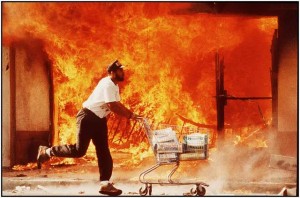
race riots LA

That event and others like it involved two overt elements. The uprising was sparked by outrage. The local community was outraged that one of their own people was treated so badly. Outrage fed opportunism. The emotion that prompted people to react opened for them the opportunity to loot and steal, vent their anger in destructive ways, and indulge their passions without restraint.

While other factors were doubtless involved, the combination of outrage and opportunism, unrestrained reaction and unrestrained greed, quickly prompted social collapse.

Deprivation

We also see examples of deprivation leading to social decline and ultimate collapse. I recently heard a chap from Cuba reflect on the impact of continued and chronic deprivation of the most basic resources. One day he returned home from a store rejoicing that he was actually able to buy toilet paper for the first time in many months. He looked at his purchase, realised how absurd his excitement was and thought, “What have I been reduced to?”

Continued deprivation of basic elements of life “reduces” people to their baser instincts. Competition becomes fiercer. Small gains, which are inconsequential under normal circumstances, become huge personal victories in the distorted thinking of a person under duress.

Societies have dissolved into social jungles where each person relied on their animal instincts and wits to survive. People have betrayed their own family members, distrust has become the norm, exploitation has become the expected thing and there have been no bounds to what one might do to another.

Civility Dissolved

In the Bible, God warned His people that if they rejected Him He would put them under such duress in famine that they would eat their own children. Even the most delicate and inoffensive person would be reduced to lying and murder, without any care for their own children or family.

“And you will eat the flesh of your sons and daughters, in the siege and restriction with which your enemies will distress you: So that the tender and very delicate man among you will have an evil eye toward his brother, wife and his remaining children: So he will not give them any of the flesh of his children whom he will eat.” Deuteronomy 28:53-55

Imagine a situation where perfectly tender and delicate people become jealous and selfish in eating their own children and keeping the flesh from the rest of their family. It is an ugly suggestion. It occurs when all sense of civility is dissolved and people are reduced to animal instincts.

Fear and Betrayal

We have seen under Communist oppression and in situations of despotic rulers, that fear and betrayal have become the rule of daily life. I recall a friend telling me that when they escaped from Albania, many years ago, their mother did not even tell her husband what her plans were, because she could not trust him.

The mother and children escaped across a lake to Macedonia. The father’s ignorance of their plans not only spared them from potential betrayal, but allowed the father to protest to the authorities that he truly had no idea of the plan.

Under situations of political oppression people prove willing to condemn their friends and family. They betray those who care for them. They live in fear of betrayal. Trusted friends become enemies. Social norms dissolve to fearful and treacherous living.

Hierarchy of Needs

Abraham Maslow proposed his hierarchy of needs in 1943, where people who are more provided for are expected to become more thoughtful and altruistic. While this is a nice idea, it reduces people to mere respondents to socio-economic conditions. However, the human heart operates independently of our level of provision.
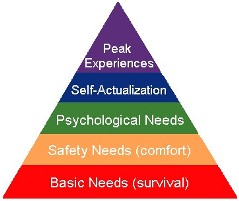
Maslow Hierarchy of Needs

Rich and well provided for people are perfectly able to act in totally selfish and exploitative fashion. Evil continues to be perpetrated, even in the most well provisioned societies.

Similarly, not all people who are deprived become full of fear or treachery. The matter is not one of provision, but of the heart of the people involved. While deprivation brings out the worst in people, it is not true that all people have evil waiting to surface.

The Resilient Jesus Christ

True nobility of spirit brings us to a place where we do not respond differently, no matter what circumstances we endure. The Apostle Paul said of himself, “I know how to be abased and how to abound”.

I know both how to be abased, and I know how to abound: every where and in all things I am instructed both to be full and to be hungry, both to abound and to suffer need.” Philippians 4:12

Paul’s role model was Jesus Christ. Jesus was persecuted, victimised, tortured, falsely accused and then killed, yet without any dissolving of His person or His divine purpose. When He was reviled He did not respond with a retort.

“….. Christ also suffered for us, leaving us an example, that you should follow his steps ….

Who, when he was reviled, reviled not again; when he suffered, he threatened not; but committed himself to him that judges righteously” 1Peter 2:21,23

Independent of Evil

Sadly, most people come under the power and oppression of the evil that is imposed on them. When people are hurt, they are inclined to hurt others. When people are accused, they are likely to accuse others. When people are deprived, they are likely to be jealous of and evil toward those who have what they want.

Yet the Apostle Paul, the follower of the example of Jesus Christ, taught us to live independently of the evil which is projected against us. We are not to be overcome by evil.

Be not overcome by evil, but overcome evil with good.” Romans 12:21

Having a right heart attitude enables us to be independent of the evil which surrounds us or which is inflicted upon us.

Back of the Bus

I once heard a gracious, elderly black American speaking about the days of discrimination. Some of his friends were agitating out of anger toward the white communities. His response amazed me. He said, “Jesus Christ would have been happy in the back of the bus, so why can’t I be happy there too?”

While some of his friends were being overcome by anger, vengeance and similar passions, feeding into a spirit of rebellion and violence, this man was able to endure the same oppressions without being overcome by the evil.

Purify My Heart

I hardly know the meaning of duress. I live in privilege compared to the situations which confront most others in the world. So I don’t want to sound pious. I have no real idea what true oppression is like for those living under it.

I know that when I am under what we spoilt westerners call duress, being overly tired, having my plans frustrated, being put under performance pressure that is more than normal, then my patience wears thin. I become less tolerant, more frustrated, more selfish for my own needs, and so on.

I expect that evil would overcome me much more readily than I want it to. So I need the Lord to purify my heart. And you need the Lord to purify yours, too.

“Lord, we ask You to purify our hearts, so we can live independent of the evil which is pushed upon us. We are weak, but You are strong. Keep us and preserve us from all that’s wrong. Deliver us from evil. Deliver us from the evil which comes against us from outside ourselves, and deliver us from the evil which springs up within us from time to time. Create in us clean hearts, that will serve and worship You, no matter what. We ask this in Jesus’ powerful name. Amen.”
The World’s Greatest Scam – Video

You have been SCAMMED by the most deadly trick on the planet. And you probably don’t realise what has happened.

This isn’t about Money, or about your career, marriage or self-image. It runs much deeper than that. And it has trapped everyone! Guaranteed!

This short video explains the situation simply, clearly and with authority. So make sure you watch it and send it on to your friends – because they’ve been scammed too!

Ps Chris has written an article about The Greatest Scam which you can read, print and forward to your friends. You’ll find that article at: http://chrisfieldblog.com/ministry/greatest-scam

Lost in the Rush of Life

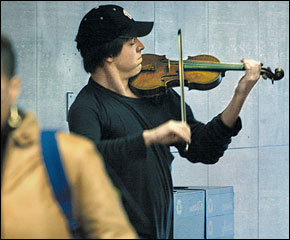
Here is an interesting account of something that should make you think. It’s about a busker at the Washington DC Metro Station, playing his violin to a rush-hour crowd at around 8am on a Friday morning. The date is January 12, 2007.

The violinist played for about 43 minutes, performing six classical pieces by Bach. A total of almost 1,100 people passed him by during those minutes. Many others would have heard the sound of his playing as it echoed through the subway corridors. They were almost all on their way to work.

joshua bell Washington subway

This is an account of those who paid him any attention. After 3 minutes a middle-aged man noticed there was a musician playing. He slowed his pace and stopped for a few seconds and then hurried to meet his schedule.

4 minutes later the violinist received his first dollar when a woman threw money in the hat and, without stopping, continued to walk. The musician had already placed some money in view, to encourage contributions from others.

Soon after a young man leaned against the wall to listen to him, then looked at his watch and started to walk again.

After 10 minutes, during what was arguably one of the most difficult pieces for a violinist to master, a 3-year old boy stopped but his mother tugged him along hurriedly. The kid stopped again to look at the violinist, but the mother pushed hard and the child continued to walk, turning his head all the time. This response was repeated by several other children. And every parent, without exception, similarly forced their child to move on quickly.

For 43 minutes the musician played continuously, moving from one piece to the next. Only 6 people stopped and listened, and each only for a short while. About 20 gave money but continued to walk at their normal pace. The man collected a total of $32.

When he had finished the normal subway sounds took their usual place of prominence. No one noticed. No one applauded, nor was there any recognition.

What the passers-by did not know was that the violinist was Joshua Bell, one of the greatest musicians in the world. He played one of the most intricate pieces ever written, with a violin valued at $3.5 million dollars. Two days before, Joshua Bell sold out a theatre in Boston where the price of seats averaged $100.

Joshua Bell was a child prodigy. His psychologist parents decided to start formal violin training for their son when he was only four years old. They were prompted to this when they saw that their son had strung rubber bands across his dresser drawers and was replicating classical tunes by ear, moving drawers in and out to vary the pitch.

And “Yes” the subway concert really did happen. It was organised by the Washington Post, as an experiment to see whether people would appreciate the highest quality musical experience if they came upon it unexpectedly. It was part of a social experiment about perception, taste and people’s priorities. Do we perceive beauty when we encounter it in a commonplace context at an inopportune time? If we do come upon it, do we stop to appreciate it?

The response of the Washington crowd prompts the question, “If so many people can so easily ignore such excellence, not even taking a moment to stop and listen to one of the best musicians in the world, playing some of the finest music ever written, with one of the most beautiful instruments ever made, then what else are most of us missing every day?”

If your day is looking a little dull today, take a moment to slow down and smell the roses, feel the breeze, enjoy the sunshine, smile at others, and appreciate the efforts of those around you.

Logophile on Law

Law is a word that fools us. Since law has serious impact on our lives we need to understand the term and how to use it properly. Importantly, we need to be aware of how it is used against us.

Some people come under the penalty of law, when the “law” used against them was not a “law” at all. You are most likely fooled by the use of “law”. So it is important that you understand the word, how it is used and what implications it has in your life.

Law is a Vague Term

Some words are used in multiple applications, with different meanings. A young woman tells her infant brother that she wishes to marry a man because she ‘loves’ him. The infant then replies that he is going to marry chocolate, because he ‘loves’ chocolate.

Love is used so broadly that its technical meaning varies in different situations. You can love sport while sport is not the love of your life. You can love your spouse, but also love getting away on your own.

The ancient Greeks used several different words for our English word ‘love’, differentiating between: attraction to the appearance of a thing; humanitarian or family concern; sexual attraction; and sacrificial commitment for the good of others.

Law is similarly a vague term. It refers to such unchangeable things as the laws of nature, but also to such changeable things as the rules of a club.

It’s the Law

When someone informs you that something “is the Law!” you can be misled as to their meaning. What type of ‘law’ is it? Who made that law? By what is it enforced? What are the consequences of breaking that law? Who is bound by that law?

Many things are the ‘law’ and have profound consequences for some people, yet can be completely ignored by others. Just because something is “the law” doesn’t mean most of us have to give any credence whatsoever. The trick is to know what is ‘law’ and what is ‘law’. That is, we need to differentiate between one law and another.

Others May but I May Not

A police officer is bound by more laws than the average citizen. Anyone who has sworn an oath of office, taking on special responsibility, is under stricter controls than normal citizens. For example, ordinary citizens are not bound by law to give their name to a police officer, but a police officer must give his name to any citizen who asks for it.

Lawyers and Barristers have sworn special allegiance to the courts, in order to be allowed to deal with the special legal matters of the court. So an ordinary citizen has much greater freedom in a court of law than their legal team does.

It is a case of “others may, but I may not”. Others may ignore the instructions or demands of a judge, but a barrister does not have that privilege. Others may ignore the demands of a police officer (under certain circumstances) but a police officer may not ignore the demands made of him or her.

Categories of Laws

Here are some of the various types of law that impact you in your normal life. There is Divine Law, Natural Law, Common Law, Imperial Law, Constitutional Law, Statute Law, Local By-Laws, Club Rules and House Rules. There are also such laws as the Laws of Nature, Maritime Law, Contract Law and International Law.

Divine Law involves mankind’s moral accountability to the Creator, who is the ultimate moral being and who holds all people accountable against His own moral standards. Such laws as the Ten Commandments and the teachings of Jesus Christ convey man’s moral responsibility to God’s Law.

Natural Law involves the natural rights and responsibilities which attend natural existence. Such things as the right to self-defence and the right to maintain and sustain life are included here.

Human Legality

While Divine and Natural Law seem to be the most basic foundation for law, they are not man-made, but spring from either the nature of our existence or the One who created us. So the next areas of ancient law (Common Law and Imperial Law) represent the early expressions of human law which have passed to many nations.

Common Law is the body of laws which developed in England over centuries, where God’s Law, especially as expressed in the Book of Deuteronomy, was applied to situations and codified into a body of rights and responsibilities. Common Law is principally focussed on limiting people’s impact on others (no murder, injury or theft) and making people accountable for their own actions (bound by their promises).

Imperial Law involves all the laws of English monarchs, which further codified Biblical, Natural and Common Law into principles by which due legal process is to be applied. Such documents as the Magna Carta from over 700 years ago are still upheld as foundations for legal practice and principle followed today. Most English speaking and former British Empire nations have ratified their continued reliance on Imperial Law. Imperial Laws have not decayed with time, but are enduring elements of what is law and lawful today.

Modern Law

While all those laws mentioned so far are perfectly modern in their validity, most unlearned citizens think of them as somehow outmoded and not relevant today. Modern people think of their nation’s constitution and the government-enacted laws (statutes) as modern law.

Constitutional Law involves that body of law which is created to define a nation and how it will operate, politically and legally. Many nations have a constitution: that which constitutes (brings together) the nation itself. All of the parts are the constituents. All legal and political practice within the nation has to be based on the law that “constitutes” (or creates) the nation.

Statute Law involves all those “laws” which are created by governments. Once a nation has been constituted (via its Constitution) its elected or appointed officials may need to create the Rules for the effective operation of the nation. Those “laws” are actually “statutes”. They are rules which are given the force of law, and are generally treated as equal to those higher laws upon which the government has been founded. Statutes are binding upon the members of the club or society which created them.

Local Law involves those rules which are created by local councils, regional administrations, clubs (for their members), social organisations, etc. For example: a student at one school is told that he must wear a particular uniform on certain days. But that localised rule, while effectively the “law” for some students, has absolutely no hold over students attending a different school. One local council may prohibit the lighting of fires in people’s yards, while the neighbouring city might encourage such fires. Local laws only apply to those who are bound by them, by membership of some group or other.

Question The Law

Which laws apply to you? If other people create a rule for them and their club, does that have any hold over you? Is the law being applied to you a Divine moral responsibility, or is it simply a statute made up to facilitate social order?

Is the law that is being pressed upon you really a law at all? If a local or statute law is against the higher laws on which they stand, then can it be a lawful law at all?

Can a government morally uphold a law that rejects or breaks God’s Law? Can a local or state government legally create a law that violates that nation’s Constitution?

When someone tells you “It’s the Law”, what do they really mean? It may be “law” for them, but is it law for you? If two laws contradict each other, which law should you obey?

A Lawful Mind

The information and questions in this lesson are to prompt you to know where you stand before the law and how you should respond to the laws you are told to obey. I want you to have a deeper and richer understanding of the law than many of those around you who say, “It’s the Law!”

Give these matters some serious thought and seek to develop a wise and lawful mind.

Rejection 16 – Cut Off Source of Hurt

The fourth response to rejection which I identify in victims is their choice to cut off the source of their hurt. This is an extension of the previous lesson, where rejected people distance themselves from certain people or type of people who have contributed to their pain. This lesson looks at the broader situation where a rejected person will create distance from the process or situation where they previously suffered.

Fight or Flight

If a wild animal hurt you it is natural for you to flee. You must either fight or take flight. Running away from trouble is a logical protective process.

In the same way, people who suffer rejection, at the hands of other people, either have to fight those people or take flight. It is not easy to fight those you want to love you. And it is not possible to fight such things as school systems, family networks or the like.

So the picture I created to represent cutting off the source of hurt shows a young rejected person hurrying away from a collection of things: school, piano, sport and their aunt Sally. I will explain why I chose those items during this lesson.

I’ll Never Do That Again

As a young lad in the school yard I watched a group of boys playing cricket. Unexpectedly one of the boys asked me if I wanted to bowl the ball. I had never played cricket before and may never have seen the game before. My father thought it to be a silly game and never encouraged an interest in sport.

I took the ball and threw it toward the boy holding the bat, as I had just seen others doing.

Immediately one of the other players derided me with his scorning remark, “That’s not a bowl, it’s a chuck!” To translate that, he was saying that I had failed to propel the ball by the approved, stiff-arm, over the shoulder means, known as ‘bowling’ the ball, but had simply propelled it as a child might throw a stone, for which term the colloquial word ‘chuck’ was amply descriptive.

Realising that I had done the wrong thing and had earned unexpected and unwanted scorn from boys I did not even know, I decided that I had insufficient interest in the sport to do anything but walk away. The boys were intent on their game and someone else was found to bowl the ball in the correct cricket manner. Unnoticed, I stepped away and decided, “I’ll never do that again”.

Choices

My childish choice was motivated by a sense of offence and rejection, at the hands of those who deemed themselves qualified to scorn others. My tender, boyish spirit had been offended. I was unprepared for being placed in a position of unwanted scorn. Clearly there was much that I needed to learn to be able to engage in the process of playing cricket without risking further unwanted rebuke, and my level of fascination with the game did not draw me to navigating that level of risk.

Simply put, I was hurt by an attempt to play cricket and so I walked away from the game. I never again took interest in the sport, until my own sons induced me to join in their back-yard game. And guess which part of the process I found the most daunting. Bowling the ball is the one thing which I was most sensitive about.

That is metaphoric of the whole process of cutting off the source of our hurt. When we are offended by some process or other we instinctively choose to avoid it and the unwanted negatives that flow to us from it.

I Hate School

Consider the situation of a child who is embarrassed by a school teacher. Maybe they are asked to answer a question or read out loud, and their wrong answer or some other issue causes the teacher or students to react, snicker, rebuke or otherwise respond in an unwanted manner.

If a child feels offended by their experience at school, either in the classroom or the playground, they can decide that they will avoid it. They may announce to their parents that, “I hate school!” They may tell their mum that they want to stay home. They may cry when taken to school and plead with their parents that they want to stay home. Such reactions are common.

Parents usually assume that they have no alternative but to force their child to go. They also believe that the child dealing with their reluctance is a process of maturity. So, in the main, children who are feeling offended and hurt by school are forced to go back again and again and face their hurt and fears.

Note that many children who skip school, or who miss certain classes, may well be carrying the pain of rejection and wishing to avoid the source of some of that pain.

The Piano and Aunty Sally

Consider the situation where a child who is learning to play the piano is asked to play a piece of music for Aunt Sally, who is visiting. The child, insecure about their talents and unfamiliar with playing for an audience, displays reluctance. The mother, however, wants to show off her child’s progress so she forces little Johnny to play his piece.

Johnny is already off-side, feeling vulnerable and afraid. As he plays his piece he makes a few mistakes and Aunty Sally seems to smile, snicker, or respond in a way that feels like an offence to the boy. He springs from the piano stool and runs out of the room. As he goes he says to himself, “I’ll never let my self get into such a situation again!”

From then on, Johnny loses all heart for playing the piano. It is a source of hurt for him. If he is forced to play he does so as if under sufferance. If he can get out of it, he will. And every time Aunty Sally comes to visit he runs and hides, goes on an errand, visits a friend, or otherwise gets out of the way.

He might even hold deep resentment toward his mum, for forcing him into a situation where he could suffer pain.

In all of that he is cutting off the source of hurt.

Pruning Your Life

Each time someone cuts something off, because it is a source of hurt they wish to avoid, they end up pruning their life. Some people, therefore, have greatly limited their whole life experience.

Some people avoid any situation where they will be asked to speak in public. Others avoid situations where they will be given responsibility. Others cut off any idea of performing in public. Others avoid situations where they must use maths, sing out loud, have the spotlight (even for just a moment or two), display physical strength, compete with anyone, do an exam, and so on.

Some people have remained single after being jilted. Some have dropped out of sport, academics, business, and the like, after a public humiliation. Some people avoid church, because they were made to feel foolish or unwanted there.

What have you pruned out of your life? Imagine how wonderful life could be if you could happily and freely bring back into your experience all those things which you have pruned out of your life.

An Open Door

Your healing from rejection is an open door to new horizons, new opportunities, new experiences, new scope, and the recovery of many things you thought you could never possess in this life.

I encourage you to find the freedom which God has for you, through His love, Christ’s sacrifice and the Holy Spirit’s anointing in your life.

Rise and be healed, in the name of Jesus!