Intercession Explained 2

Intercession is a powerful and valuable expression of prayer ministry that has its own unique and wonderful place in ministering to the needy.

In part 1 of this series I opened the subject for you, and in this lesson I will move into the explanation of what Intercession is.

We have already seen that some people find a sense of burdening coming upon them at times when they pray. This can be emotional feelings, deep inner perceptions and physical responses within their body. The person is not sensing these things on their own behalf, but on behalf of someone else who is in need.

When this burden comes upon them, placed there by the Holy Spirit, the intercessor will pray with fervour and intensity, pushing through the barrier and resolving the sense of burden that has come upon them. Once they have done so a feeling of relief and going back to normal settles upon them.

So, What is Intercession?

I see Intercession as having three components. It is firstly the ‘making of a petition’, or pleading on someone else’s behalf. So, a person could write a letter to an employer, on behalf of someone else, pleading with the employer to consider the special needs of the person being interceded for.

When ever someone pleads on behalf of someone else, that could be identified as intercession.

At the same time intercession carries the idea of ‘identification’. The person writing on behalf of a friend is identifying with and feeling concern for the situation of their friend.

Thirdly, intercession involves one party ‘acting on behalf of another’. Not only do they identify with the burden, but they use their own position, authority, voice, strength or wit to lend aid to the one who is burdened.

Often people who are helpless appeal to those who have better standing than them to act on their behalf. When someone does that they are acting as an intercessor, making intercession.

The Intercession Process

I picture the intercession process as starting with a person who is stooped over and weighed down with a burden. That burden could be fear, grief, shame, sickness, debt, obligation, insecurity, or whatever.

An intercessor comes along and identifies with that burden, by stooping down to stand alongside the burdened person under their load. Now, the intercessor is not personally burdened by the same fear, grief, or whatever. But they tune in to that burden, as it were.

Then the intercessor allows the weight of that burden to be taken on their own shoulders, so the person who had the burden is relieved. As the intercessor shoulders the burden the other person is able to stand tall, stretch and feel the joy of relief.

Temporary intercession would result in some relief to the burdened person, before they carried their load again. While that is not as good as total freedom, it is better than no relief at all.

Alternatively, the intercessor could carry off the burden so that the person is permanently set free from its load. However, if the intercessor was then permanently burdened there would not be the victory which the Holy Spirit wants to bring, through Christ’s finished work.

Ideally the intercessor, being stronger in spirit and with the Holy Spirit’s anointing, will not only shoulder the load, freeing the burdened person, but have the spiritual might to totally destroy and throw off the burden completely.

Christ the Intercessor

Our best example of Intercession is Jesus Christ and His work for us on the Cross.

Mankind is burdened by sin and the death penalty which comes from our sinfulness. Jesus became human, identifying with us and our situation. He then, on the cross, took all of our burdens upon Himself, so we could become totally free from sin and death.

Jesus then defeated sin and death, throwing them off and coming back to life. He defeated the devil, sin, death and all the evil which attacks us. He went through the whole process I described earlier in the Intercession Process. And now we can live completely free from sin, death and hell.

An Ideal Example

Back in 1980, in New Zealand, a young man I was encouraging in his ministry came to me to share his first experience of Intercession. Mal was a ‘no-holds-barred’ enthusiastic Christian who jumped in and did what he felt impressed to do, without needing to understand what was going on. It was great to see his faith in action, although at times he seemed to be living dangerously.

He excitedly shared with me that he was entering into the ministry of healing people’s inner lives which he had seen me do. What he actually stepped into was powerful intercession.

The Baptist Pastor at Te Puke asked Mal to assist him in praying for a woman who had breakdowns at the same time each year. As the three began praying in the woman’s home Mal prayed in tongues (praying in the Holy Spirit) for a while, then felt an incredible burden come on him. He continued praying as he wept and struggled with intense feelings. Then the intensity turned to a feeling of delight and freedom.

The lady explained that as they started praying she saw in her imagination a baby in a darkened room, desperately crying for the attention of the adults whose voices could be heard through a closed door. The woman felt the agony of the baby and realised it was a vision of her as an infant. She also realised that the sound of a baby crying always accompanied her times of breakdown.

She then told Mal, “When you became emotional something wonderful happened”. She saw the door open and Jesus walk to the crying baby. He picked the baby up and cradled it in His arms. As He did so the woman felt pain and tension drain out of her body until she felt a wonderful release and peace.

Analyse This

The woman was under a burden of personal pain that went back to her infancy. It may have been rejection, but we don’t have a label for it. When a burden of intercession came upon Mal, the Holy Spirit released a healing process into the woman’s life, as Mal carried the pain for a season.

The ministry of the Spirit brought to the woman a revelation of the source of her problem and also revealed Jesus as the healer of that situation. Once the prayer process was over there was no more burden being carried. Mal only shouldered it temporarily and the woman was able to be free from pains she had carried all her life.

Note that Mal did not know the effect of his praying. He simply allowed himself to be moved by the Holy Spirit. Only when the lady explained what she was seeing could Mal have known the effect of his prayers.

The Baptist pastor said, “I’ve never seen anything like this ever before”. He probably thought Mal was a spiritual wonder-worker, but Mal was way out of his depth, just going with what the Holy Spirit led him to do.

Rees Howells

The book, Rees Howells Intercessor, about this great man of prayer from mid last century is a wonderful example of a man identifying with others and then having great impact in prayer.

His experience and example are a mixture of a burden to identify with the needy, and the development of a small group of prayer warriors who received prophetic guidance in their prayers. You will find it a great encouragement to spirit-led praying.

Release of Intercession

In the lovely and powerful name of Jesus Christ I release a spirit of intercession upon the body of Christ and upon those reading this, so that the supernatural ability to bear one another’s burdens becomes abundant in the Body of Christ, so God’s Kingdom will come and His will be done in the earth as it is in heaven.

To see the first part of this study on Intercession go to the following link …..

http://chrisfieldblog.com/ministry/intercession-1

Ghost Driver 4

The Ghost Driver carriage returned much sooner than anyone expected.

Maddened drivers raged upon each other and bullied for the reins, but each was powerless to take charge. Stubbornly the wagon made its haltering way toward a modest cottage nestled in a valley. A determined face pushed it on with the force of her own insistence.

As the horses stamped their uncomfortable presence a woman stepped from the carriage and stood, looking at the humble home. A woman stepped from the threshold and reached out her arms toward the visitor.

Tears streamed down both faces, but both were frozen in place. The younger woman turned her face away, struggling with internal torments of unbearable potency.

“You have come.” The older woman spoke, to break the spell of their meeting.

“She is dead.” The young woman measured her tears, as remorse, pain and anger fought for ascendancy within her. “She was thrown from the carriage in a wild moment and dashed to pieces under the hooves of these dreadful horses.”

The woman moved quickly from the cottage and embraced the stiffened body of the beautiful young visitor. “I’m so sorry”, she soothed.

“I am not”, the younger replied. “I hated her.”

“But she is your Mother!” The older woman urged.

“She was never a mother to me.” The words were bitter and pained. “She lived only for herself and did not care what I suffered under her wild will. She was never a mother to me. Never!” There were no tears with this, but cold hardness of heart.

“Well, now you are free.”

“No. I am not free. These wild urges surge in me more powerfully than ever. They have lost their slave and are determined to own me more than they ever owned her.”

“But that’s alright. We can help you get freedom.” The tone was filled with promise.

The visitor stood stiff, struggling with surging internal currents. “I do not want to forgive her. Hating her makes me feel better. And I don’t want to give up my will. I am afraid of being mocked as a servant to others. I like being admired and envied. Part of me wants to taunt others and prove that I am right. If I give up all this, I will face unbearable shame.”

The woman gently led the stunned guest toward the cottage, speaking tenderly as she did. “But you desperately want to be loved, don’t you.”

At this the visitor wept freely. She did desperately want to be loved and valued and cherished and be appreciated for more than her seductive beauty or painted eyes. She wanted the freedom to be as plain as a country servant and yet to be loved none-the-less. Her life as a raging beauty had never brought her such treasures.

Moments later the guest dropped hot tears into the mug of tea in her trembling hands. The warmth of the country kitchen and the sounds of children singing as they were busy with their chores invoked senses which were as intoxicating as they were foreign to her. This reality affirmed a expectation deep within her that such things must exist.

“You can stay with us, if you like. My son will deal with the horses and the carriage. He has done it before, for others. We can guide you and help you cut all the cords that enslave you. You can be as free as a bird and as whole on the inside as you could ever imagine.”

The woman’s motherly care was welcome, but uncertainties stormed against the situation now before the young woman. Could she endure such a change of her whole existence?

Through the window she watched a young man approach the horses, whip in hand. He was cautious, but not afraid. He spoke to them and presented the large whip to their view. They pulled back from him, but he held them from rearing up as they were wont to do. After a long and painstaking process they were led to take steps under the man’s direction. When unseen hands lifted another whip and phantom voices raised a cry of protest, the man simply stared them down until they were silent.

Finally the carriage was drawn into a yard and the horses tethered there. This was not the end of the process, but just the beginning, but a good start had now been made.

The young woman slumped into a chair and wept freely. Hope stepped one pace closer in her chest.

Thus began a long and wonderful season that would lead to a young woman shining with double beauty. She would one day display the beauty of her natural features and the richer beauty of a yielded spirit.

But that day was not to come without many a struggle, within the woman’s heart and between her and those who loved her. They would be tested and drained by the process, but their compassion for her would bring them through.

When the young man entered the room and slipped his woollen cap from his head the young guest nodded to him. He looked upon her differently to the way other men did. And immediately she was stirred. Something inside her demanded that she have alluring power over such males and one of her first struggles began right there.

Romantics speculate at this point that the young man and young woman made a lovely couple in due time. But that is to be distracted. The story is not about romance, but about Freedom. Don’t be distracted by emotional excursions when far more important matters are afoot.

The “Happily Ever After” sentiment of the Fairy Story cheats us of life’s reality. Life is not achieved by a romantic ending to a story, but by godly wisdom applied on a daily basis to challenges which mature us and deepen our grip on God and His grip on us.

So, as you make your own journey from here keep an ear attuned to the cry of Ghost Drivers who have already gained a hold on you or who come along with the promise of gain, so they can drive you at their will. Refuse the “Cumalongnow” call of the tormentors and prepare yourself for the “Come up here” call of the Lord, taking you into His presence.

To read the earlier instalments in this important story of slavery and freedom click the following links:

Part One: http://chrisfieldblog.com/ministry/ghost-driver

Part Two: http://chrisfieldblog.com/ministry/ghost-driver-2

Part Three: http://chrisfieldblog.com/ministry/ghost-driver-3

Rejection 12 – Insecurity

It is no surprise that people who have been rejected struggle with feelings of insecurity. While not all become devastated and jelly-like throughout their life, their confidence is undermined and they will likely struggle at times with uncertainty about what life may deal to them and how they will cope.

The Earth Moved

I remember the first time I felt the earth move under my feet. I was at Bible College in New Zealand, a land of many tremors, and felt the ground shake for a few moments. What surprised me was how that short tremor affected me. While the shake only lasted a few seconds, the disturbance within me lasted much longer.

I felt wobbly. If something as solid as the ground under my feet could not be trusted, then we are all much more vulnerable than we think.

That physical experience is an allegory for what happens to us internally when those who should love us and care about us fail to do so. The foundations we should have as our anchoring reference points are no longer to be trusted. The only alternative, naturally, is to become insecure about our footing from then on.

Vulnerability

Another description of insecurity is ‘vulnerability’. It is the feeling that, at any moment, something could go wrong.

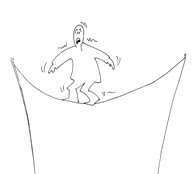
To picture this sense of insecure vulnerability I use the image of someone walking a tightrope. The past success does not mean they are not continually in danger of falling. There is no place, up there on the tight-rope, to feel carelessly secure.

Sadly, that is how many people live their lives. They find that every day is a challenge, with fears and vulnerabilities assaulting their hearts and minds. This may account for the many people who turn to alcohol, drugs, therapy, despair and even suicide.

Safe Formality

Some of those who feel vulnerability retreat into the safety of formality in their dealings with other people. Keeping contacts with others ‘businesslike’, cognitive and formal, allows people to navigate their social context with some sense of stability.

While formality is often sterile, at least the vulnerable person can maintain their career, social contacts and family life with some degree of effectiveness. Friends may find it hard to really get to know them and they may run away from people who are more effusive and relational. However, when you are feeling vulnerable, self-preservation takes a very high priority.

Confidence Lost

One of my joys in helping people recover from rejection is seeing them regain the confidence they have lost. I recall assisting a young lady named Avis, in New Zealand thirty years ago. She had been impacted by rejection and suffered many consequences.

Some female friends were helping Avis gain release from various things that had messed up her life, and they sent Avis to me for assistance with her rejection. I took her through my Steps to Release and brought her out of the rejection that had dogged her lifestyle.

A week or so later, Avis came back to see me, advising that, although she felt free on the inside, she was still living in intimidation and insecurity. As I prayed with her to find out what the problem was I sensed that, although she was free, she did not feel she could enter into that freedom. Her whole life pattern was schooled to be insecure, fearful, retiring and intimidated.

I prayed with her again, to break the old lifestyle habit patterns which trapped her life. Then I sent her home, commissioned to enter into the new life which Christ had purchased for her.

New Living

I received a call from Avis’ flatmates the next day, asking what I had done to Avis. She was so wonderfully transformed.

It seems that Avis had returned home to find the two girls who were mentoring her talking quietly together. As soon as Avis arrived they stopped talking in an awkward silence. Avis would normally have been very intimidated by this and felt like she needed to leave the room.

Instead, Avis went across to the girls, draped herself over one of the armchairs near them, and said, “I bet you were talking about me!” From that moment on Avis entered a new level of relationship with them, based on her new inner freedom from insecurity and vulnerability.

That’s part of what Paul meant when he described the “glorious liberty of the children of God”.

“Because creation itself also will be delivered from the bondage of corruption into the glorious liberty of the children of God.” Romans 8:21

Insecurity is Not Sin

Feeling insecure is not a sin. We each have to work through new and challenging situations at times and can feel uncertain and vulnerable, especially if there is high risk involved. How would you feel working with explosives the first time?

There is no need to feel condemned if you struggle with insecurity. There is not need to feel condemned if you are deeply insecure. The Lord does not condemn you, but He loves you and longs to see you blossom into the life which He created you for.

Being a victim of rejection is not your fault. It has damaged you and robbed you of your destiny, but God does not blame you for the hurtful actions of others. He created you to be who you are, and some others may have rejected you for that. Parents may have wanted a boy or girl, or a sportsman, or an academic, or someone strong and healthy, but ended up with you. But you were designed by God, whatever your ‘unchangeables’ - race, sex, DNA, etc. It is not your fault that others rejected you for being what God made you.

Find Your Feet

The only anchor for life is God. Everything else could move under your feet. Societies get overthrown. Wealth is lost or stolen. Health is fragile. Friendships are not guaranteed. Family is no surety of affection and support.

So, find your feet in God. Place yourself on a Rock. You can come free from insecurity and vulnerability. You can become the most confident, assured, fearless and daring person in the world. You can be transformed from the scared youth, to the hero victor over the nation’s enemy as Gideon was.

I invite you into freedom, in Jesus’ name.

Study Skills 2

I have begun to unpack for you three vitally important keys to strong study and learning skills. These key areas, which will be unfolded in this series, can be broken down and elaborated on, as I began to do in lesson one and continue here. But my main aim is to put these three keys clearly into your mind and to get you started in using them.

Pay Attention

The first key involves your ability to pay attention. If you can be attentive to what is going on around you, what people are saying, and even to what is distracting you, you will gain control of yourself and your mental faculties. With that attentive approach you will be able to focus, absorb, investigate and explore the things you are studying or need to learn.

However, most people operate with their brain out of gear. Being inattentive becomes a habit and a lifestyle. So, this may not be as easy a lesson to learn as you think.

Test Your Attention

I asked my son to close his eyes and tell me what he had seen in our yard when he looked out the window that morning. I had seen him gazing into the yard, particularly watching our cat. My son described the yard, but from memory of the yard, not from having paid attention. Even though he was looking into the yard he was not seeing it.

He described some things which were not visible through the window he had been looking from, but he knew they were in the yard. However, he failed to mention a piece of furniture which is moved around our yard and which happened to be clearly in view where he had been looking. When I told him to check what he had missed he was surprised that he could not recall it when it had been very clearly visible.

That showed that he was not paying attention, but just mindlessly scanning the yard. A spy or policeman would be trained to be very attentive to certain things, even if just scanning a yard.

This also shows what I said earlier, that we don’t really use our brains, we have then in neutral much of the time.

So, test yourself. Think of some room in your house or office where you have recently been. Then see how well you can describe its current state. Then go and see how well you did. You may be surprised.

Recognition

I call this Key “Recognition”. It is the process of recognising what is there, as part of your normal routine, as you turn your brain back on, remove the clutter and get on with attending to the matters of life and learning which are around you.

Pay attention. If you don’t understand something then you don’t ‘recognise’ it, so ask questions. If you are looking mindlessly, or half-listening, then you won’t fully ‘recognise’ what is being said. If you have distracting thoughts and emotions then they will abduct your attention, so you cannot ‘recognise’ the face of what you are supposed to attend to.

Be There

Other expressions I have heard from people who promote this kind of attentiveness includes the saying, “Where ever you are, Be There!”

Another person called this process, “Practicing Presence”. It is the process of being attentive to your self, your surroundings, the things people are saying, the intent behind their words, the thoughts, feelings and reactions within you, the facts and information you need to note, and so on.

Explore the Turf

Since the key is Recognition, and foreign places, names, language and experiences are harder to pin down, you are wise to explore the turf, learn the lingo, become familiar with the surroundings, get used to the funny sounds, tastes and sensations, until you can ‘recognise’ what is going on and better lock in your attention to the key issues at hand.

Multi-Sensory Engagement

Educators know that we have multiple sensory doorways. Employing more of them enhances the learning process. So make a habit of Recognising things in multiple ways.

For example, when you come across a new name, of a person or place, say the name out loud, write it in upper case, then in lower case, listen to someone else say it, repeat it with a fake foreign accent, and so on. These diverse experiences with the piece of knowledge open a variety of sensory gateways into your consciousness, subconscious and memory.

Cranial Engagement

Along with the multi-sensory engagement, I like to use Cranial Engagement for key information. This involves you applying your mental capacities to the piece of information.

One way to do this is to create a slogan about the topic. Alternatively you could create a mnemonic code or acronym. I like to create my own definitions, instead of using the ones given me by others. I also like to listen to someone and then summarise what they have told me in one or two succinct sentences which package what they have told me better than they could have packaged it themself.

The process of applying mental energy to the topic deepens the brain’s ‘recognition’ of the information at hand.

Apply the Brain

Let me play with some facts with you to show how cranial engagement might work. I have summarised here some excerpts from my many Church History posts. The story of Robert Moffat is most stirring.

One of the famous missionaries to Africa was Dr David Livingstone, who, as a young English medical student, was prompted to give up his potential wealth and fame in London, by hearing missionary pioneer Robert Moffat make a famous statement, “I have seen in the morning sun the smoke of 1000 villages where no missionary has ever been”. Livingstone went to South Africa, married Moffat’s daughter, Mary, and became so devoted to reaching Africa that he became lost to the outside world. American reporter Henry Morton Stanley found Livingstone and followed in his footsteps. It is to Stanley that we owe the well-known line, “Dr Livingstone, I presume”.

We could summarise that by saying: “Moffat moved Morton with a Living Stone”. Or: RM drew DL to SA to marry M and meet HMS. Or: Moffat’s smoke drew England’s doctor who drew America’s reporter.

Recognition is the Foundation

This kind of mental activity accentuates ‘Recognition’ of the material at hand. It doesn’t guarantee we will remember or learn the content. That is for the next two keys. But it provides the solid foundation upon which sound learning can be established.

If you cannot pay attention then you are lost from the start. If you are skilled at being attentive your ability to study and learn is already on track for success.

To see the first post in this series click the link below….

http://chrisfieldblog.com/ministry/study-skills-1

Faith Factor 12 – Double Delight

We saw in Faith Factor 3 that our faith “pleases” God. Without faith it is impossible to please God. Therefore only faith pleases God. That sets up a situation where faith becomes the “Double Delight”, and so that is my theme in this lesson.

Faith Pleases God

We know that faith pleases God, and we saw in lesson 4 that it is “Only Faith” that does the job. When you choose to put your faith in Jesus Christ as your Saviour and Lord, God is pleased. When you step out in faith and rely on God, God is pleased.

When you do anything without faith being part of it, God is not pleased.

“But without faith it is impossible to please him (God): for he that comes to God must believe that he is, and that he is a rewarder of them that diligently seek him.” Hebrews 11:6

In fact, if you are not engaging faith you are in sin!

“And he that doubts is damned if he eat, because he eats not in faith: for whatsoever is not of faith is sin.” Romans 14:23

No wonder, then, that Christians must have a complete lifestyle of faith; living by faith, because only faith pleases God.

“For therein is the righteousness of God revealed from faith to faith: as it is written, The just shall live by faith.” Romans 1:17

Faith Not Results

We have a tendency to evaluate faith based on the “results” it produces. If we hear of someone who believed God for great things and those things came to pass we ascribe them as possessing “great faith”. Yet if another person steps out to believe God for great things and those things do not come to pass we see the person as foolish, irresponsible and lacking in faith.

Now, that tendency which humans fall into so easily is against what God thinks. God’s ways are higher than ours and we should always be ready to give up our natural thinking, since it will likely be far below God’s best.

Hebrews 11, the chapter listing the Heroes of Faith, not only lists people who achieved great exploits, but also those who seem to fail miserably. The early verses speak of Noah, the patriarchs and Moses. Then the list includes great achievers such as Samson and David. Great exploits are listed.

However, before the chapter ends mention is made, with equal respect, to people who suffered terribly and new saw some great breakthrough.

“And others had trial of cruel mockings and scourgings, yes, moreover of bonds and imprisonment: They were stoned, they were sawn asunder, were tempted, were slain with the sword: they wandered about in sheepskins and goatskins; being destitute, afflicted, tormented” Hebrews 11:36,37

Celebrating Faith

We are ready to celebrate results, but God celebrates faith. It is “faith” that delights God, not might, money, muscle or mission accomplished.

God was delighted with those who were tortured or cut in two. God did not see them as ‘losers’ who couldn’t get the victory, but as ‘winners’ who brought delight to Him, by their faith.

And that’s a real turn-around for many Christians. Some of the people we look down on as having failed in their faith venture are included in God’s list of modern-day faith heroes. Some of those who made newspaper headlines and whose names have been mocked for their failed attempt to achieve for God are actually celebrated in heaven, while we have not yet made an impression there.

Did Moses Fail?

I always saw Moses fleeing from Egypt as a real loser. I have heard preachers heap scorn on Moses for trying to help the Israelites in his human strength and then falling flat on his face. Moses’ flight from Egypt is seen as a symbol of failed humanity.

Moses killed an Egyptian, but was then rejected by an Israelite who was fighting with his brother. As a result Moses feared and Moses fled.

“And he said, Who made you a prince and a judge over us? Do you intend to kill me, as you killed the Egyptian? And Moses feared, and said, Surely this thing is known. Now when Pharaoh heard this thing, he sought to slay Moses. But Moses fled from the face of Pharaoh, and dwelt in the land of Midian: and he sat down by a well.” Exodus 2:14-15

That sure looks like “failure” to me. And that’s how I always thought of it, not noticing what Hebrews 11 said about it, until many years later, despite reading it several times.

Moses the Faith Hero

Moses is not only listed among the Heroes of Faith in Hebrews 11, he is specifically commended for the very act of running away. What looks like failure from human perspective turns out to be a delight to God, from God’s perspective.

By faith Moses, when he was come to years, refused to be called the son of Pharaoh’s daughter; Choosing rather to suffer affliction with the people of God, than to enjoy the pleasures of sin for a season; Esteeming the reproach of Christ greater riches than the treasures in Egypt: for he had respect unto the recompense of the reward. By faith he forsook Egypt, not fearing the wrath of the king: for he endured, as seeing him who is invisible.” Hebrews 11:24-27

If Moses can look like a failure to human eyes and yet be recorded in Heaven as a hero, then how many other people who we think of as failures have brought delight to God’s heart?

Faith Brings Delight

Our faith, and only our faith, brings delight to God. We don’t have to win or get the breakthrough to have pleased God. It is the faith, not the outcome, that is important.

God looks at the heart, not the record books. When God sees faith in the heart God is delighted. The person may stumble and fall, fail at their attempt, make a mess, offend others who despise their actions and failure, or whatever, but God will still be delighted with the faith that was in their heart.

I talked with a stranger on a plane many years ago who turned out to be the son of a pastor who stepped out to achieve something for God. The venture failed and the man was so shamed and attacked that he left the ministry. The son felt a need to apologise for his father’s actions. But I wonder if God might see that man’s venture entirely differently to how the newspapers saw it.

A Second Delight

We know that our faith brings a delight to God.

So where is the second delight? How do I come up with a “Double Delight”?

When you reach into God’s Storehouse of Grace and apprehend anything that God has for you in there, including, as Paul did, apprehending that for which you were apprehended (Philippians 3:12), God is delighted. So, what about another level of delight?

Daddy’s Delight

The second delight is the delight of God’s Father heart in giving good things to His children.

Parents enjoy blessing their children and God is no different. God gives good gifts to His children. He will give them better things than earthly fathers give to their children.

Look for the ideas of “father” and “pleasure” in this statement made by Jesus Christ …

“Fear not, little flock; for it is your Father’s good pleasure to give you the kingdom.” Luke 12:32

Wow! God gets a great delight out of giving things to His children!

And look here at an Old Testament statement about the delight God gets in giving…

“Let them shout for joy, and be glad, that favour my righteous cause: yea, let them say continually, Let the LORD be magnified, which has pleasure in the prosperity of his servant.” Psalm 35:27

King David was confident that God enjoyed blessing His children.

God is delighted to give.

Double or Nothing

Every time you reach into God’s Storehouse of Grace to take hold of what God has already prepared for you and placed in there, you have to use faith. That faith pleases God. It brings Him delight.

But at the same time you are receiving from Him, as His child, the very things He is delighted to give you as your Heavenly Father.

When you ask in faith for what God is delighted to give, there is Double Delight. God enjoys your act of faith and God enjoys being able to give you what He always wanted you to have.

Delightful Faith

Let me recap the Double Delight, so you can see how delightful faith is to God.

God is delighted to give.

When we ask in faith God is also delighted.

So when we ask in faith for what God is delighted to give, there is Double Delight.

You can put two smiles on God’s face at the same time!

So, let’s do it!