Another self-preservation routine which rejected people can fall into is that of Keeping People at a Distance. Similarly to what we saw in the last lesson, where people put a fence around their heart, people can also put a fence around their life.
Since people have caused pain to a rejected person, they can become afraid of people, or certain types of people, and put up barriers to keep such people at a distance.
The picture I use is simply of someone reacting to the approach of a new person. I have depicted the new-comer as someone who is confident and friendly, since that kind of person is a high risk contact in the eyes of a person trying to avoid others.
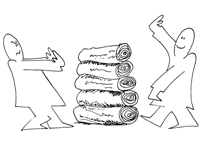
Avoiding People
Some rejected people choose to avoid contact with other people as much as is possible. Some find that just about any contact with people is highly stressful for them, due to fear of rejection or the like. In such cases those people can seek out reclusive lifestyles, where they are able to keep people at a distance.
This doesn’t mean that every recluse is deeply rejected. But an isolated location, back-room job, quiet keep-to-myself lifestyle and head-down routine can be protective patterns for those who wish to avoid people. At times, when back room people are called on to a more public setting, such as assisting in a sales negotiation, reporting to the board, or receiving a public honour for work performed they can be quite uncomfortable. This may be from simple lack of practice in such settings, but it can also reflect that fact that this kind of public situation is the very thing they have studiously avoided.
Selective Avoidance
Some people keep certain kinds of people at a distance. If they have been put at disadvantage by loud and forceful people, then they may selectively avoid those kinds of people. When someone like that turns up in their environment they seek to get away.
Selective avoidance can be directed to certain individuals, such as a bossy mum or angry dad, or the parents in general. It can be directed to certain classes of individuals, such as authority figures, women, macho men or overly confident individuals.
Selective avoidance springs from the fact that certain people, representing a class of people in the mind of the victim, have caused them pain. Possibly their parents rejected them. Possibly authority figures humiliated them. Possibly girls embarrassed them. Possibly men imposed themselves upon them. Possibly certain people mocked them.
Whoever and whatever caused them pain can be chosen for selective avoidance.
Closed Close Circle
Most people have a close circle of friends and associates who they feel most at ease with. For most people that close circle is open to include new members from time to time. However, for a person who seeks to avoid people they will keep their close circle as closed as possible.
If one of their close contacts tries to introduce someone new, the rejected person can resort to formal and non-open communication, keeping the new-comer at an emotional distance.
People with a closed close circle are very hard to reach out to. They will not accept new offers of friendship and may even take years to finally relax with people who they work with or who have joined their family or circle of connections.
The Rebuff
If it is not possible to be isolated from people, or if people invade the space of someone trying to avoid new contacts, one possible response is to rebuff invaders.
Rebuff represents the emotional barrier. It is a strong “You are not welcome” signal. It is an emotional barricade against those who try to enter the private space of another.
Some people are downright rude to people they meet. They are happy to offend, since that will keep the other at a distance. Some are so lame in their responses that they signal quite clearly, “I am not interested in meeting you or getting to know you”. Some simply ignore the new person, as if they are not there or not worthy of recognition.
A rude person is most often left to themself, which may be exactly where they want to be. If they are avoided by others it saves them having to avoid anyone. They can get on with life, without the unwelcome task of relating effectively with others.
Trapped by Pain
Sadly many of those who reject others, seeking to avoid dangerous contact, really long to be contacted and to be in the happy, open relationships they see others enjoy. Their problem, however, is that they are trapped by their pain. They are caged in a lifestyle which they cannot unlock.
They may sit quietly in a public place, such as a lunch-room at work, keeping to themselves as they hear the laughter and banter of others who are free to relate happily with others. While they may project disdain, it is only their pain that is talking. In their heart they would love to have the freedom which others find so easy to enjoy.
Family Pain
Sadly, these rejected people, who reject others due to their own insecurity, become perpetrators of rejection. Each person they avoid is a victim of their own rejection of that person. So the victim becomes a perpetrator, just by trying to survive their own victim situation.
In my book, Family Horizons, I explain that some families carry generational issues which are passed down from parent to child, generation after generation. I label this condition “Family Pain”, because the pain is successfully passed down the family line.
A rejection victim becomes a perpetrator of rejection upon their own children. Their own closed world and personal limitations impacts their children in various forms of rejection. Thus the next generation carries the pain on to the third generation, and so on it goes.
Glorious Liberty
Having been a rejection sufferer and personally encountering many of the things I describe in this series of lessons I have come to love a particular term from the Bible. The Apostle Paul spoke to the church at Rome about “the glorious liberty of the children of God”.
“Because the creature (creation) itself will also be delivered from the bondage of corruption into the glorious liberty of the children of God.” Romans 8:21
When I was released from the caged life which strangled me internally (even though I appeared confident outwardly) I began to enjoy levels of personal freedom (liberty) which I thought I would never experience. So I love the idea of “glorious liberty”. It is my delight to enter into it and to explore it.
Captives Released
One of the ministries of Christ, under the anointing of the Holy Spirit, is to set prisoners free. This is a wonderful privilege for all those who are trapped by rejection. Christ will open the prison doors to the cell that keeps you locked up on the inside. He will lead you out into the freedom for which you were created.
“The Spirit of the Lord GOD is on me; because the LORD has anointed me to preach good tidings to the meek; he has sent me to bind up the broken-hearted, to proclaim liberty to the captives, and the opening of the prison to them that are bound; To proclaim the acceptable year of the LORD (that’s the Year of Jubilee release), and the day of vengeance of our God; to comfort all that mourn; To appoint to them that mourn in Zion, to give them beauty for ashes, the oil of joy for mourning, the garment of praise for the spirit of heaviness; that they might be called trees of righteousness, the planting of the LORD, that he might be glorified.” Isaiah 61:1-3
I encourage you to take heart and to press in to Him, for the release from the prison of rejection, into the glorious liberty of the children of God. I have been there and done it, so I know it is absolutely possible for you.
Toward the end of this series I will present a discussion of the process by which God set me free through His overwhelming love.
