Rejection 15 – Keeping a Distance

Another self-preservation routine which rejected people can fall into is that of Keeping People at a Distance. Similarly to what we saw in the last lesson, where people put a fence around their heart, people can also put a fence around their life.

Since people have caused pain to a rejected person, they can become afraid of people, or certain types of people, and put up barriers to keep such people at a distance.

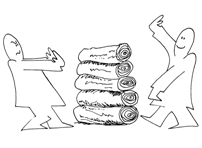
The picture I use is simply of someone reacting to the approach of a new person. I have depicted the new-comer as someone who is confident and friendly, since that kind of person is a high risk contact in the eyes of a person trying to avoid others.
Reject 15 Distance

Avoiding People

Some rejected people choose to avoid contact with other people as much as is possible. Some find that just about any contact with people is highly stressful for them, due to fear of rejection or the like. In such cases those people can seek out reclusive lifestyles, where they are able to keep people at a distance.

This doesn’t mean that every recluse is deeply rejected. But an isolated location, back-room job, quiet keep-to-myself lifestyle and head-down routine can be protective patterns for those who wish to avoid people. At times, when back room people are called on to a more public setting, such as assisting in a sales negotiation, reporting to the board, or receiving a public honour for work performed they can be quite uncomfortable. This may be from simple lack of practice in such settings, but it can also reflect that fact that this kind of public situation is the very thing they have studiously avoided.

Selective Avoidance

Some people keep certain kinds of people at a distance. If they have been put at disadvantage by loud and forceful people, then they may selectively avoid those kinds of people. When someone like that turns up in their environment they seek to get away.

Selective avoidance can be directed to certain individuals, such as a bossy mum or angry dad, or the parents in general. It can be directed to certain classes of individuals, such as authority figures, women, macho men or overly confident individuals.

Selective avoidance springs from the fact that certain people, representing a class of people in the mind of the victim, have caused them pain. Possibly their parents rejected them. Possibly authority figures humiliated them. Possibly girls embarrassed them. Possibly men imposed themselves upon them. Possibly certain people mocked them.

Whoever and whatever caused them pain can be chosen for selective avoidance.

Closed Close Circle

Most people have a close circle of friends and associates who they feel most at ease with. For most people that close circle is open to include new members from time to time. However, for a person who seeks to avoid people they will keep their close circle as closed as possible.

If one of their close contacts tries to introduce someone new, the rejected person can resort to formal and non-open communication, keeping the new-comer at an emotional distance.

People with a closed close circle are very hard to reach out to. They will not accept new offers of friendship and may even take years to finally relax with people who they work with or who have joined their family or circle of connections.

The Rebuff

If it is not possible to be isolated from people, or if people invade the space of someone trying to avoid new contacts, one possible response is to rebuff invaders.

Rebuff represents the emotional barrier. It is a strong “You are not welcome” signal. It is an emotional barricade against those who try to enter the private space of another.

Some people are downright rude to people they meet. They are happy to offend, since that will keep the other at a distance. Some are so lame in their responses that they signal quite clearly, “I am not interested in meeting you or getting to know you”. Some simply ignore the new person, as if they are not there or not worthy of recognition.

A rude person is most often left to themself, which may be exactly where they want to be. If they are avoided by others it saves them having to avoid anyone. They can get on with life, without the unwelcome task of relating effectively with others.

Trapped by Pain

Sadly many of those who reject others, seeking to avoid dangerous contact, really long to be contacted and to be in the happy, open relationships they see others enjoy. Their problem, however, is that they are trapped by their pain. They are caged in a lifestyle which they cannot unlock.

They may sit quietly in a public place, such as a lunch-room at work, keeping to themselves as they hear the laughter and banter of others who are free to relate happily with others. While they may project disdain, it is only their pain that is talking. In their heart they would love to have the freedom which others find so easy to enjoy.

Family Pain

Sadly, these rejected people, who reject others due to their own insecurity, become perpetrators of rejection. Each person they avoid is a victim of their own rejection of that person. So the victim becomes a perpetrator, just by trying to survive their own victim situation.

In my book, Family Horizons, I explain that some families carry generational issues which are passed down from parent to child, generation after generation. I label this condition “Family Pain”, because the pain is successfully passed down the family line.

A rejection victim becomes a perpetrator of rejection upon their own children. Their own closed world and personal limitations impacts their children in various forms of rejection. Thus the next generation carries the pain on to the third generation, and so on it goes.

Glorious Liberty

Having been a rejection sufferer and personally encountering many of the things I describe in this series of lessons I have come to love a particular term from the Bible. The Apostle Paul spoke to the church at Rome about “the glorious liberty of the children of God”.

“Because the creature (creation) itself will also be delivered from the bondage of corruption into the glorious liberty of the children of God.” Romans 8:21

When I was released from the caged life which strangled me internally (even though I appeared confident outwardly) I began to enjoy levels of personal freedom (liberty) which I thought I would never experience. So I love the idea of “glorious liberty”. It is my delight to enter into it and to explore it.

Captives Released

One of the ministries of Christ, under the anointing of the Holy Spirit, is to set prisoners free. This is a wonderful privilege for all those who are trapped by rejection. Christ will open the prison doors to the cell that keeps you locked up on the inside. He will lead you out into the freedom for which you were created.

“The Spirit of the Lord GOD is on me; because the LORD has anointed me to preach good tidings to the meek; he has sent me to bind up the broken-hearted, to proclaim liberty to the captives, and the opening of the prison to them that are bound; To proclaim the acceptable year of the LORD (that’s the Year of Jubilee release), and the day of vengeance of our God; to comfort all that mourn; To appoint to them that mourn in Zion, to give them beauty for ashes, the oil of joy for mourning, the garment of praise for the spirit of heaviness; that they might be called trees of righteousness, the planting of the LORD, that he might be glorified.” Isaiah 61:1-3

I encourage you to take heart and to press in to Him, for the release from the prison of rejection, into the glorious liberty of the children of God. I have been there and done it, so I know it is absolutely possible for you.

Toward the end of this series I will present a discussion of the process by which God set me free through His overwhelming love.
Rejection 14 – No Trespassing

This is the second of those responses which rejected people choose to engage in. Last lesson looked at the human bandage which rejected people put on their heart to minimise their pain. In tandem with that those rejected individuals put up barriers around their heart.

Protective Barriers

Self preservation demands that we shelter that part of us that is wounded or vulnerable. And so, for rejected people, with their injured heart and feelings of personal vulnerability, it is only logical that they will erect barriers around their heart.

This is consistent with the fear of people, which we looked at in lesson 9. People are a danger to someone carrying inner hurts. Since people inflicted the injuries they carry, people are a serious risk to them.

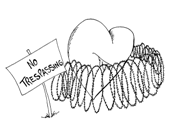
Initially the protective barriers are erected around the heart. The inner feelings become a “No Trespassing” zone within their life. That’s why my picture for this lesson is a heart surrounded by barbed wire, with a “No Trespassing” sign. That’s how it is on the inside for some people.

Reject 14 No Tresspass

Not My Heart

It is not uncommon for rejected people to still live “normal” lives and engage in business, interests, family life and so on. To do this they usually rely on their social skills, intellectual capacities and so on.

What is significant about those carrying serious rejection issues is that they will allow people to interface with just about their whole life, but not their heart. They will engage intellectually, professionally, physically, socially, with responsibility and authority, giving their time, talents and resources, but not letting the tender areas of their heart be touched.

Their “ground zero” is the heart. That is the “No Go!” area of their life.

Off Limits

Because of their own personal pain, rejected people can be very sensitive to the pains and needs of others. They may also be more attuned to the environment, since they need to navigate it more carefully than others.

So, it is quite possible that people carrying their own internal burdens will end up in the ‘helping profession’, trying to assist others who are carrying personal burdens. Counsellors, ministers, psychologists, carers and the like can be motivated with concern for others, prompted by their own acute pains.

Yet, as they help others, they will find it difficult to share their own personal pain. They may share details of events and facts about what they suffered, but not their tender, injured feelings. Those things usually end up “off limits”.

I’m Out of Here

When these people end up in situations where personal issues are to be shared, they will escape the risky environment. While they may handle a business meeting with tenacity, a sales challenge with exemplary professionalism, a corporate deal with flair, or a birthday party with considered care, they will run away from situations where their “heart” issues risk being trampled on.

When someone comes to them and wants to bring up personal issues, either in the rejected person, or in themself, looking for a compassionate response, the rejected person can get a sudden attack of “I’m-Out-Of-Here”-itis.

They may respond with coldness, rebuke and hardness, simply because they cannot handle the matter any better, since it cuts close to their own personal pain.

Self-Preservation

Rejected people do not wish to offend in such situations. They do not intend to annoy or let down others. They are doing what they can to maintain self-preservation. Their survival instincts take precedence in those difficult situations.

What they are saying to themselves is, “I won’t let myself get hurt again!” In order to fulfil that promise to themselves they have to cut and run when they feel that someone threatens to trespass on their feelings.

Formal Relationships

A high-flying corporate executive engaged me for a communications training session. I spent several hours with him and another executive in the company. As part of the process I had both men make a personal statement to their loved ones on camera. The senior executive produced a formal policy statement, including all the right things one should say to their closest family. However it came out as forced and formal. It came out almost insincere.

When the other senior executive made his presentation it was powerfully warm and genuine. It came from the heart and was a thrill to listen to.

When I discussed the situation with the personal friend who had recommended me for the project he confirmed that the obvious evidence was representative of the top executive’s personality. The hope was that my involvement would help him move beyond his personal limitations, which hindered all of his communications, due to his lack of warmth and reality.

The man was a brilliant businessman. Yet, having been orphaned at a young age, he carried the baggage of personal pain which locked him up on the inside. While the other man was keen to continue the sessions the senior executive cancelled the project, since he felt he did not need assistance. I wonder if he wasn’t simply protecting his tender internal parts from the challenges I put him at risk of.

Sterile Relationships

Some marriages and parent-child relationships are denied the warmth and fervour which should be expected, due to one or both parties carrying feelings of rejection. When one heart is hidden behind barriers and is a “No Go” zone, there is no real hope of developing a warm, intimate, heart-to-heart relationship.

Consequently many relationships end up as sterile, formal, convenient, intellectual, sensual or routine, but not open hearted. What a joy it is for people in such situations to step into the freedom which Christ has for them and for their relationships to warm up and move into new territory.

Rejection 13 – Human Bandage

We move now from the results or impacts of rejection, which the victim has little control over, to the choices and responses which victims make. Rejection needs to be dealt with at two levels. We need to resolve the spiritual and personal impact of what the victim experiences at the hands of others, and the victim needs to undo what they have done in their response to being rejected.

Coping Skills

People have different coping strategies and coping skills for surviving life’s challenges. I heard recently of an African nation where, as a consequence of war and disease, there are families of surviving children where an eleven year old is the ‘adult’ caring for two younger siblings. The survival instincts and coping skills needed in such a situation challenge the understanding of comfortable westerners.

Because people are different and each situation is unique, there are many diverse responses which people create to deal with their problems. What I present in this and the next few lessons are the responses I have seen most often. I see these as the core responses to expect in the life of someone who has suffered rejection.

Ease The Pain

An early instinct, in a survival situation, is to reduce our suffering. We automatically look for ways to ease our pain. We withdraw from the problem or the source of pain, and then attend to our wounds.

A wounded ‘heart’, as we saw in an earlier lesson, cannot be treated in the normal medical facilities which help heal our bodies. We are often left without any real help for dealing with our hurt feelings, confused thinking and damaged internal life.

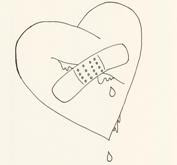
What we do, then, is apply a bandage of our own making. I call this the Human Bandage, and I depict it as a bandage across the open wound in our heart. A bandage on such a wound does not help it heal since we need God’s healing touch to ‘restore our soul’. However, we are usually quick to come up with our own bandages to dampen the pain we feel inside.

Man Made Bandage

It is important to distinguish between a ‘man made bandage’, what I call the Human Bandage, and the divine healing tools which God supplies. The man made bandage is that which comes easily to the mind of people. It does not usually have the divine therapeutic value which comes from God’s ways and God’s word.

I have met many people with their man-made-bandage, who are quite insistent that their own way of dealing with a problem is working. I have found it difficult at times to prompt people to look for God’s full and wonderful healing, because they have been quite satisfied with their own makeshift remedy.

Whatever they have done to cover the wound and numb the pain is their human bandage. It is their attempt to protect their wound from further bumping, and to minimise the pain they feel inside.

Blur Blame and Bluff

Among the coping skill, survival strategies which I have often seen are Blur, Blame and Bluff.

Blur is where a person plays mind games, such as rationalisation, to mollify the sting of what they have been through. They may say, “Everyone had it tough in those days, so I shouldn’t be upset about what I went though.” Or they may say, “Mum was very sick, so I can understand why she was so cruel to me.” This kind of thinking is an attempt to paint over the cracks, but it doesn’t change the fact that real pain was felt and still persists.

Blame involves directing or dumping the hurt and hardened feelings onto someone else. “It’s all my father’s fault! If he had never left us I wouldn’t have gone through all this!” However, the blame game does not bring any healing. It actually nurtures a ‘root of bitterness’, which creates a whole new set of problems.

Bluff includes such things as the simple assertion that “time heals”. Time does not heal anything. Pain may become more buried over time, but it is still there, raw and painful, under your pile of bandages. When someone tells me, “I’m over it now”, I am suspicious. I know that unless someone has actively applied the love and grace of God to their pain they are unlikely to be free.

Distracted Life

One of our tools for dealing with pain and pressure is to bury ourselves in activity. People develop a ‘distracted life’, filled with activities, business, hobbies, parties, relationships, and things that keep them distracted from their past pains.

While this might give the impression they can maintain normal life, their life is not ‘normal’. Their whole existence is one huge coping mechanism. They are not living, but running a life-long strategy. Their work, achievements, busy-ness, social butterfly flittering, intense devotion to their hobbies, and the like, are not what they were created for. Those things have been adopted to smother their pain, not fulfil God’s plan.

Don’t let pain destroy God’s plan for your life.

Proving Yourself

Another coping strategy, human bandage trick is to prove your self-worth. Because rejection attacks your confidence and sense of self-worth it is easy for rejected people to throw themselves into proving themselves, as a way of ameliorating their pain.

If a person can count their achievements, affirm their own worth, and prove that they are not what others think they are then they can blur the feelings of rejection deep inside. Sadly, these achievements do not take away our pain, but they play into our desire to rationalise what is going on. It provides material for our mind to toy with, even though that does not pour oil into our wounds.

Me and My Bandages

I have mentioned before that I had put so many bandages on my own heart they had become a small hill. I tried to cover my sense of internal pain and I was extremely reluctant to ever expose it, even to God.

God graciously assured me that He would not bruise me in the process of healing me. I was comforted by the scripture about the Lord not breaking a bruised reed or putting out the last spark in a smouldering cloth.

A bruised reed he will not break and the smoking flax he will not quench: he will bring forth judgment unto truth.” Isaiah 42:3

Eventually I let God get His fingers under the bottom bandage and pull them off my life. I am ever so glad that I did. He healing in my life has been so wonderful and opened to me a life much more abundant than I ever thought I would have.

Rise and Be Healed in the Name of Jesus

You were not created to be a victim or to live your life in pain. You were not created to be hidden behind a bandage or mask, or to consume your life in survival strategies.

You were created to be hugged by God. You were created to play like a child on the golden pavement before His throne. You were created to bask in the sunshine of His love and to be surrounded by the security and overwhelming grace of His presence.

So, in the lovely and powerful name of Jesus the Christ, the Son of the Living God, I command you to Rise and Be Healed. Walk in freedom, wholeness and transformation, showing to the world the awesome grace of our amazing Heavenly Father.

I command that your soul not only be ‘restored’ (as Psalm 23:3 says) but ‘prospered’ (as 3John 2 says), so you can not only live your life, but amazingly bless everyone else’s too!

Rejection 6 – Heart Wound

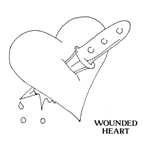
While the picture of rejection used in the last article summarises the process of rejection, this lesson looks at the most poignant element of the impact of rejection.

When people cut off the love supply we go through the process of rejection. What that does on the inside of us is create a deep, internal wound that we may carry for the rest of our life.

Knife in the Heart

I use the rather dramatic imagery of a knife in the heart to describe what it feels like at times when we are rejected. The person offending or rejecting us might be horrified if they understood the pain, impact and dimension of what they have done to us.

Many parents, spouses, friends and people try to dismiss what they have done and to excuse their outburst, neglect, selfish behaviour, and so on. But for the one who feels rejected the action can prove to be devastating in its significance.

We have seen in previous lessons that the main area where rejection impacts us seems to be our emotions. So the knife in the heart imagery makes a pretty good generalisation to represent how rejection affects us.

Broken Heart

We use the expression “brokenhearted” to describe the internal feeling we have when we are let down, jilted or hurt by others. So an image of a heart broken in two might work just as well.

The Bible uses the term “broken in heart”, so that gives further legitimacy of the idea of hour heart being the place where the injury takes place.

“He heals the broken in heart, and binds up their wounds.” Psalm 147:3

However, I like the idea of a knife in the heart, because it suggests an attacker. Even if the person who caused the hurt is ignorant of their impact, the victim can usually identify the one who they feel has hurt them. When we come to the stage of resolving rejection you will find that the process of ‘forgiveness’ is very important. So having a sense for the offender, or the one who wounded us, in mind, will lead easily into that process.

Reference to a “broken heart” does not maintain consciousness of an offender in the same way a knife in the heart does.

Hurts

Another terminology for the inner wound which we experience in rejection is “hurt”. We speak of carrying hurts. These hurts are bruises on our heart.

While the knife imagery invokes the more severe impact of rejection we also carry many bruises, hurts and inner pains that are not such intense wounds.

Many people carry some level of pain, even if they call it disappointment, hurt feelings, soreness, or whatever. Hurt is a good term to use for that large collection of inner injuries which impact us to varying degrees, even if not serious enough to be called ‘wounds’.

The Mind

I should point out that the imagery of a wounded heart does not rule out the wider impact of rejection. Our mind gets involved in the rejection issue, so I want to take a moment to acknowledge that too. While our focus may be with hurt feelings, inner wounds, deep personal pain and other emotional effects, we may not realise how much our mind is impacted by the rejection experience.

Troubled thoughts, agony of mind, struggle to find reasons, rationalisation, intense self-interrogation, and other mental mind-traps can tangle a person in distraction.

Most people who are carrying deep inner hurts are mentally distracted. Some find it impossible to concentrate or even think clearly.

The focus on a wounded heart should not displace our awareness of the intense mental pain that many people go through. The mind is part of our soul and it needs to be restored, just as our feelings do.

Pain Vocabulary

The feelings which people grapple with when they have been rejected can be wide ranging. We have already mentioned hurt and pain. Along with them there are such things as being disheartened or discouraged. People can lose heart and give up on themselves, others, relationships, studies, career, and even life itself.

Feelings of inferiority are a powerful element of rejection. The notion comes to the victim that if they are worthy of being abused, rejected or neglected by the people who should love them, then maybe they are simply of no real value.

Feelings of fear, especially the fear of further rejection, can enslave people’s hearts and minds. Distrust of others and uncertainty about emotions, relationships and their own expectations from life can easily spring up in a rejected life.

Trauma

We will look in future posts at some of the responses which tend to spring up in the fertile soil of a wounded heart. All of those various feelings tend to be underpinned by the overriding experience of personal trauma and pain.

When I am working with people to lead them into freedom I like to find, if possible, the moment when the knife pierced their heart. That moment of personal trauma can be a key to unlocking the pain that has engulfed them.

Delayed Impact

While looking for the moment of trauma I came to realise that there can often be a delayed impact in a person’s life.

I have encountered many families where all the children were abused in one way or another, and yet each person responded differently. They each had a personal journey of abuse, despite their shared experiences.

The idea of ‘delayed impact’ is summarised by the scenario where a father keeps putting off time with his child. Imagine a child going to his dad to show him something. The father brushes off the child with something like, “I’m busy at the moment. Show me later.” Then, later, the dad is on the phone, reading the paper, about to make an important call, not wanting to be disturbed, thinking about something important or the like.

Each time the child goes to his dad the child is in reality being rejected. But the child trusts the father and accepts his excuses, not feeing the pain of rejection. But then, on one momentous occasion, after being rejected yet again, the penny drops for the child. They suddenly feel the impact of rejection and realise that their dad is never going to have time for them.

In a family this delayed impact can hit each child at a different age or stage of life for each one. They may all be rejected but some feel the impact far more deeply. Some children can even be so robust emotionally that they never realise how rejected they have been, while their sibling has been devastated by the same treatment all the children received.

Handle on the Knife

If you can remember the day that the knife struck your heart you will find it fairly easy to grab the handle of the knife and remove it from your life. Rejection can be healed in either case, but I like to encourage you that if you can relate to the knife in the heart imagery you are on track for wonderful freedom.

God is able to give you a new heart. He binds up the broken in heart. He restores your soul. He even makes your soul prosper (3John 2). So don’t be afraid of what you have gone through or the pain that has destroyed you. Your day of deliverance is at hand, because Jesus has done all that needs to be done for you.