Rejection 9 – Fear

Among the various results of Rejection is the key area of Fear. Fear is a major weapon which the enemy of our souls uses against us. The Bible alerts us to the fact that the devil uses ‘fear’ to keep people in slavery all their lives.

Hebrews 2 tells us that Jesus became human, like us, so that through His death He could destroy the devil, who had the power of death up to that time. This would enable Jesus to set people free from the ‘fear of death’.

“And deliver them who through fear of death were all their lifetime subject to bondage.” Hebrews 2:15

Multiple Deaths

Since we are tri-partite, made of three parts, spirit-soul-body, we are able to be in fear of death at three levels. We can fear physical death to our body. This involves fear of disease, fear of accidents, fear of pain, fear of spiders, and so on.

We can also fear death at a spiritual level, which includes the fear of falling from God’s grace, fear of hell, fear of eternal damnation, and similar terrors.

Rejection is centred around the fear of death to our soul. That involves the fear of death to our mind, emotions, will and personality. Mental death includes the fear of insanity and senility. Death to our will involves being enslaved, incarcerated, addicted or dominated.
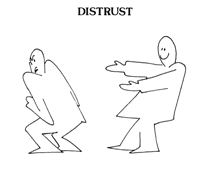
Emotional Death

Death to our emotions centres around our fear of being hurt. We don’t want to be rejected or told that we do not have value. We want to be loved, so we fear any of those actions or expressions from people that make us feel worthless, stupid, unloved, unworthy, out of place, and so on.

It is possible to have no fear when it comes to our body, such that we are a dare-devil and thrill-seeker in our actions, and yet to have deep fear when it comes to dealing with people.

Emotional Fears

The fear of emotional death, even if we do not understand it as such, leads us to such things as a fear of people, fear of rejection, fear of intimidation, fear of rebuke, fear of correction, fear of mockery, fear of hurt and fear of being found out.

These fears dictate our actions, choices and responses. Many people’s lifestyle, career choices, friendships, routine and so on are the product of their navigation of their fears, trying to keep away from threatening or dangerous situations.

Fear of People

Since we want people to love us and it is therefore people who hurt us, those who have rejection issues carry a fear of people. A fear of people drives some to the point of becoming hermits, choosing isolated lifestyles, remaining un-married, avoiding crowds, not connecting with active social groups and fading to the background in their social contexts.

Note that people can manage their fears, even though those fears still hold them. So, just because someone carries a fear of people does not mean that they automatically avoid social settings. Some extroverts push past their fear of people and perform under the spotlight, despite their underlying sense of danger at the hands of insensitive people.

Insecurities and Anxieties

Fear also manifests in various feelings of insecurity and anxiety. A person who has been rejected has had their personal confidence damaged. While they may maintain their bravado publicly, they can carry deep-rooted insecurities and unseen anxieties.

Imagine trying to get on with life, study, career, marriage and family with deep-seated insecurities and anxieties. That’s how some people navigate their whole life. They manage to live a normal life, raise a family, run a business, build a career and have friendships, hobbies and interests but by swimming upstream, as it were, in everything they do.

Imagine how freeing it is for those people to dump their burdens of fear, insecurity and anxiety, through the love of God and grace of our Lord Jesus Christ. Imagine how much easier life is and happier their existence becomes when God breathes His grace and life into their being!

Stolen Life

The devil is a liar and a thief. He comes to rob from us the life which God has given us. He comes to steal, kill and destroy all those things which are God’s gifts to us.

“The thief comes not, but for to steal, and to kill, and to destroy: I am come that they might have life, and that they might have it more abundantly.” John 10:10

Many people are living with only the left over pieces of the life God gave them, because the devil has come along and stolen, killed and destroyed much of what is their life. Sadly, humans do not have the ability to beat the devil and reclaim what was stolen from us. Only God can do that, because Jesus destroyed the devil through His resurrection.

If you are existing instead of living, it is probably because the devil has stolen the life God gave you. Your life is meant to be full, blessed, happy, delighted, confident, purposeful and rich. If it is not these things then you have been robbed. You need to call upon God to bring His power and grace into your day to day existence and give you life more abundant.

Fear Torments

The fear which comes from rejection needs to be broken from your life, because fear torments you. It shakes your heart and mind, challenging your confidence, intimidating your faith, agitating your inner being and bringing undue pressure into your body.

“There is no fear in love; but perfect love casts out fear: because fear has torment. He that fears is not made perfect in love.” 1John 4:18

Receive the Gift

The gifts of life, love, family, friends, faith, purpose, destiny, fruitfulness and satisfaction are meant to be everyday blessings in your life. I offer you the gift of life more abundant through Jesus Christ. Call out to God, through faith in Christ, for God’s love to be poured out into your life, so you can be healed of rejection and have your life restored.

Don’t settle for anything but the blessing and freedom God created you for.
Rejection 4 Spirit Soul Body

Applying healing to people suffering from rejection involves an understanding of where the remedy is to be applied. That brings me to a look at how humans have been created. The area where much of the damage takes place through the experience of rejection is our “soul”.

Modern people have little understanding of their inner workings. This is made more complicated by the promotion of non-Biblical ideas about how we are made. Freud’s theories about the inner workings of the mind and the plethora of psychological theories do not help us understand who we are in God’s presence.

Simple Model

For the purposes of helping people move into freedom I like to explain our makeup in the simplest terms. And I don’t insist that you have to agree with my picture. What I am sharing with you is what I understand from the scriptures and from my experience. I share this simple model to help you move forward. You don’t have to agree with my analysis in order to gain freedom.

I expect that you will at least have some sense of understanding which might give you greater confidence in allowing God to deal with your heart and mind.
Spirit Soul and Body
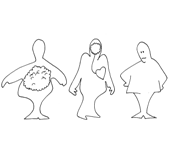
Paul, writing to the church in Thessalonica, presents us with a list of three parts which seem to summarise how we have been made. These parts are Spirit, Soul and Body. Note that the first part listed is not the body, but the spirit.

“And the very God of peace sanctify you wholly; and I pray God your whole spirit and soul and body be preserved blameless unto the coming of our Lord Jesus Christ.” 1Thessalonians 5:23

There is not guarantee that Paul’s list of these three parts is a final proof of our makeup. Some argue that it is not. However, there is no better description that I have found in the Bible to give us an insight into how God has made us. So, I assume that this is a description of our whole being. Note Paul’s use of the word “wholly” in that verse.

Note too that our being is defined from our spirit man, outward to our body. Today’s materialist thinking is distracted with the visible, external person and tries to work in from there. God, who is Spirit, deals with us and knows us from our spirit man first.

Defining the Parts

God is described as a “trinity”, or a tri-partite being. That is to say that God is made up of three distinct and identifiable elements, which are all equally part of the same whole being.

God is identified as the Father. God is also identified as the Son. And God is further identified as the Holy Spirit. Yet, despite the existence of these three identifiable elements, we know that there is only one God. Each of these three expressions of God is equally God. Yet they function in distinctly independent fashion.

While this is a challenging concept to grapple with, it is clearly presented to us in the Bible. We have one God. God is expressed in these three parts. God can exist in the reality of a single identity with three unique expressions.

So, when God made man in His own image (Genesis 1:26,27) it is logical that God made man as a tri-partite (three part) being, where three identifiable parts are all equally real parts of the one being. Thus the three components identified by Paul in 1Thessalonians 5:23 make sense: Spirit, Soul and Body.

You body and spirit are just as much “you” as each other, but they can be separated from each other. Your mind can think one thing, while your emotions struggle with something else.

So let me give you a simple working definition of the three parts given to us by Paul.

Spirit Man

Our ‘spirit’ is the part of us that is able to be in intimate relationship with God. It is therefore the most mysterious part of us and the hardest for us to identify within us. Jesus referred to this part of us as our “belly”, so it is often identified with our stomach.

“He that believes on me, as the scripture has said, out of his belly shall flow rivers of living water.” John 7:38

The Apostle Paul referred to our “inner man”.

“That he would grant you, according to the riches of his glory, to be strengthened with might by his Spirit in the inner man” Ephesians 3:16

Our Soul

Our soul is the part of us which happens inside our life, but which is independent of our communion with God. It is the realm of our thoughts, feelings and volition (use of our will), which we can engage whether we are in touch with God or not. Heart and Mind are the two parts of us that could readily be linked to the New Testament idea of ‘soul’.

We also have reference in the Old Testament to the ‘soul’. That term is used in the Old Testament at times to speak of our life in general, rather than a specific mind and heart component. Yet there are some places where the word ‘soul’ is used to describe something that is part of our inner processes.

On three occasions the Psalmist talks to his “soul”, as in internal part of him that is struggling with feelings of discouragement. This sounds very much like emotions and troubled thoughts.

“Why are you cast down, O my soul? and why are you disquieted in me? hope in God: for I will yet praise him for the help of his countenance.” Psalm 42:5 (see also Psalm 42:11 and Psalm 43:5)

I suggest that the same sense for our internal being, mind and emotions, is in focus in two other psalms relevant to our internal restoration. In the much loved Psalm 23 (The Lord is My Shepherd) we have the statement, “He restores my soul”. And in Psalm 147 we are told that God puts a bandage on the broken heart.

He restores my soul: he leads me in the paths of righteousness for his name’s sake.” Psalm 23:3

“He heals the broken in heart, and binds up their wounds.” Psalm 147:3

Our Body

They body hardly needs any introduction. It is the part of us which we are quite aware. Our physical feelings and appearance press themselves on us much of the time.

What is important is that we are much more than the sum of our physical parts.

And we should note that it is possible to put a smile on our face while we are feeling desperately sad on the inside. Our physical body can hide or mask our inner thoughts and feelings.

Most people rely on our physical appearance to signal to them who and what we are. Some people become masterful at deceiving others, hiding their inner self, deeper thoughts and feelings and even the decisions of their will, by their confident, smiling countenance.

The Place of Rejection

Rejection seems to have its greatest practical impact on our mind and emotions. That “cast down” feeling which the psalmist described in Psalm 42:5 is well known to people who are carrying around feelings of being un-loved or rejected.

So the place of rejection in our lives is often identified as being in our emotions. Our “hurt” feelings seem to be located in our heart.

Now, a more careful analysis may prove that there is much more to it than that. But, for my purposes, that simplification is perfectly workable. If you are given to profound analytical thought then be my guest to try mapping all the nuances and shades or internal geography. But know this, if you are planning to help yourself and others, what I have presented here is perfectly sufficient.

So, now we are ready to move on.