Big Bang Culture

Why do you think today’s scientists came up with a Big Bang? Hmmmm???

In an age when everyone wants ‘instant’ success, easy solutions, quick fix, five minute meals and sudden deliverance why not come up with a Big Bang Cosmology?

Big Bang encapsulates the worldview of the instant gratification culture.

Causeless Creation

Take a look at the Big Bang and what it represents in terms of cultural values. All of a sudden something that wasn’t there came into virtual spontaneous creation, in a big, big Bang!

The Big Bang does not connect to cause. It is causeless creation. It is the happy accident that made our very existence possible, by sudden, unbelievably enormous spontaneous generation. A random chance lucky event is supposed to have happened.

And that’s what most Westerners are living for. They want to be the lucky person in the right place at the right time to enjoy a causeless benefit.

Big Bucks

Western culture has lost sight of the notions of hard work, reward for effort, diligent productivity, earned benefits, personal achievement by persistent endurance, and so on. The gambling culture, Hollywood hopefuls, stock-market dabblers, get-rich quick investors and budding entrepreneurs often base their hopes on nothing more than luck. They want to be the one who is struck by chance, lucky to pick the right winner, picked out of the crowd, favoured with fame and fortune, and all by pure happenstance.

While not all westerners are suckers for the get-rich quick, instant success, easy road delusion, there is a strong undercurrent of luck-based hope in the culture. The dream of big bucks is held in the chest of many people, without them ever intending to put in the hard yards to earn such benefits.

Mindless Chance

A key quality of chance is that it is mindless. It is not connected to morality. Chance blesses the undeserving as readily as the worthy.

While God represents moral responsibility and accountability, random-chance events are devoid of such impositions on morally hedonistic society. So chance gets the vote and God gets the gong.

And that social value system is celebrated in the Big Bang. Just as culture wants to exist outside of moral accountability to God, science has ruled God out of the picture and enshrined “chance” in His place. A happy accident is now the source of human existence in our universe.

Society and its science have their feet anchored firmly in fantasy. Their only hope is luck. Their only morality is random chance events. Their only meaning is accidental.

Connection Lost

In order to enshrine luck in such a primal place in human existence something else had to be displaced. God has been displaced by luck. Our connection with order, intelligence, design, purpose, morality, responsibility, accountability, fulfilment and meaning has been lost.

Luck does not give us order, intelligence, design, purpose, morality, responsibility, accountability, fulfilment or meaning. Western society is now disconnected. We are drifting in space, happy for a lucky accident, but unsure of anything.

We should expect such society to drift into slavery, shame, defeat, hopelessness, suicide, immorality, addiction, weakness and delusion. There is nothing to protect it from these things.

Who is to Blame?

Do we blame false science for creating a vain culture? Or do we blame a vain culture for seeking a false science?

People who have thrown away their connection to the Living God have sought substitutes for themselves. But there is not substitute for the awesome reality of the God of miracles.

They have collected the elements of a pseudo-culture: government, science, education, order, direction, meaning, purpose, morality and religion. But without the Living God activating each one it is empty and vain.

True culture is anchored on God. It is anchored on the Fear of God, godly morality, responsibility, accountability, divine power, grace, salvation, and so much more that God presents to us in His Word, the Bible.

Stand Out

While western culture crumbles, due to building itself on sand, we should expect godly families to stand out from the crowd. They will display all the qualities that come from being connected to the Lord of the Universe, God of Creation and Father of us all.

Godly families will have meaning, morals, purpose, power, authority, wisdom, fulfilment, understanding, hope, direction, resolve, responsibility and power. They will be able to take action and bring hope where others are wallowing in emptiness.

However, that will also place on godly families the responsibility to act for the good of the foolish and hopeless ones who have bought into the lie of luck, in place of the grace of God. Because God’s children love their neighbour, they will seek the good of those foolish and deluded people around them.

By God’s grace those stand-out godly families may well be the salt that saves a rotting society and the light that shows the way to lost souls.

The Real Bang!

The Big Bang is a fizzer. It fizzles out in the light of God’s reality. It fizzles out in its inability to provide a guiding light to those who worship it. It fizzles out as an explanation for reality and as a sign of our times.

The real ‘bang’ in our society is not in the hands of those who love luck and happy chance. The real ‘bang’ is in the hands of people connected to the God of all eternity, Almighty God, our Creator.

Society is not going to be built on empty pseudo-science which worships the shallow values of a shallow culture. It is going to be built by people who do know their God and who can therefore do Exploits!

“And he will corrupt with flattery all such as do wickedly against the covenant: but the people that do know their God will be strong, and do exploits.” Daniel 11:32

Faith Factor 5 – Holding On

Understanding faith can be achieved by various approaches. One thing might quicken your faith now, and yet a completely different thought may prompt your faith on another occasion. In fact, faith, simple as it is, is spiritual, and therefore profoundly complex. Different things will inspire faith at different times.

With that thought in mind I am sharing various Faith Factors with you, to provide various angles from which to view and understand faith. You may well find that see God for who He is quickens your faith on one occasion, while discovering your part in faith may excite your faith on another occasion.

So, here is another Faith Factor which I find important in my application of Christian faith. It is the process of Holding On.

Pressing Through

Faith is persistent. It takes a stand, based on who God is and what He asks of us and it maintains a dogged persistence. This is what I call Holding On. But it could equally be called Pressing Through.

Faith claims God’s promises. Faith apprehends what God has for us. Faith presses in and pushes on. It is determined to claim the prize. It will not take “No” for an answer. It maintains course and defies all challenges to the stand it takes.

Now, to be realistic, there are many times when people’s faith does not maintain such heights of victorious persistence. We can all be ‘weak in faith’ and cry out the Lord in despair, rather than expectancy. Thankfully and wonderfully God comes through for us, even when we are falling in a heap.

Think of the disciples in the boat, desperately afraid they will die. Their fear and panic did not stop them receiving a miracle. Think of Gideon’s inability to believe what the angel of God told him about his ability to win a victory. Yet God continued to uphold him, bearing with his insecurity, until the fearful one had won a great victory.

Yet, for all that, there is a wonderful aspect of faith that is victorious, persistent, unconquerable and soul stirring.

Faith in Action

Faith is seen in the actions of the one who holds it. We are told by the Apostle James that “faith without works is dead”, James 2:20.

“For as the body without the spirit is dead, so faith without works is dead also.” James 2:26

When faith is present there will be some resultant actions which attest to it being there. Faith itself becomes the evidence and substance of what is believed for.

“Now faith is the substance of things hoped for, the evidence of things not seen.” Hebrews 11:1

Faith is therefore best seen when a person purposes to believe in unseen substance and then acts accordingly.

The Action of Resting

When I talk about faith being linked to action, or faith being seen in the ‘works’ of one who believes, I do not want you to think only of busy activity. One of the most powerful actions of a man of faith is ‘rest’.

In the face of fear people become agitated. They may engage in busy work. They may tend to talk a lot, fidget, run to and fro looking for help, and so on. In such a case the act of ‘resting’ is a powerful testimony to a person’s faith.

Hebrews 3 and 4 address this factor of ‘rest’ as a result of faith. Those who do not trust God are not able to enter into rest. Those who trust God cease their own labours, relying on God to do what man cannot do. This does not mean inactivity, but it does mean the cessation of futile human energy thrown at some problem.

“And to whom sware he that they should not enter into his rest, but to them that believed not?” Hebrews 3:18

“For we which have believed do enter into rest, as he said, As I have sworn in my wrath, if they shall enter into my rest: although the works were finished from the foundation of the world.” Hebrews 4:3

“For he that is entered into his rest, he also has ceased from his own works, as God did from his. Let us labour therefore to enter into that rest, lest any man fall after the same example of unbelief.” Hebrews 4:10,11

The Action of Rejoicing

Another work of faith which I love to see is the rejoicing of one who is confident in God. If you knew that God had solved your problem you would break into rejoicing, song, praise and worship.

Coming to a place of confident celebration in the outcome, before the outcome has become visible is a ‘work’ of faith. Because, by faith, you have the ‘substance’ of what you are believing for, even before the answer has arrived, you now not only rest, but you rejoice. What joy it is to be confident that God has solved the problem and met every need!

Don’t Give In

I am reminded of an occasion before I was married when I faced a faith challenge to hold on and press through in faith. I was working using an oxy-torch to melt brass in a metal fabrication process. I was manufacturing hundreds of pieces and my protective gloves developed holes over time.

I accidentally turned the naked flame onto my exposed thumb and burned it badly. In agonising pain I hastily turned off the flame, pulled off the glove and pressed my good hand onto the burnt thumb, praying madly for protection.

I had heard many testimonies of God’s healing power in response to prayer and I prayed keenly, knowing that I was badly burned and desperately needed healing. The workshop in which I was working was empty at the time. After my initial cries of pain and desperate prayer, I headed across the open factory floor, toward the foreman’s office. I knew that there was a special burn spray in the office which I could put onto my thumb.

Half way across the factory I was pulled up by a thought. I realised that if I had prayed in faith and believed God to heal me, then I would not need to use the spray. However, my thumb still pained badly. I lifted my hand to look at the thumb and its skin was burned brown. I was in a dilemma. I wanted to act in faith, but I also wanted my thumb to have the best chance of recovery. Faith said, “You have prayed, now leave it to God and expect His good work”. Realism said, “Your thumb is very badly burned. You need to get it attended to.”

I was caught between those two opinions for quite a while. Then I decided that I would rather act in faith and please God, than to throw my faith away, just because of my pain. I turned and went back to my work bench. I gingerly pulled on the stiff, worn gloves, re-lit the torch, and went back to work.

The heat of the torch made my thumb pain even more. I had to work slowly, because of how sensitive my skin was. But I felt good about having chosen to act in faith.

Over the next hour the pain subsided and I just got on with my work. By the end of the day the brown burn had subsided to a small area in the middle of the thumb. By the next morning there was hardly a sign that my thumb had been burned at all. I was healed, beyond all reason. I had chosen well to hold on in faith.

Heroes of Faith

Hebrews 11 records some heroes of faith who suffered torture. They were heroes of faith because they held on to their believing. They would not be dissuaded, even by the threat of death or torture.

While we all love the accounts of faith that wins out in the end, it is not the outcome that is important to God, but the faith that is expressed in willingness to press through.

Remember the three Jewish boys in Nebuchadnezzar’s court who refused to bow to his idol. They were threatened with death in the fiery furnace. They declared their confidence that God would deliver them, but they added that even if He did not save them they would not bow.

“If it be so, our God whom we serve is able to deliver us from the burning fiery furnace, and he will deliver us out of your hand, O king. But if not, be it known to you, O king, that we will not serve your gods, nor worship the golden image which you have set up.” Daniel 3:17,18

Hang in There

Faith survives the many challenges which are thrown up against it. Faith finds rest when others are afraid. Faith delights in outcomes which have not yet occurred. Faith praises God for His deliverance, while the battle is still raging.

Faith hums a song of happy expectancy, while others wring their hands in anxiety.

So, hang in there. Press through in faith. Determine to trust God, even if it appears that all is lost.

Remember that God is pleased to see you faith. God will be delighted with you, no matter how things work out in the natural circumstances. Hang in there and bring a smile to God’s face by your determination to trust Him, no matter what.

Rejection 4 Spirit Soul Body

Applying healing to people suffering from rejection involves an understanding of where the remedy is to be applied. That brings me to a look at how humans have been created. The area where much of the damage takes place through the experience of rejection is our “soul”.

Modern people have little understanding of their inner workings. This is made more complicated by the promotion of non-Biblical ideas about how we are made. Freud’s theories about the inner workings of the mind and the plethora of psychological theories do not help us understand who we are in God’s presence.

Simple Model

For the purposes of helping people move into freedom I like to explain our makeup in the simplest terms. And I don’t insist that you have to agree with my picture. What I am sharing with you is what I understand from the scriptures and from my experience. I share this simple model to help you move forward. You don’t have to agree with my analysis in order to gain freedom.

I expect that you will at least have some sense of understanding which might give you greater confidence in allowing God to deal with your heart and mind.
Spirit Soul and Body
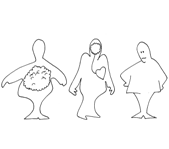
Paul, writing to the church in Thessalonica, presents us with a list of three parts which seem to summarise how we have been made. These parts are Spirit, Soul and Body. Note that the first part listed is not the body, but the spirit.

“And the very God of peace sanctify you wholly; and I pray God your whole spirit and soul and body be preserved blameless unto the coming of our Lord Jesus Christ.” 1Thessalonians 5:23

There is not guarantee that Paul’s list of these three parts is a final proof of our makeup. Some argue that it is not. However, there is no better description that I have found in the Bible to give us an insight into how God has made us. So, I assume that this is a description of our whole being. Note Paul’s use of the word “wholly” in that verse.

Note too that our being is defined from our spirit man, outward to our body. Today’s materialist thinking is distracted with the visible, external person and tries to work in from there. God, who is Spirit, deals with us and knows us from our spirit man first.

Defining the Parts

God is described as a “trinity”, or a tri-partite being. That is to say that God is made up of three distinct and identifiable elements, which are all equally part of the same whole being.

God is identified as the Father. God is also identified as the Son. And God is further identified as the Holy Spirit. Yet, despite the existence of these three identifiable elements, we know that there is only one God. Each of these three expressions of God is equally God. Yet they function in distinctly independent fashion.

While this is a challenging concept to grapple with, it is clearly presented to us in the Bible. We have one God. God is expressed in these three parts. God can exist in the reality of a single identity with three unique expressions.

So, when God made man in His own image (Genesis 1:26,27) it is logical that God made man as a tri-partite (three part) being, where three identifiable parts are all equally real parts of the one being. Thus the three components identified by Paul in 1Thessalonians 5:23 make sense: Spirit, Soul and Body.

You body and spirit are just as much “you” as each other, but they can be separated from each other. Your mind can think one thing, while your emotions struggle with something else.

So let me give you a simple working definition of the three parts given to us by Paul.

Spirit Man

Our ‘spirit’ is the part of us that is able to be in intimate relationship with God. It is therefore the most mysterious part of us and the hardest for us to identify within us. Jesus referred to this part of us as our “belly”, so it is often identified with our stomach.

“He that believes on me, as the scripture has said, out of his belly shall flow rivers of living water.” John 7:38

The Apostle Paul referred to our “inner man”.

“That he would grant you, according to the riches of his glory, to be strengthened with might by his Spirit in the inner man” Ephesians 3:16

Our Soul

Our soul is the part of us which happens inside our life, but which is independent of our communion with God. It is the realm of our thoughts, feelings and volition (use of our will), which we can engage whether we are in touch with God or not. Heart and Mind are the two parts of us that could readily be linked to the New Testament idea of ‘soul’.

We also have reference in the Old Testament to the ‘soul’. That term is used in the Old Testament at times to speak of our life in general, rather than a specific mind and heart component. Yet there are some places where the word ‘soul’ is used to describe something that is part of our inner processes.

On three occasions the Psalmist talks to his “soul”, as in internal part of him that is struggling with feelings of discouragement. This sounds very much like emotions and troubled thoughts.

“Why are you cast down, O my soul? and why are you disquieted in me? hope in God: for I will yet praise him for the help of his countenance.” Psalm 42:5 (see also Psalm 42:11 and Psalm 43:5)

I suggest that the same sense for our internal being, mind and emotions, is in focus in two other psalms relevant to our internal restoration. In the much loved Psalm 23 (The Lord is My Shepherd) we have the statement, “He restores my soul”. And in Psalm 147 we are told that God puts a bandage on the broken heart.

He restores my soul: he leads me in the paths of righteousness for his name’s sake.” Psalm 23:3

“He heals the broken in heart, and binds up their wounds.” Psalm 147:3

Our Body

They body hardly needs any introduction. It is the part of us which we are quite aware. Our physical feelings and appearance press themselves on us much of the time.

What is important is that we are much more than the sum of our physical parts.

And we should note that it is possible to put a smile on our face while we are feeling desperately sad on the inside. Our physical body can hide or mask our inner thoughts and feelings.

Most people rely on our physical appearance to signal to them who and what we are. Some people become masterful at deceiving others, hiding their inner self, deeper thoughts and feelings and even the decisions of their will, by their confident, smiling countenance.

The Place of Rejection

Rejection seems to have its greatest practical impact on our mind and emotions. That “cast down” feeling which the psalmist described in Psalm 42:5 is well known to people who are carrying around feelings of being un-loved or rejected.

So the place of rejection in our lives is often identified as being in our emotions. Our “hurt” feelings seem to be located in our heart.

Now, a more careful analysis may prove that there is much more to it than that. But, for my purposes, that simplification is perfectly workable. If you are given to profound analytical thought then be my guest to try mapping all the nuances and shades or internal geography. But know this, if you are planning to help yourself and others, what I have presented here is perfectly sufficient.

So, now we are ready to move on.

Choose Your King

Your power of choice is incredibly important to you. No more so than with your choice of who to bow to. Ultimately you must bow your knee to Jesus Christ. You can do that in your life, now, and be happy about that for eternity. Or you will end up bowing your knee to Jesus Christ after this life is over, and having eternity to regret not having done it now.

Choice

Joshua, who led Israel into the Promised Land, understood the importance of making a choice about who you will bow to. He challenged the nation of Israel to choose who they would serve. He declared, as an old grandfather, that he and his entire household were dedicated to serve the Lord.

“And if it seems evil to you to serve the LORD, choose you this day who you will serve; whether the gods which your fathers served that were on the other side of the water, or the gods of the Amorites, in whose land you dwell: but as for me and my house, we will serve the LORD.” Joshua 24:15

So it is for each of us. We must make the choice of who we will bow the knee to.

That is why this post is titled, “Choose Your King”.

Abraham and Kings

Abraham did business with kings. He negotiated with them. He rebuked them. He feared them. He did battle with them. He fought on their behalf. So Abraham had opportunity to reveal how a man of God should deal with kings.

The historical record lists a group of warrior kings who oppressed parts of Palestine in the days of Abraham. There is no record that they oppressed Abraham personally, but Abraham’s nephew, Lot, was living in Sodom, and so came under the oppression of these kings.

“And it came to pass in the days of Amraphel king of Shinar, Arioch king of Ellasar, Chedorlaomer king of Elam, and Tidal king of nations; That these made war with Bera king of Sodom, and with Birsha king of Gomorrah, Shinab king of Admah, and Shemeber king of Zeboiim, and the king of Bela, which is Zoar.” Genesis 14:1,2

War of the Kings

When the local kings rebelled against the oppressors war broke out. The dominant kings invaded the land, attacked the rebelling cities and took them all captive.

“And there went out the king of Sodom, and the king of Gomorrah, and the king of Admah, and the king of Zeboiim, and the king of Bela (the same is Zoar;) and they joined battle with them in the vale of Siddim; With Chedorlaomer the king of Elam, and with Tidal king of nations, and Amraphel king of Shinar, and Arioch king of Ellasar; four kings with five. And the vale of Siddim was full of slimepits; and the kings of Sodom and Gomorrah fled, and fell there; and they that remained fled to the mountain. And they took all the goods of Sodom and Gomorrah, and all their victuals, and went their way. And they took Lot, Abram’s brother’s son, who dwelt in Sodom, and his goods, and departed.” Genesis 14:8-12

Abraham’s Army

Fortunately for Lot, Abraham had his own standing army. And that army was an impressive force. Abraham had 318 trained servants in his household who were prepared for warfare.

“And when Abram heard that his brother was taken captive, he armed his trained servants, born in his own house, three hundred and eighteen, and pursued them unto Dan. And he divided himself against them, he and his servants, by night, and smote them, and pursued them unto Hobah, which is on the left hand of Damascus. And he brought back all the goods, and also brought again his brother Lot, and his goods, and the women also, and the people.” Genesis 14:14-16

That’s a pretty good effort. Four kings which dominated the region and beat all that was before them were overpowered and defeated by a small private army. It begs the question of what “trained servants” means and what kind of ‘training’ Abraham gave them.

King Rejected

Obviously Abraham was a hero after such a victory. The King of Sodom was overjoyed to receive his people and goods back. Abraham was like an angel to him. So the King offered to give a huge reward to Abraham.

However, Abraham declined to take anything from the King. Abraham did not want it to ever be said that the King of Sodom had made him rich. Abraham allowed his own servants to receive a reward, but he refused for himself.

“And the king of Sodom said unto Abram, Give me the persons, and take the goods to yourself. And Abram said to the king of Sodom, I have lifted up my hand to the LORD, the most high God, the possessor of heaven and earth, That I will not take from a thread even to a shoe-latchet, and that I will not take any thing that is yours, lest you should say, I have made Abram rich” Genesis 14:21-23

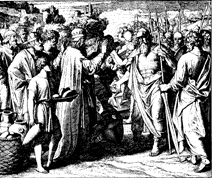
Abraham rebutted the King of Sodom, refusing to receive anything from him.

King Honoured

On the same day Abraham rejected the King of Sodom he met yet another king and gave that king total adoration. Now, isn’t that interesting? Abraham did not treat all kings equally. Abraham rebutted one king and fell at the feet of another.

The Bible records that Abraham met Melchizedek, the King of Salem, or King of Peace. Some even suggest that Melchizedek was King of the Heavenly Jerusalem (see the word “Salem” in the word Jerusalem).

“And Melchizedek king of Salem brought forth bread and wine: and he was the priest of the most high God. And he (Melchizedek) blessed him (Abram), and said, Blessed be Abram of the most high God, possessor of heaven and earth: And blessed be the most high God, which hath delivered your enemies into your hand. And he (Abram, later called Abraham) gave him (Melchizedek) tithes of all.” Genesis 14:18-20

Spiritual King

We learn later, in the book of Hebrews in the New Testament, that this meeting was very significant.

“For this Melchisedec, king of Salem, priest of the most high God, who met Abraham returning from the slaughter of the kings, and blessed him; To whom also Abraham gave a tenth part of all; first being by interpretation King of righteousness, and after that also King of Salem, which is, King of peace; Without father, without mother, without descent, having neither beginning of days, nor end of life; but made like the Son of God; abides a priest continually. Now consider how great this man was, to whom even the patriarch Abraham gave the tenth of the spoils.” Hebrews 7:1-4

This King of Salem was a divine and eternal being. I believe that Melchizedek was a pre-incarnate manifestation of Jesus Christ. He brought “bread and wine” to Abram, just as Jesus gave His disciples the Communion (Eucharist) meal at the last supper, in which He said, “This is my body… This is the New Covenant in my blood”.

So Abraham fell down and worshipped the spiritual king, but did not give place to the wishes of the wicked earthly king.

Wicked King

How do we know that the King of Sodom was a wicked king?

Not long after Abraham had rescued the city from the invading kings that whole region was destroyed because of the homosexuality of the men. The King of Sodom ruled a land of sensual, sexually abhorrent men. No righteous king would have created a culture so wicked that God would destroy it.

The King of Sodom presided over a nation of men who had lost their manhood. They had taken up a ‘lifestyle’ which cut the gizzards out of their personal moral authority. That is why they could not defend themselves, while a few hundred morally pure men under Abraham’s command could rescue them all. When men live for sex and abandon their calling as real men they also lose their moral might as men.

The King of Sodom had created a nation of wicked men. So it could hardly be argued that he was anything but a wicked king.

Choose Your King

Satan comes to us with all the grandeur of human kingly authority and offers us wealth and all that man could think valuable. But we are to reject that offer, even if it seems we are offending the King.

Christ comes to us with all the grandeur of heavenly kingly authority and challenges us to lay down all for him. We are to run to Him and gladly suffer the loss of all things in order to have Him as our Lord and King.

Abraham had no difficulty in choosing which king he would bow the knee to. But we get tangled up in the compromise of wanting wealth from earthly kings, through certifications, welfare payments, concessions, grants, funding, approvals and the like. We fall down and worship the “kings of Sodom” without realising the spiritual compromise that we enter into.

When we bow the knee to the “heavenly King”, ensuring our devotion to God’s divine leadership in our lives, even shunning the gifts offered us by earthly kings, we remain in the place where God’s blessings can manifest in our lives.

Shortly after Abraham’s sunning of the King of Sodom the city was destroyed and Abraham received the promised heir.

My wish for you is that you escape the destruction of the earthly kings and receive the fullness of God’s promises in your life instead.

Sacrificial Purpose of Manhood Video

Being a “Man” challenges us at the very core of Western values. Our culture teaches us to look out for Number One, and to seek things which will please ourselves. Self-Interest, then, is a core value in Western culture.

So God’s intention that men live by Sacrificial Purpose cuts across our instincts and cultural training.

However, the Bible is clear that men are not to live for themselves but for others. And so Pastor Chris Field gives a clear and strong call to men to step up to that kind of living. He opens up the Bible and shows that this is not some crazy idea in his own head, but a truth that rings clear from the pages of scripture.

Other Videos by Pastor Chris Field include ….

SEXUALITY VIDEO“Sacred Nakedness” http://chrisfieldblog.com/marriage/sacred-nakedness-video

MARRIAGE VIDEO“What is Marriage?” http://chrisfieldblog.com/marriage/what-is-marriage-video

MARRIAGE VIDEO“50-50 Marriage?” http://chrisfieldblog.com/marriage/50-50-marriage-video

MANHOOD VIDEO“The Manhood Call” http://chrisfieldblog.com/manhood/manhood-call-video

TRUTH VIDEO“Where Does Your Truth Come From?” http://chrisfieldblog.com/ministry/truth-video

PARENTING VIDEO“Heart of a Child” http://chrisfieldblog.com/parent/heart-of-child-video

PARENTING VIDEO“Godly Seed” http://chrisfieldblog.com/parent/godly-seed-video

PARENTING VIDEO“Child Discipline” http://chrisfieldblog.com/parent/child-discipline-video