Adjusting the Settings

My first factory job had me chomping lengths of angle-iron in a metal fabrication shop. The boss would set the stopper on the old Italian cutting machine and I would either push the lengths toward the machine or pull the chomper handle once the length had been measured.

Wanting to make a good impression I worked hard and wore holes in the protective gloves. However the boss came out an hour later in a foul mood. We had pushed the metal so hard that the measuring mark had moved over time. We were now cutting lengths that were too long.

We were then taught how to check our lengths regularly and adjust the stopper if we moved it. Our pace was reduced, but our output was much more consistent.

And so it is with many processes. Machines and systems have to be recalibrated. Machines have to be put back to the manufacturer’s settings from time to time. It’s part of routine maintenance of most equipment.

Check the Settings

Parenting involves attention to the settings in our children’s lives. It is ours to determine the correct settings, put those settings into our child’s life, and then check the settings regularly, making adjustments as required.

Most parents, however, don’t even realise that they are responsible for the settings in their child’s life. Most don’t know what the best settings are. Nor do they know how to check the settings and adjust them. Consequently, most parents don’t realise that there are many people messing with the settings in their child’s heart and mind. That is why some families are completely surprised by the direction their child takes over time.

This series will open your thinking to this important process and give you some notion of how it works. You will be directed toward the best settings to follow and the best way to reset your child’s life to the settings you want them to follow.

First I need to get you thinking about the settings in your own life.

The Missing Printer
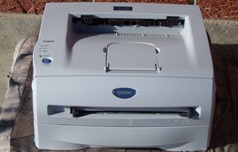
printerLast week we struck a problem when our laser printer went out of service. The reliable older machine no longer matched the newer equipment we used on a daily basis. An old laptop was our only means of activating the printer. When that old laptop gave up the ghost we were stuck.

My mind went to finding adaptors that would allow our newer computers to drive the reliable older printer. I called people who could help me and tracked down a store where I believed I could get the right parts.

Just before I set off to buy the needed adaptors my son pointed to a machine sitting on a shelf and asked, “Isn’t that a printer?” I had to look twice to confirm that indeed it was. I did not remember the machine even being there. It was more modern than the machine we had been using, but for some reason it had been put aside. I was able to get that machine working fine and our printer problem was solved, without adaptors.

Blind Spots

I would have sworn that there was not another printer in the building. But what is worse, I had looked at the shelf containing the waiting machine many times each week for the past few years. The printer was in my line of sight, but never registered in my brain. My eyes saw it, but my brain did not.

This relates directly to “settings”. I had deemed that printer to be of no value, due to a problem with the toner supply. Once my brain had accepted that setting it no longer saw the machine as a “printer” but simply as something to ignore. My brain did an excellent job of ignoring that equipment. I completely forgot it was there.

Settings in my brain determined how it processed information it received. My eyeballs regularly provided an image of the printer, but my brain relabelled the image as “irrelevant” and did not catalogue the machine among the things it bothered to remember.

My brain creates blind spots, based on the settings I tell it to follow.

Reticular Activating Device

Our Reticular Activating Device (RAD) is credited with being able to program our brain to see or not see certain things. Until something becomes significant to us we can be completely blind to it. Once we have our eyes “opened”, as it were, by being tuned in to something, we begin to see what we never saw before.

A crowd of people will look like a crowd of people to a casual observer. But someone looking for a pretty girl will have looked at the crowd differently. A security guard will have looked at the crowd differently again. An insurance salesman will have looked at the crowd with different eyes again.

Each person has their own unique “settings” which engage the brain in filtering information in a unique way.

Heart and Mind

The process of “seeing” involves more than just a mental process. Heart issues are just as potent as thoughts of the mind. They are probably more significant. Moral issues, motives and similar heart responses impact our ability to see, just as our mind does.

If someone accidentally spilled coins onto the footpath some people would rush to their aid while others rushed to get something for themselves. Some people reject the opportunity to steal, lie, cheat or be immodest, because of moral sensitivity in their heart. Others have no qualms about such things, because their heart is darkened.

Manufacturer’s Settings

Most machinery is supplied with the manufacturer’s settings installed. Changes can be made to those settings if required.

adjusting2Your role, as a parent, is to imprint the basic manufacturer’s settings into your child’s heart and mind. You are to ensure they have the correct settings and that those settings are not being tampered with.

Whether you like it or not, you are impressing settings into your child’s heart and mind all the time. Your attitudes, reactions, values, choices, words, daily routine, and so much more are pre-programming your child’s future.

Others, such as their friends, television programs, songs, teachers, and even strangers who cross their path, are also programming your child in one way or another. So parents, the task is “adjusting the settings” is your mission for the first decades of your child’s life. Get used to the idea.

And look out for further posts in on Adjusting the Settings, where I explain more about this important aspect of your parental responsibility.


If Only You Knew Me

Someone sent me an email with the following images and I thought it would be a blessing. So I am posting it here as a permanent place to find it.

Consider these “If”s in your life….

If you never felt pain, Then how would you know that I am a Healer?

1

If you never had to pray, How would you know that I am a Deliverer?

2

If you never had a trial, How could you become an overcomer?

3

If you never felt sadness, How would you know that I am a Comforter?

4

If you never had a problem, How would you know that I can solve them?

5

If you never got stuck, How would you know that I have more for you? 6

If you never were in trouble, How would you know that I will come to your rescue?

7

If you never were lost, Then how would you know that I came to find you?

8

If you never felt guilty, How would you know that I forgive?

9

If you never had any suffering, Then how would you know what I went through?

91

If you never asked, Then how would you know I had the answers?

92

If you never had a need, How could I do a miracle for you?

93

If I never corrected you, How would you know that I love you?

94

If you had all power, Then how would you learn to depend on me?

95

If your life had no struggles, Then what would you need me for?

96

The Big Stick is not the Big Stick

I love it when I see something in a completely new light. Mostly we don’t need to see “new” things, but to see the old things the way they really are. When our brains are told to interpret things one way or another we can be effectively brain-washed by that instruction. Somehow we overlook the evidence and keep interpreting it according to the definition or label we were told to apply to that thing.

Many of the things we “know” are only things we “believe”. We “believe” them to be true, and thus think we “know” them. But, alas, we are deluded, and are even blind to an accurate interpretation because of the pre-programmed beliefs.

Praise God, He sets us free from deception, because Jesus Christ is the “Truth”! Jesus said, “I am the way, the truth and the life!”

“Jesus said to him, I am the way, the truth, and the life: no man comes to the Father, but by me.” John 14:6

Deceptive Labels

Education involves learning to put labels on things. The bigger our set of labels the better educated we are. We are able to discern between things when we have a large enough set of labels to enable us to put different things into different categories. Hoorah for labels!

But, if we are given the wrong label for something, then we have not been truly educated at all. In fact, we have been brain-washed, indoctrinated, deceived and denied insight into the truth.

Notice that socialist economists have influenced much of modern academia on economic themes. I expect that the labels a socialist mind conceived for economic processes put those processes in a different light to a Biblical economist, or a capitalist economist.

The label “prehistoric” is a philosophical statement in itself. Biblically speaking nothing is pre-historic, since the Bible record accounts for human history all the way back to day one. But the label “prehistoric” is deceptive and brainwashes the hearer into thinking that there must have been existence before the historical account began. Thus the term “prehistoric” embodies an attack on the Biblical record. It is a deceptive label.

Carrot and Stick

carrot and stick

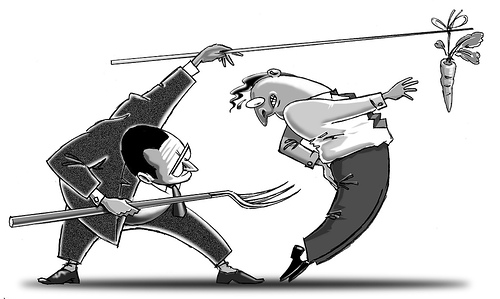
Let me get toward my point. We have all heard mention of the two forms of motivation, the carrot and the stick. Carrots are positive inducements that prompt people to action. The stick represents negative inducements to action. A carrot might be a bonus for completing a task on time. A stick might be a punitive outcome if the task in not completed on time.

Management theory has addressed the competing tools of the carrot and the stick. And these labels have had a “reductionist” effect on human thinking.

Most people’s first thoughts about motivating themselves or others will orient toward either or both of the carrot and stick. These two categories tend to dominate and thus obliterate perception of alternative possibilities.

Other Possibilities

Many people do what they are asked to do and perform well, simply because that is their choice. They are not motivated by the carrot or the stick, but are simply doing what they have been programmed or trained to do.

Some people make a greater effort out of concern for others who they see under pressure. They pitch in out of social motivation, based on their sense of shared responsibility and their desire to see their friend aided in a difficult situation.

Some people simply love a challenge. They are motivated by realisation of a need and the definition of a clear challenge to overcome that need. The feeling of “We did it!” is all the reward they need.

The Big Stick

Biblical Parenting involves use of the “stick”. King Solomon instructed humanity thousands of years ago to train children by using words and physical discipline. The old English translation, the King James Bible, uses the word “rod of correction” to describe the stick that is used by parents to train their children.

“Foolishness is bound in the heart of a child; but the rod of correction will drive it far from him.” Proverbs 22:15

“The rod and reproof give wisdom: but a child left to himself brings his mother to shame.” Proverbs 29:15

He that spares his rod hates his son: but he that loves him chastens him as required.” Proverbs 13:24

Punitive or Therapeutic?

Influenced by the “carrot and stick” labels, how should we interpret the use of the “rod of correction” by parents? It is seen as a punitive, negative reward. It is seen as the opposite of the more positive encouragement inducement or positive reward option.

In a “carrot and stick” world, use of the “rod of correction” is seen as the ugly choice. Caring, sensitive, compassionate, New Age parents think they can discard the cruel ancient wisdom of Solomon and embrace more advanced and enlightened methods of training their children. Such parents aim to use rewards, coaxing, mature negotiation and other alternatives to the offensive “hit the kid with a stick” option.

The “carrot” triumphs over the “stick” in today’s modern homes.

Back to the Book

The Bible was written long before the more modern discussions about the carrot and the stick. And Solomon’s wisdom needs to be seen for what it is, not what the labels have brainwashed us to think it says.

So, let’s go back to the book and see what is really being said about the “rod of correction”. Let me repeat a verse I quoted earlier…

Foolishness is bound in the heart of a child; but the rod of correction will drive it far from him.” Proverbs 22:15

The use of the “rod of correction” is not punitive in this instruction. It is therapeutic! The rod of correction has a specific and vitally important function, and it has nothing to do with motivating a person to do what mummy tells him to do.

The “rod of correction” has a transformational impact on a child’s heart. It drives “foolishness” far from the child. If that foolishness is not driven away, by the use of the “rod of correction”, then the child will carry foolishness in his heart right through his adult life.

The Good of the Child

The “rod of correction” is for the good of the child. A parent who refuses to do this good to their child is described as hating their child.

He that spares his rod hates his son: but he that loves him chastens him as required.” Proverbs 13:24

The punitive “big stick” is for the good of the manager or the person who wants to get their project done or their will obeyed. The Big Stick is an aid to the teacher, boss, prison warden or similar role where a person in charge demands compliance.

That kind of big stick can lead to abuse and dominance of those under punishment. The “rod of correction” applied for the good of the child cannot be a tool of abuse. It is not an indulgence for the parent, but a blessing to the child.

Quoting Myself

In a recent article on Leadership, titled Leading With Authority, I made an aside about the use of force. I quote myself here….

“Note here that Biblical use of the “rod of correction” is not coercive. Parents are not told to use the rod to get action or obedience. They use the rod of correction only temporarily, in order to create a heart change in their child. Once “foolishness” has been driven from the child’s heart by the “rod of correction” (not the rod of abuse or anger) then the rod becomes redundant. So adult leaders who think they have a Biblical clearance for the use of force and threats are misguided.”

carrot-and-stickBack to the Stick

Parents need to go back to the stick. But the Big Stick is not the Big Stick! The “rod of correction” which godly parents use to train their child is not a “Big Stick” of threat and intimidation to coerce appropriate behaviour. If the stick is used as a “threat” then it is not being properly used.

The “rod of correction” is not of value because of its intimidation and the fear of its use, but by its application and its measured and appropriate use. Godly parents who wisely use the “rod of correction” to remove foolishness from their child can then get on with parenting their child without recourse to the Big Stick. They don’t need to threaten the child, or intimidate the child with the stick waved over the child’s head.

Those two concepts are foreign to each other and have created the kind of confusion that leads some authorities to seek to ban godly discipline. The Rod of Correction is not the Big Stick. It never was and was never meant to be.

It’s time for parents to go back to the “rod of correction”, for the sake of their children. Its application will only be temporary. It is not a punitive and intimidating “negative reinforcement” mechanism. It is a means of delivering the child from foolishness. Once that is done, the rod is put away and your effective parenting continues with those other Biblical training processes you have already been using as well.

Go to it!

Self-Control Without Self

I realised something recently that sounds like a contradiction. Imagine “self-control” without any “self” involved! Is such a thing really possible?

Self-control is a major challenge for people. Many struggle for the whole life to rein in their words, addictions, urges, reactions and so on. Most resolutions that people make are probably focused on gaining some new level of control over their actions, thoughts, words, spending, and so on. Self-control is a major component of personal development and making progress in life.

I Will Succeed

We admire people with strong wills, who can overcome obstacles and achieve things that others cannot win over. Losing weight, getting fit, quitting smoking and slugging through difficult studies are just some of the areas in which people have shown their determination to succeed.

self-controlDetermination and self-control by sheer willpower is seen as a great achievement and a true credit to those who display such things. These are the people held up as examples to us all.

If It Is To Be …

The saying goes, “If it is to be, it is up to me!”

That catch-cry is meant to rally people to improved resolve of will to push ahead and make the changes that need to be made. They are told not to rely on others or to dump their challenge onto some other person, but personally persist, until they get the breakthrough.

It’s great stuff. We applaud those self-reliant people who know that it is up to them to make things happen, and who get off their chair and get things done.

But, In The Bible…

However, despite the popular human notions of self-will and self-reliance, leading to self-control, the Bible has something to say about this stuff. And what the Bible has to say is quite surprising. It is the Bible that suggests to us the idea of Self-Control without “self”.

Let me show you where I get this from. Self-Control is shown to be a “Fruit of the Holy Spirit”.

When the apostle Paul wrote to the church in Galatia, he listed a bunch of things that were the fruit coming from the work of the Holy Spirit in people’s lives. Self-control is listed as one of them.

Fruit of the Spirit

“But the fruit of the Spirit is love, joy, peace, longsuffering, gentleness, goodness, faith, Meekness, self-control: against such there is no law.” Galatians 5:22,23

The King James Bible uses the word “temperance” in that text, while modern translations use the updated term we are more familiar with: self-control.

So, self-control is a “fruit of the Spirit”. Self-Control does not come from “self”, but rather comes from the work of an agent separate to our “self”. It comes from the work of the Holy Spirit of God.

It is Not Up To Me!

Imagine that! If it is to be, it is NOT up to me. If it is to be, it is dependent on God. If self-control is to be part of my life, I am dependent on the work of the Holy Spirit to create that fruit within me!

That does not mean that I am relieved of the responsibility to gain self-control. What it does mean is that the best way to get self-control is not through the determination of my own will, but through yielding to the work of the Holy Spirit in my life.

I have seen many people whose personality and character has been transformed as the Holy Spirit worked in their life. Anger and hardness gave way to joy and peace. Explosive reactions and addictions fell away and a quiet spirit emerged instead. When the Holy Spirit is allowed to work in a life the fruit is really sweet.

Fruit not Sweat

Notice that self-control is listed among the “fruit” of the Holy Spirit. Trees don’t groan and struggle to pop their produce at the end of the limb. You do not get kept awake at night by the sound of fruit trees grunting to grow their fruit. You do not see fruit trees in a lather of sweat as they struggle to be fruitful.

Fruit just grows. It starts small and gradually fills out until it is ripe and ready to be eaten.

And that’s how it is with self-control in our lives. When we yield to the Holy Spirit and allow God to minister into our lives we develop lovely, fresh fruit. There is no sweat or struggle. We don’t curse ourselves and chant encouragements to ourselves to keep pressing on. It just happens naturally and almost unseen on a day to day basis.

Self-control is a Fruit of the Spirit, not a Work of the Flesh.

Worship Will or God

The apostle Paul, writing in a letter to the church in Colosse, used the term “will worship” (Colossians 2:23). He referred to those who become committed to human rules and religious ordinances. They display great discipline in neglecting themselves and maintaining the various rules they have adopted.

People caught up in such things, however, are not living in the freedom purchased for them by Christ. If you have chosen to follow Christ, then you won’t be party to those things and the will worship that goes along with them.

Serving religious duties can cause those with strong wills, who keep the rules most diligently, to look better than others. But all that counts for nothing. We are not to worship our will, but to worship God.

Gain Self-Control

I want you to gain self-control. I want you to have so much of it that you rule your own spirit and are stronger than the mighty ones who capture whole cities.

“He that is slow to anger is better than the mighty; and he that rules his spirit is better than he that takes a city.” Proverbs 16:32

Don’t build up your self-control by reliance on your own self-will. Build self-control by looking outside your “self”. Find it in the work and ministry of the Holy Spirit in your life. Be filled with the Spirit. Be baptised in the Holy Spirit. Be led by the Spirit. Do not quench the Spirit. Soak in Bible truth for it is the sword of the Spirit. Walk in the Spirit every day. Pray in the Spirit and sing in the Spirit. Stay under the anointing of the Holy Spirit.

As you let the Holy Spirit into more and more of your life you will discover that self-control is developing within you, without any demands upon your self-will. And along with it will be “love, joy, peace, longsuffering, gentleness, goodness, meekness and faith”. Now, that’s a pretty good deal, eh?

Do you Indulge Your Child?

My wife, Susan, was praying with a mother recently about the raising of the woman’s children. Susan was prompted to enquire about a particular child. While praying for that child Susan’s mind was quickened to the word “indulgence”. Since this word seemed to be prompted to her, Susan mentioned it to the mum.

Susan asked the mum if she indulged that particular child. The mother did not know what Susan meant. Susan explained that if a child refuses to cooperate or otherwise makes demands and the parent eventually gives in, then the will of the child has been indulged.

With that explanation the mother admitted that she certainly did indulge the child. Susan then cautioned the mother that pandering to the will of the child, especially when the child was seeking to get around the mother’s will, would reap terrible consequences in years to come. Susan then explained to the mum her need to be firm with the daughter and to apply godly wisdom and Biblical child training to the children, so they are freed from foolishness and learn to fear God and live wisely.

Let me ask you again….

Do you indulge your child?