Words That Control Us 1

Those who control us do so by “Words”.

This series of articles walks you through an understanding of the Words that Control Us and what we can do about it.

This first lesson looks at the fact that Words impact us.

A Shout

The Deputy Headmaster at my high school (St Marys High – not a Catholic Girls School as some thought) was Jack Curry and he loved to catch people off guard with his shouted cry “You Boy!”

Just about everybody in earshot would freeze when they heard that distinctive, commanding call.  We would all turn around to see if “Curry”, as he was called by the boys out of earshot, was calling to us or someone else.  It was always a relief to realise he had someone else in his sights.

Occasionally the senior boys would mimic the “You Boy!” call, first creating a shock, then a chuckle as people realised it wasn’t Mr Curry.

Jack Curry was promoted to Headmaster at a nearby school and we were spared his intimidating call.

Getting Your Attention

If someone calls loudly near us we usually turn around to see if someone is trying to get our attention.

Someone may be calling to us, or to someone else.  So unless we check the matter out we won’t know.

They may be warning us of an approaching car or similar danger.  They may want to get our attention so they can sell us something, as happens when westerners visit some tourist destinations and the sellers want to hawk their wares.  There may be some official wanting our attention, or someone who simply wants to say “Hi!”

When people call for our attention we tend to naturally look in their direction and then assess the situation from there.  We can stop and listen, or walk on and ignore them.  We can heed the warning and adjust our actions as we see fit.  Or we can be completely dominated by the demands of the other person.  It is up to us to decide how to react to someone wanting our attention.

Speaking With Authority

While most of the voices we hear around us are just those of other people with no authority over us, it is possible that the person speaking has some right to be demanding our attention.

We use the term Jurisdiction to describe the right to speak word (diction) that have authority (juris).  The Deputy Headmaster of a school has a lot of authority and speaks with Jurisdiction.  But one of the junior students can be ignored, because they are without authority.

Yet at times a junior student would turn up in a class with a message demanding that some student report to the office.  That demand did not come in the name of the junior student, who was without authority, but usually came in the name of the Headmaster.  If the junior student was ignored then the Headmaster who sent that student was also being ignored, and that was a serious matter.

Someone doesn’t have to possess personal authority to speak with authority, if they are speaking under the authority of someone else.

When I Say “Jump”

Speaking with someone else’s authority is clearly illustrated in the words of a Roman Centurion who history records meeting with Jesus of Nazareth, 2,000 years ago.

The Centurion described his authority as follows:

“For I am a man under authority, having soldiers under me: and I say to this man, Go, and he goes; and to another, Come, and he comes; and to my servant, Do this, and he does it.” Matthew 8:9

The Centurion’s men did exactly what he told them to do, but only because the Centurion was “a man under authority”.  When the Centurion said “Jump” the men jumped.  But that is because when the Centurion’s bosses said “Jump”, HE jumped.

So some voices that call for our attention will be voices with delegated authority, giving them jurisdiction.

Imposing Our Words Onto Others

It is interesting to note that people tend to defer to those who are assertive.  If someone starts to assert their authority or speak in a compelling manner it is likely that a good percentage of people will at least pay attention.

Those of us who are trained in civility, to honour others, do as we are told, respect authority and so on, are highly likely to pay attention to someone who appears to have authority making assertions.

This is the process of imposing words onto others.  Most people do that, even in casual conversation.  Mostly it is an innocent negotiation for the attention and interest of others.

In official matters, however, it is a serious subject demanding our understanding.

Mary Slessor and Words

An amazing example of a person imposing their words on others comes from the legendary English missionary lady Mary Slessor who went to the remote tribes of Nigeria where no white man or woman had been before.

From 1888 she worked with the godless Okoyong tribe which delighted in bloodshed.  She often stood between war parties to stop them killing each other.

Her methodology was to call the leaders of the two fighting groups to account to her the reasons for their arguments.  She would set herself up in the shade of a tree with her knitting, and listen as each side put its case.  Her aim was to keep them talking until they had cooled off or it was too late in the day to do the fighting.  By this means she saved many lives, and did a great deal of knitting.

On one occasion she learned of a fight about to take place at some distance from her.  She cut out a piece of cloth and quickly made various ink markings on it.  She then rolled it up and closed it with a wax seal, giving it the appearance of something very important.  She sent it off by a man who ran to the scene of the fight and presented it to the leaders, saying that the white woman would be along soon to explain the meaning of the mysterious, and obviously important document.

When Mary arrived she unwrapped the cloth and made up her explanation of the random symbols, and thus averted the bloodshed that would otherwise have occurred.

Gladys Aylward and Words

Another feisty English lass who went to remote places was Gladys Aylward who ended up in the mountains of northern China.  On one occasion she was called to deal with a bloody riot in the local prison.  The local mayor and prison commander were terrified and so they demanded that she go into the jail and stop the riot.

She was pushed through a small door which was hastily locked behind her.  She then walked through a darkened tunnel to emerge into the courtyard where dismembered bodies lay about.  A huge man with a blood soaked meat cleaver stood nearby, his chest heaving.  Others were fleeing, crying in pain, or lying dead.

In what became her typical fashion, Gladys scolded the man for his bad behaviour and demanded that the man give her the cleaver, which he did.  Her unexpected appearance and forthright manner quelled the whole drama in a matter of moments.

Yet all Gladys had on her side, apart from her faith in God, was a forthright manner and a bunch of words.

Gladys later used the same demanding manner and calls to people to rally a village to deal with the aftermath of a deadly strike by Japanese war planes.

Imposing Words

In the examples of both these ladies we see the use of words which imposed something over the audience.

Asserting authority and using words enabled both of these godly women to bring about a positive change.  Yet what they were doing involved imposing their will onto others, by their resolute demeanour and their commanding words.

We too are impacted by those around us who use those techniques.  And those techniques are not always used for our good.

People in uniforms or with official positions, using their fancy words on fancy paper, or shouting their commands with an air of authority, can quickly herd people into the responses those people impose.  Yet, like the cloth sent by Mary Slessor, the documents and apparent significance can be completely fictional and of no real substance.

Under Control

You are already under the control of others who have used nothing more than assertion and words to impose their will onto you.

Some of those may have the right to speak.  They may have true “jurisdiction”.  But others may have assumed and asserted control that they do not have.

The purpose of this series is to explore the impact of other people’s words over you and the control they assert, so you can make your own decision about how you respond.
Speaking With Authority

I saw something sweetly tantalising in a familiar Bible text on Sunday. It has to do with Authority which is a bit of a thing with me over the past year or so, linked in to such things as Jurisdiction, personal sovereignty and such like.

What I saw is that authority is directly linked to speaking authoritatively, so that things happen as a result.

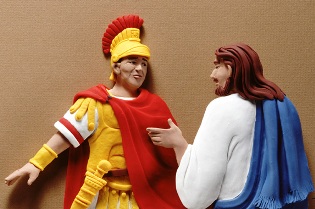
Now, guess where I found that in the Bible. It is in a passage that is often quoted in reference to authority – the comments by the Roman Centurion to explain why he was confident that Jesus could heal the centurion’s servant simply by speaking the word.

ClayDetailCenturian

“And when Jesus entered Capernaum, a centurion came to him, begging him, And saying, Lord, my servant lies at home paralysed, grievously tormented. And Jesus said to him, I will come and heal him. The centurion answered and said, Lord, I am not worthy that you should come under my roof: but speak the word only, and my servant will be healed. For I am a man under authority, having soldiers under me: and I say to this man, Go, and he goes; and to another, Come, and he comes; and to my servant, Do this, and he does it. When Jesus heard it, he marveled, and said to those that followed, Truly I tell you, I have not found so great faith, no, not in Israel.” Matthew 8:5-10

Now, in case you missed the salient point let me remind you that this dialogue is about Authority. The centurion is absolutely confident that Jesus has the Authority to heal the sick servant. And that confidence about authority is directly linked in the Centurion’s mind to speaking.

The Centurion is saying, “I know how authority works. When you have authority all you have to do is give a command and it is obeyed. Jesus, I know you have authority so all you really have to do is give the command and the healing will be done.”

As you explore your own authority remember that it is directly linked to your words. When dad gives an instruction to his children or says “No” to their request there is great power in that expression of his authority. When a person who has authority speaks up in a meeting, to raise a question or press a point, the words have effect.

People who don’t have authority are ignored, shouted down, disregarded and silenced. If that is you, then you need to talk with God about what you have to do to recover your personal authority, or the authority of your place (as parent, husband, leader or whatever).

Another key from that passage about the Centurion is that a person has authority not inherently of themself, but because they are “under authority”. The Centurion said “I am a man under authority, and so I am able to tell others what to do.” If you have lost your authority it may be that you need to repent of having rejected the authorities which God has placed over you (your parents, husband, boss, leaders, etc).

I encourage you to discover the authority God has given you, reclaim and heal it if it has been damaged or lost in some way, and then Speak Up! Speak as one with authority, so you can release that authority into those you are responsible for.

The image of Jesus with the Centurion, above is “A Centurion’s Plea” from Clay Illustrations by Georgia Cawley

Authority Confusion

Recent discussion about whether present day Governments can legislate away our long-term rights and such things as our Common Law rights prompts me to discuss “Authority Confusion”, or, better put, “Jurisdictional Confusion”.

An analogy or two might be helpful, to open the subject.

Analogy 1 – The Military Commander

Imagine a Military Commander who instructs his army to invade a particular region and take the cities. In the process a young soldier realises that the region they are invading belongs to the broader realm of the King he serves. He asks his Sergeant to explain what is going on. The soldier is told that the Military Commander decided to bring that region under military control, instead of the King’s control.

The soldier eventually challenges the Military Commander. “Sir, how can we invade our own land and violate our own nation and King?”

The Military Commander explains that the King gave him the right to rule the army and so he is doing with it what seems best to him.

Jurisdictional Confusion

Do you see the Authority confusion there? Can you see the Jurisdictional confusion?

The Military Commander draws his authority from the King who appointed him. He has jurisdiction over the army, on behalf of the King, not independently of the King. The Military Commander violates his own authority, abandoning the right to hold it, once he attacks the very authority who gave him his position and jurisdiction.

Analogy 2 – The McDonald’s Manager

Imagine a man who is promoted to Manager of a McDonald’s hamburger outlet. Once in that position he chooses to change the recipe for the burgers, give free burgers to his friends and add a few home cooked products from his mum.

When the customers and staff ask him why he is doing it he explains that he is the manager now and can do what he likes.

That is ridiculous, because he only has authority as a manager because he is in the employ of the company. Once he mocks the company by abusing the position of responsibility and trust they have given him, he disqualifies himself from the role of manager. He will be sacked.

Conferring Authority

Authority is conferred. The authority of the Australian Government, for example, has been conferred upon it. Centuries of British legal and cultural heritage, with Christianity, the Holy Bible, Common Law, application of Natural and Divine Law, the Westminster System, Imperial Decrees, Maritime Law, and so on, have conferred on the present Government the responsibilities they currently hold. The people of Australia hold authority as the “electors’ parliament” and need to confer their personal vote to a government in order for that government to have authority to govern.

Captain James Cook, operating under Maritime Law, subject to the Crown of England and the British Parliament, anchored in Common Law, based on Natural Law and Divine Law, based upon the Person, Place and Values of Almighty God as expressed in the Imperial Document the Holy Bible (King James Version), provided the basis for today’s Government of Australia.

When a Government violates and rejects the principles upon which that very Government has been established it invalidates itself.

No Government or Parliamentary System can destroy its own foundations, violate the principles on which it stands, or revoke the rights, responsibilities and privileges upon which it is established without making a mockery of its own existence.

Subverting Authority

However “power corrupts” and so politicians and legislators are not above the temptation to distort reality, arrogate privileges to themselves and violate the rights of others. What is happening in modern societies is the assertion of the exclusive rights of the present forms of Government, independently of the basis on which they stand.

High Court rulings, Statute Laws and University text books notwithstanding, reality has not changed. A wrong decision does not dictate a new reality. Foolishness does not destroy wisdom. Lies do not render the truth powerless.

Powerful People

People, who are free indeed, by Divine Law, Natural Law, Common Law and their cultural and legal heritage, should not be fooled by those who tell them that they no longer possess that freedom.

In Australia we also have the Australian Constitution to further affirm our personal freedoms.

And notice what happens each time we are asked to vote. Our politicians come to us hat-in-hand at each election asking us to confer upon them the authority which we hold as Australians. Without our permission they cannot hold office.

We are not pawns of the Parliament, but they are our servants, as their repeated appeals for our votes affirm.

True Freedom

Parliamentarians do not determine our freedoms. Those freedoms are ours from creation and through history. Parliamentarians and legislators can only operate within a narrow margin of function. Any intention on their part to cross those boundaries reveals that they are unworthy of the trust placed in them and are ready to violate the very authority on which they stand.

Basis of Human Law Part 4

In the past three posts on this topic I pointed out various observations from the early chapters of the Holy Bible which have import to the subject of human law. The principles found there provide an important basis for human law.

I have grazed through a number of observations, en route to a picture of our modern legal system and the process of human law. I can’t guarantee we’ll get there, but the journey has been valuable so far.

Review

Before pressing on with more things to observe, it is fitting to take some time to review what we have observed so far. To help harvest some of the insights and their significance for future application I am not only revisiting the content, but grouping it into several sub-headings.

All of these points come from a source that is identified as divine revelation. That is, they were not worked out by human thinking or made up by human inventiveness, but were revealed to mankind by God, Himself. God inspired holy men to write what was impressed to them. At the same time historical records were kept of the events of people’s lives. As centuries passed the collection of holy writings became increasingly potent, because things that seemed of little note when recorded in antiquity became powerfully relevant and significant in later times. Thus a book which was actually written by God was passed to us, and, despite the many contributors over many centuries, we have a book that conveys a unified message from one creative author, God.

So here are the points we have covered so far, from the Biblical text.

Existence

The essence of life is our very existence. But we humans are not the only identities which have significant existence.

God is our pre-existent, sovereign creator. All existence springs from God’s existence from eternity.

Natural law is a product of what has been created by God. It is thus a by-product of God’s existence. To appeal to natural law as the foundational legal reality, without regard for God, is a nonsensical idea. Nature is not the place from which we spring, but a product of God’s creativity, just as we are. It was not made in God’s image, but we are.

Man is a created being, morally accountable to the holy Almighty God.

Man’s existence is a consequence of God’s existence. God exists because He is God. Man exists by the will of God.

Life is impacted by three types of being: God; Man; and the Devil. The devil actively influences people to rebel against God, especially by getting them to reject God’s Words.

Note that the devil is a created being. He was at first an angel created to serve God, but he rebelled against God’s authority and thus awaits his eternal doom. Meanwhile, God allows him to tempt mankind as a means of testing he hearts of men, to find those who will truly submit to God.

Supremacy and Jurisdiction

Law requires courts, judges, rulers and the like. These people have some level of authority over others and some realm of jurisdiction in which their word holds sway.

God is the supreme being and has jurisdiction over the entire universe and all that is known and unknown.

Jurisdiction allows a being to speak over a certain realm with authority. God’s jurisdiction is eternal and unbounded. Everywhere that light can go is within the bounds of God’s jurisdiction.

Because man is under God’s jurisdiction, man is a moral being. Therefore there are moral consequences to man’s moral choices and actions. Man is accountable, not a law unto himself.

Natural Law is not the highest and final realm of law. Divine Law, based on the pre-existence of God, as revealed to us in the Holy Bible, has much greater authority and conveys much more powerful truth than natural law could ever imagine.

God gives assigned roles to people, just as He did in the creation, giving man dominion over the rest of creation.

Man is under direct command from God and must obey God’s instructions.

Man is under moral law, so man is accountable for moral actions, not just natural consequences of his actions.

Superiors have authority over their subordinates, and can command them.

Authority and Accountability

Rules are unavoidable. All of life is governed by limitations. There is no such thing as being a law to ourselves or being outside law.

Those with authority have the right to summons and interrogate those accountable to them.

Those with authority have the right to pass sentence on those accountable to them.

Divine law speaks morality into the world, causing everyone to be accountable, not based on natural endowment, but on moral principle.

Mankind has been created with equality before God and has been given equality of purpose on the earth.

Words

Because ‘jurisdiction’ is the right to speak over a realm, words are very important legal elements. Words control the realm over which they have right to apply. Word usage, definitions and the terms of agreements are very important.

Words are elements for which we are accountable.

Consequences

Actions lead to consequences, both natural and moral. We cannot control the consequences or stop them from happening.

Sin has moral power, causing moral consequences which can be profound and far reaching.

Moral consequences can be experienced at a completely internal level, yet be more real and devastating than actions upon our external body.

Human delusion does not create reality. Man cannot become free from divine morality, no matter what man chooses to believe.

It All Starts with Law

From what we have seen so far, the universe is a law based environment. It is logical that people operate under law, since the very shape of life as it was created is a legal context. A superior Being created people who are accountable to Him.

That Being, God Almighty, determines the roles of man, the standards by which man must live and the consequences for his actions. Thus we have the formula for all legal contexts, where people with authority and position enforce standards that others are to live by, even determining the punishment to be meted out when requirements are not met.

Legal Study

I’d like to suggest that you study law, since we live under law in every aspect of our lives. But that might send you off studying some law course or other that is designed to bring you to a wrong place under man’s impositions. Just because something is called law doesn’t make it true law, as we may see in future posts.

Rather, we need to study the Biblical basis for human law, as I am splashing through it with you, so we see the right responsibilities and accountabilities that God has place upon us.

Basis of Human Law Part 2

In Part One of this series I opened up the subject of Human Law by looking at several important points introduced in the first chapter of the Holy Bible. Since the Bible is the most reliable of all ancient texts, is the most celebrated of ancient texts, has the greatest endorsement and track record of any ancient text and is given full authority within the High Court of Australia, it is a worthy text to address in looking for the basis of human law.

In part two, I look at some other principles which spring from the first few chapters of Genesis. I have long had a high regard for the amount of significant points given to us in just a few chapters of the Bible. These key points undergird the rest of the Bible and our understanding of the whole of human history.

Words

We have already seen that God spoke words which released power. God said, “Let there be light” and the immediate result was that light sprang forth. This ability to speak things into reality testifies to God’s supreme authority and jurisdiction (the right to speak over the entire universe).

Another principle which has significance in law is the power of words. Words and their meanings are a very important aspect of legal business. Definitions, word usage, distinctions of meaning, what is written, what was agreed to, and so on, take up much of the energies of those engage in law.

The Bible endorses the vital importance of words in many places, confirming the significance of referring to this reality in the third verse of the Bible. Consider these other verses.

“And I say to you, that every idle word that men shall speak, they shall give account thereof in the day of judgment. For by your words you will be justified, and by your words you will be condemned.” Matthew 12:36,37

“He that rejects me, and receives not my sayings, has one that judges him: the word that I spake, the same shall judge him in the last day.” John 12:48

“But he answered and said, It is written, Man shall not live by bread alone, but by every word that proceeds out of the mouth of God.” Matthew 4:4

Take with you words, and return unto Jehovah: say to him, Take away all iniquity, and accept that which is good: so will we render as bullocks the offering of our lips.” Hosea 14:2

Law and Words

Much of law is constructed by words and names, defining responsibilities and consequences contingent on the impact of those words. Yet words do not make up moral law. Divine law stands apart from the various laws which people create to serve the purposes of their own society, club or process. We see that distinction in the New Testament, where a Roman official dismisses the Jewish legal complaint as simply a matter of their own words, names and laws.

“But when Paul was about to open his mouth, Gallio said to the Jews, If indeed it were a matter of wrong or of wicked villany [here he refers to moral wrongdoing], O ye Jews, reason would that I should bear with you: but if they are questions about words and names and your own law, look to it yourselves; I am not minded to be a judge of these matters. And he drove them from the judgment-seat.” Acts 18:14-16

Assigned Roles

We saw previously that God gave man dominion, which prescribed a specific place for man. The dominion mandate of Genesis 1:26-28 reveals that positions are God given. God, who is sovereign over all, ascribes to people their place in His created realm.

This ability to assign roles to people is important in terms of human law, because rulers and others who gain authority have the power to make and enforce laws. The validity of their role directly impacts their right to make and enforce laws and the obligation of others to work with or under those laws.

Under Command

In the second chapter of the Bible, Genesis 2, we see another principle of law at work. God imposes moral law onto mankind.

God created a beautiful resort garden for the man to live in. Only the best trees were planted there. Also planted there were two trees of great power. One of those trees, the Tree of Knowledge of Good and Evil, was banned from man. The man was commanded not to eat of that tree or he would die.

“And Jehovah God commanded the man, saying, Of every tree of the garden you may freely eat: but of the tree of the knowledge of good and evil, you shall not eat of it: for in the day that you eat thereof you will surely die.” Genesis 2:16,17

Mankind was not simply given life by God. Man is under command. We are not the free agents which some people want to believe they are. We are accountable to God for our actions. God has prescribed behaviour for us. We cannot do as we please.

Note too, that God’s authority over us places us under moral law. This is not natural law (discussed in part one), but a moral obligation which is independent of the natural considerations. God is a moral being. Man is made in his image, so man is a moral being. God reserves the right, as creator and supreme sovereign, to hold man accountable to moral requirements.

A further legal principle evident here is that superiors have the right to make demands of subordinates. God did not need man’s permission to make demands of man. God is the superior and his right to make demands is simply part of his jurisdiction. The same principle is true for all who have been given authority by God. Note that God is not superior by brute strength. God is the primary cause of man’s existence and is of a nature vastly superior to man’s being. This is not survival of the fittest, but moral order, based on God’s being and His role in the creation of man.

Submission

Note too that rules are a normal part of life. Existence is designed to operate within constraints, rules, moral order and due process. It is not truly possible to live outside of rules and regulation. The very nature itself is regulated and operates according to laws which man has been able to identify, such as gravity.

We must all submit to a range of constraints. We cannot live outside of those constraints – or we would simply float out into space, un-bound by gravity.

However, people seek opportunity to do as they please. This is one of the urges in selfish human nature. We see in history that there were occasions where people did what they pleased.

“You shall not do after all the things that we do here this day, every man whatsoever is right in his own eyes” Deuteronomy 12:8

This may seem a positive situation for those who seek self-will, but we are warned that the consequence of such choices is evil.

“There is a way which seems right to a man; But the end thereof are the ways of death.” Proverbs 14:12

Submission is part of the human condition, but it is something which mankind wishes to pull against – not just against divine authority, but against natural authorities and responsibilities as well.

Consequences

Actions lead to consequences, both natural and moral. God warned Adam about the consequences which attended eating of the forbidden fruit.

Actions are not in our own power. We cannot dictate the outcome of our deeds. We cannot make a bad outcome good. We cannot turn off the consequences.

This is why moral choices are so very serious. Wrong moral choices create consequences which cannot be removed. Great devastation has come upon people throughout human history because of wrong moral choices leading to nasty consequences.

In today’s western culture where people have been blinded to the concept of consequences there are many who are stunned by the fruit of their foolish and ignorant selfishness. They have been lied to by humanist philosophy which ignores moral accountability and consequences. Thus they are completely shocked by the results which they did not want and cannot reverse.

Yet More to Come

All of what has been discussed so far is simply putting in place the principles and moving parts which make up our legal landscape. Yet there is more to be put on the table, so part three will open up yet more new principles and elements that need to be understood.

To read the first post in this series on Human Law go to: http://chrisfieldblog.com/ministry/human-law-1

For further reading on the Right To Speak go to: http://chrisfieldblog.com/ministry/the-right-to-speak