Faith Factor 15 – Build Your Faith

Your faith is your responsibility. You have been given a measure of faith, as everyone has (Romans 12:3). It is your responsibility to use the faith you have and to build it up. So this lesson looks at how you can build your faith.

Faith in Various Sizes

People can have “little faith” (Mark 8:26), “great faith” (Mark 8:10), “faith as a grain of mustard seed” (Matthew 17:20) and “no faith” (Mark 4:40). While we all have the capacity for faith and have all been given a measure of faith, our personal faith capacity changes over time and even from moment to moment.

The variation in our amount of faith is dependent on us. It is up to us to do something about our level of faith and to choose to activate our faith.

Your Faith Determines Outcomes

There are several occasions in the life of Jesus where He reveals that the outcome a person received was directly linked to their level of faith. The expression, “Be it unto you according to your faith” occurs several times in various forms.

“Then touched he their eyes, saying, According to your faith be it unto you.” Matthew 9:29

On another occasion we are told that Jesus did not do many mighty works specifically because of the lack of faith, or the high level of “unbelief” that was operating there.

“And he did not many mighty works there because of their unbelief.” Mark 13:58

On another occasion we see Blind Bartimaeus determined to receive from Jesus. The man called to Jesus, was told by the crowd to be quiet, but cried out even louder. Jesus sent for him and then asked him what he wanted. The man said, “That I might receive my sight”. Jesus then healed him, telling him that it was the man’s faith that made him whole.

“And Jesus said to him, Go your way; your faith has made you whole. And immediately he received his sight, and followed Jesus in the way.” Mark 10:52

We see quite clearly in that series of events that the only reason the miracle occurred was because the man was sure that God “could” heal him and was determined that Jesus “would” heal him. Truly his faith was at work.

If Bartimaeus had listened to the crowd he would not have been healed.

Your Faith is Your Fault

We are held accountable for our use of the faith God has given us. God can rightly judge us if He has given us faith and we have decided not to use it.

When Jesus saw that His disciples were fearful in a storm He challenged them about the fact that they had “no faith”.

“And he said to them, Why are you so fearful? How is it that you have no faith?” Mark 4:40

On other occasions Jesus told them not to be fearful but to believe.

“Then said he to Thomas, Reach here your finger, and behold my hands; and reach hear your hand, and thrust it into my side: and be not faithless, but believing.” John 20:27

He even rebuked His disciples for not believing the report of His resurrection.

“Afterward he appeared to the eleven as they sat at meat, and upbraided them with their unbelief and hardness of heart, because they believed not them which had seen him after he was risen.” Mark 16:14

So, your level of faith is something which the Lord could rebuke you for. If He was to check your faith right now would He have occasion to rebuke you for not activating your faith?

Activate Your Faith

We saw in the verses just quoted that Jesus could insist that people believe and even rebuke those who did not. Your faith is your fault.

So you are to activate your faith in several ways. One is to make a choice to believe. Faith is, in reality, a choice to believe. You need to make up your mind that you will believe what God said. That’s what we see in those cases where Jesus specifically instructed people to “believe”.

“Then said he to Thomas, Reach here your finger, and behold my hands; and reach hear your hand, and thrust it into my side: and be not faithless, but believing.” John 20:27

“As soon as Jesus heard the word that was spoken (that the man’s daughter was dead), he said to the ruler of the synagogue, Be not afraid, only believe.” Mark 5:36

The Apostle Jude gave us specific instruction to build ourselves up in the area of our “most holy faith”.

“But you, beloved, building up yourselves on your most holy faith, praying in the Holy Spirit” Jude 1:20

How to Build Faith

Two keys to building up our faith that I will point out here are that of prayer and “hearing” the Word of God. The Apostle Jude, in giving us instruction to build up our faith, indicates that this is done by “praying in the Holy Spirit” (Jude 1:20).

Paul used the expression “pray in the Spirit” to refer to praying in the heavenly “tongues” language which he enjoyed and taught about. So it seems that Jude was also refer to the “speaking in tongues” type of prayer. Paul tells us that such praying means we are “speaking mysteries”.

“For he that speaks in an unknown tongue speaks not to men, but to God (that’s what “prayer” is): for no man understands him; howbeit in the spirit he speaks mysteries.” 1Corinthians 14:2

Taking time each day to pray “in the Spirit” will build up “your most holy faith”.

The other way to build up your faith is by “hearing the Word of God”, as Paul explained to the church at Rome.

“So then faith comes by hearing, and hearing by the word of God.” Romans 10:17

Hearing of Faith

When you “hear” God’s Word you need to be careful how you “hear”. If you hear it as a religious notion you won’t activate your faith. If you hear it as someone’s opinion you won’t activate your faith. You must hear the Word of God for what it is, God’s Living Word to you, in which you are to place your faith and release the power of God.

“And he said to them, Take heed what you hear: with what measure you measure out, that’s how it will be measured to you: and to you that hear will more be given.” Mark 4:24

The fact that hearing the message builds faith is captured by Paul in his term “the hearing of faith”. He challenges the believers in Galatia that they received the Holy Spirit and worked miracles as a consequence of the “hearing of faith”.

“This only would I learn of you, Received you the Spirit by the works of the law, or by the hearing of faith?” Galatians 3:2

“He therefore that ministers the Spirit to you, and works miracles among you, does he do it by the works of the law, or by the hearing of faith?” Galatians 3:5

The way you receive, or “hear” the Word of God determines whether it produces faith in your heart. You need to open your heart to God’s Word, so it can come alive within you, you can believe it, and the Word can be “made flesh”, which means it becomes a reality in your natural life.

Steward of Your Faith

You are a steward of the faith which God has given you. He will hold you accountable for how you use the faith which He has entrusted to you.

Be a good steward. Use what God has given you and add to it, by building up your faith. Hear God’s Word. Act on the faith you have. Choose to believe. Press in for the miracles which God has for you.

Remember, God “can” do it. And God “will” do it, as a reward for those who diligently seek Him. If you choose to believe that you activate your faith and bring delight to your Heavenly Father.

Who Are You Two?

I want to awaken you to your “identity”, but I fear you are not interested. There is so much for you to gain by making a journey of discovery about who you really are, that I find myself drawn back to trying to make you think about it.

So bear with me. Allow me to push this topic onto you again. Read this and think about it. If you do I suspect you will have reason to be glad, sometime in the future.

Identity Blur

Identity has been lost to many people today. They think they have understanding about who they are and how they fit in, but have never looked at the topic. So, they don’t realise how fuzzy their thinking is on the subject. For most people their ‘identity’ is a blur.

When you don’t know who you are, others can rob you of your destiny.

In my first post on this topic I mentioned Shasta, from CS Lewis’ story, The Rider and His Boy. Shasta was heir to a throne, but had lost any knowledge of that identity. Others had then taken control of his life and he willingly complied with their “ownership” over him.

You, too, have lost sight of your identity, and many people and forces have gained illegitimate control over your life and destiny.

Who I Am In Christ

Many people testify to the transforming discovery of who they are “In Christ”. Having grown up as sinners, living in the world system, they have been denied understanding of what it is to be a child of God.

When they become Christians they tend to still live in their familiar turf of the world’s messages about who they are. The devil intimidates them and people mock them, so they don’t blossom into the “glorious liberty of the children of God”.

It is not until someone presses upon them the truth of God’s word about who they are in Christ that they begin to change their thinking and move into the new life that already belongs to them. Sadly some Christians go to the grave, never discovering the reality of who they are.

Who are You?

That is why I keep coming back to the question of who you are. You are a slave if you do not know who you are and how you fit in among all the other people on the planet.

Due to your ignorance of the truth, you will make assumptions, fit into cultural expectations, believe the cultural lies, succumb to cultural controllers, live under cultural oppression, and let others tell you who and what you are, until and unless you decide to change all of that.

If your idea of who you are is a lame, misguided perception, then you will live a lame and misguided life. If your idea of who you are is delusional, then your life will be lost in disillusionment. If your idea of who you are is controlled by others, then you will be controlled by those others.

If you are blind you will fall into a ditch. If you are being led by the blind, you will both fall into a ditch. If you are careless and despise your birthright, you will lose it and never get it back, no matter how many tears you cry (as happened to Esau).

So, let me ask you again, “Who are you?”

Your Dimensions

You exist in multiple planes, so your identity is complex. It is wrong to summarise who you are in a few simple words, unless those words have been very carefully chosen.

You exist as a spiritual being, with moral impact at work upon you.

You exist within a family genealogy, which carries its inherited moral history into your life.

You exist as a political being, with some level of authority and under some level of accountability, ultimately linked back to who you are spiritually.

You exist in relationship, with family, friends and society at large.

You exist within certain things, such as your ethnicity, and thus outside of many other things, such as all the other ethnicities which you are not part of.

You exist as a discrete entity with its own capacities and limitations.

You also exist as part of various corporate contexts, which impinge on who you are.

You do all of this and more at the same time. So it is hard to find words that define and express the summation of who you are.

Hierarchy of Identity

When you list all of the qualifiers which identify you, you can then discover which ones have greater significance. We allude to that in such expressions as, “Blood is thicker than water”. By that we say that a person’s family connections take priority over other connections.

Which descriptors of who you are really make the difference and define who you Really are? Is your hair colour more significant than your wealth? Is your present wealth more significant than your past or future financial situation? Is your wealth more significant than your genealogy? Is your family connection more important than your career achievements? Is your marriage more important than your family of origin? Is a person’s present marriage more important than a past one?

Is being a parent more important than being a spouse? Is being a Christian more important than your ethnicity? Is being a member of one church more important than being a member of another?

Is being a backslidden Christian better than not having been one at all? Is being educated better than being rich? Is being self-reliant better than being dependent? Is being arrogant better than being humble?

Where do your most valued identifiers fit into the big picture of who is who and what is what?

The Row Boat

A row boat came ashore from a sailing ship. The row boat contained three adult men and a ten year old boy. One of the men wore a uniform and held a rifle. Who is who and what is what?

Is this a scene from Kidnapped? Is the lad the Captain’s cabin boy? Is the man with the rifle in charge? Is something illegal going on?

What do you think?

Well, you can’t really know until and unless you know who these people are. How are they connected? Who is who in terms of their relationships? Who is in command and what is going on?

I’ll let you ponder that and give you the answer in my next post in this Who Are You series.

All Men Are Equal

In his book, Animal Farm, George Orwell gave us the line, “All Animals Are Equal, but some animals are more equal than others!”

Are all men equal? Do all people pay the same taxes? Do all visitors to your country have the same visa? Do all employees get the same pay? Do all investors make the same money? Do all song writers have the same level of success? Do all sportsmen win the same trophies?

If equality exists it does so only in some limited way. Do you understand that? Do you understand how you fit in to the inequality of life? Do you know who you are and what impacts you, placing you where you find yourself? Do you know what to do about it if you wanted to change it?

Who in the world are you?

Study Skills 4

The first three lessons in this series were devoted to Recognising things, by paying attention. Before moving on, I reiterate that your ability to pay attention is the most powerful tool you bring to your study and learning career.

Yet there is more that can be built upon that foundation and so I come now to the second key study skill, which is the good old faithful, “Repetition”.

Say it Again, Sam

There are various statistics touted around at times about how little we take in from seeing, hearing, reading and so on. While the figures vary the fact is the same. We are not good at absorbing things. So repetition is important right from the start.

Haven’t you noticed that something suddenly became significant to you the third of fourth time you read it? Or you suddenly noticed something in a text you had read and re-read many times.

That’s why going over your notes, re-reading a text, reviewing the subject, having a discussion with a tutorial group, and so on, prove to be so important in our learning and study program.

Big Blob

My emphasis on Repetition, however, goes beyond the need to make sure we have Recognition. While hearing it all one more time will help people catch on to something, I am interested in the repetition process as a means of creating a Big Blob.

Look at it this way. Your brain is being bombarded with gazillions of bits of information all the time. If you are studying then you are pumping information and facts into your brain as fast as you can. So, all the bits of information are competing with each other for significance in your memory banks.

If a piece of information is important, then you need to give it higher significance in your huge bucket of data. You want that tiny blip of information to become a Big Blip!

When you repeat something, over and over again, you build upon that tiny blip and expand it into a large enough piece of information to be readily accessed. See it like a tiny drop of blue paint on the ground. If you keep dripping extra tiny drips on top of the first one, you eventually get a big blue blob. What was initially un-noticeable has become very obvious.

That’s what you want to happen inside your brain.

Learned by Rote

When I was a child (OK it was aeons ago!) we learned our multiplication tables and other facts by rote. We chanted them, song-like, over and over again. “Two threes are six! Two fours are eight! Two fives are ten!” And so on it went.

The teacher wrote down the side of the blackboard a list of key facts, such as the speed of light, speed of sound, number of ounces in a pound and number of yards in a mile. Multiple times each day she asked us to stop what we were doing and to read the facts in unison.

This is what is called “Rote Learning”. It fell into disrepute some years later, even though it had been a proven method for a long time. Discovery learning became the buzz for a few decades, and other experimental methods. Academic standards dropped away, reading levels fell, spelling skills crumbled and people needed calculators to do simple maths. But that’s another story.

What I want you to realise is that Repetition Works! When you drill yourself with information, repeating it multiple times, in various settings, at various times of the day, you build up the mental signal of that information, making it a more permanent and significant element in your memory and understanding.

Same Girl, New Dress

While raw rote is a proven and powerful way to get the information in, there is also much to be said for dressing up the information in a new way.

Rather than hammering in the information in its one shape and size, you can repeat it into the memory in a new packaging. It’s the same information, but by modifying it in some way it finds a larger place in the memory banks.

As the simplest of examples, “two three’s is the same as three two’s”. At a more meaningful level, we can help our memory of the name of Julius Caesar’s killer, Brutus, by linking it to Caesar’s question, “Et tu Brute?” (Even you Brutus?)

Adding detail to a fact builds the size of the information in your memory banks. For example: Captain Cook discovered Australia. We can expand that fact with his first name and other information. He is Captain James Cook, who sailed in a ship named the Endeavour. He was killed in Hawaii.

And you can even add some nonsense to help if you like, such as the silly school-yard song some Aussie children would sing. “Captain Cook chased a chook all around Australia. He jumped a fence and tore his pants and landed in Tasmania.” I think I hear you say, “That’s not much help to me”, and you may be right.

Distilling

While the repetition I just suggested involved repeating the information by expanding it, another way to repeat something is by distilling it. In this process you summarise and reduce the information to a very potent capsule, rather than a barrow load of verbiage.

The Walk Through the Bible program links a key word with each book of the Bible and then links the key words together in a set of physical movements. Thus the list of Bible books and their content is summarised in short routine. This is an example of distilling a great deal of information into a much smaller capsule.

Mnemonics and acronyms also achieve the same result. I learned “Harry ClAgNaK” to remember elements with a valency of 1. ‘Every Good Boy Deserves Fruit’ gave me the names of notes on the treble clef lines. The acronym HOMES is a mnemonic aid to remember the names of the North American Great Lakes: Huron, Ontario, Michigan, Erie, and Superior. And the planets in order from the Sun are remembered by: “My Very Elderly Mother Just Sat Under the North Pole”.

I distil the essential elements of faith, from Hebrews 11:6, down to two words, “Can” and “Will”. If you believe God Can do it, and that He Will do it for you, you have released your faith into action.

Interlinking

Connecting one piece of information with others also repeats the information, in a new context. This is similar to what happens when we expand the initial piece of information, but actually involves tying one piece of information to another significant piece.

The key points made by Jesus in the famous Sermon on the Mount, could be linked to the relevant laws which Moses received in Mount Sinai. The Mosaic Law was given new light by the Law of Christ, and both were presented on a mountain. Linking those two separate and significant events allows each one to support the other in our memory and understanding.

Some of the memory tricks that are promoted include linking important facts or things to remember to some pre-determined set of references. For example, the old “One, Two, Buckle my Shoe” poem leads to a list of items which points can be linked to in numeric order: Bun, Shoe, Tree, Door, Hive, Sticks, Heaven, Gate, Pine, Hen.

Again and Again and Again

I don’t mean to prompt you to be too clever. The Study Skill key is Repetition, plain and simple. Good old “Rote” is as good as you need to get, to drill yourself and pump that info in, over and over again, until it sticks and won’t fall out.

Start with Recognition, then get working on Repetition. Once you have those two working well, you are a strong student and a good learner.

To see the other posts in this series click the links below….

http://chrisfieldblog.com/ministry/study-skills-1

http://chrisfieldblog.com/ministry/study-skills-2

http://chrisfieldblog.com/ministry/study-skills-3

Rejection 14 – No Trespassing

This is the second of those responses which rejected people choose to engage in. Last lesson looked at the human bandage which rejected people put on their heart to minimise their pain. In tandem with that those rejected individuals put up barriers around their heart.

Protective Barriers

Self preservation demands that we shelter that part of us that is wounded or vulnerable. And so, for rejected people, with their injured heart and feelings of personal vulnerability, it is only logical that they will erect barriers around their heart.

This is consistent with the fear of people, which we looked at in lesson 9. People are a danger to someone carrying inner hurts. Since people inflicted the injuries they carry, people are a serious risk to them.

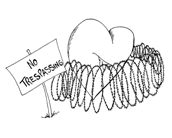
Initially the protective barriers are erected around the heart. The inner feelings become a “No Trespassing” zone within their life. That’s why my picture for this lesson is a heart surrounded by barbed wire, with a “No Trespassing” sign. That’s how it is on the inside for some people.

Reject 14 No Tresspass

Not My Heart

It is not uncommon for rejected people to still live “normal” lives and engage in business, interests, family life and so on. To do this they usually rely on their social skills, intellectual capacities and so on.

What is significant about those carrying serious rejection issues is that they will allow people to interface with just about their whole life, but not their heart. They will engage intellectually, professionally, physically, socially, with responsibility and authority, giving their time, talents and resources, but not letting the tender areas of their heart be touched.

Their “ground zero” is the heart. That is the “No Go!” area of their life.

Off Limits

Because of their own personal pain, rejected people can be very sensitive to the pains and needs of others. They may also be more attuned to the environment, since they need to navigate it more carefully than others.

So, it is quite possible that people carrying their own internal burdens will end up in the ‘helping profession’, trying to assist others who are carrying personal burdens. Counsellors, ministers, psychologists, carers and the like can be motivated with concern for others, prompted by their own acute pains.

Yet, as they help others, they will find it difficult to share their own personal pain. They may share details of events and facts about what they suffered, but not their tender, injured feelings. Those things usually end up “off limits”.

I’m Out of Here

When these people end up in situations where personal issues are to be shared, they will escape the risky environment. While they may handle a business meeting with tenacity, a sales challenge with exemplary professionalism, a corporate deal with flair, or a birthday party with considered care, they will run away from situations where their “heart” issues risk being trampled on.

When someone comes to them and wants to bring up personal issues, either in the rejected person, or in themself, looking for a compassionate response, the rejected person can get a sudden attack of “I’m-Out-Of-Here”-itis.

They may respond with coldness, rebuke and hardness, simply because they cannot handle the matter any better, since it cuts close to their own personal pain.

Self-Preservation

Rejected people do not wish to offend in such situations. They do not intend to annoy or let down others. They are doing what they can to maintain self-preservation. Their survival instincts take precedence in those difficult situations.

What they are saying to themselves is, “I won’t let myself get hurt again!” In order to fulfil that promise to themselves they have to cut and run when they feel that someone threatens to trespass on their feelings.

Formal Relationships

A high-flying corporate executive engaged me for a communications training session. I spent several hours with him and another executive in the company. As part of the process I had both men make a personal statement to their loved ones on camera. The senior executive produced a formal policy statement, including all the right things one should say to their closest family. However it came out as forced and formal. It came out almost insincere.

When the other senior executive made his presentation it was powerfully warm and genuine. It came from the heart and was a thrill to listen to.

When I discussed the situation with the personal friend who had recommended me for the project he confirmed that the obvious evidence was representative of the top executive’s personality. The hope was that my involvement would help him move beyond his personal limitations, which hindered all of his communications, due to his lack of warmth and reality.

The man was a brilliant businessman. Yet, having been orphaned at a young age, he carried the baggage of personal pain which locked him up on the inside. While the other man was keen to continue the sessions the senior executive cancelled the project, since he felt he did not need assistance. I wonder if he wasn’t simply protecting his tender internal parts from the challenges I put him at risk of.

Sterile Relationships

Some marriages and parent-child relationships are denied the warmth and fervour which should be expected, due to one or both parties carrying feelings of rejection. When one heart is hidden behind barriers and is a “No Go” zone, there is no real hope of developing a warm, intimate, heart-to-heart relationship.

Consequently many relationships end up as sterile, formal, convenient, intellectual, sensual or routine, but not open hearted. What a joy it is for people in such situations to step into the freedom which Christ has for them and for their relationships to warm up and move into new territory.

Streams of Ministry

God has multiple ways of doing the same thing. The River of God flows in a variety of streams, making room for much diversity and for different types of ministry to work in divergent ways.

Yet Christians fail to understand this and think that their own pet expression of God’s grace is the best, or main way that God operates. So I have had to prompt various ministry people at times with an understanding of the “Streams of Ministry”.

I’m sharing this message with you, in the hope that you will not become blind to God’s great grace and the multiple ways He can and will move in the earth.

Diversity

Preachers love to extol preaching. Prayer warriors see the importance of prayer. Administrators are offended when they see others who do not value good organisation. Teachers tend to elevate teaching over other ministries.

Chris Praying

Those who see visions and dream dreams feel the value of those experiences. Evangelists can easily see that as the main ministry. And so it goes.

There is great diversity in Christian ministry, not just in modern practice, but in Biblical principles too. And this is not a problem. It is God’s way of making sure there are multiple streams of ministry available to address our needs.

Preaching or Prayer

We know that “the prayer of faith” heals the sick.

“And the prayer of faith will save the sick, and the Lord will raise him up; and if he has committed sins, they will be forgiven him.” James 5:15

We know that “the effectual fervent prayer of a righteous man avails much”.

“Confess your faults one to another, and pray one for another, that you may be healed. The effectual fervent prayer of a righteous man avails much.” James 5:16

Jesus told us that if we ask for things in His name He will do them for us.

“And what ever you will ask in my name, that will I do, that the Father may be glorified in the Son.” John 14:13

So, there is no doubt that prayer is a vital ministry. This is so much so that many people are totally committed to the ministry of prayer. Great testimonies, such as Praying Hyde in India, attest to the awesome effectiveness of a prayer ministry.

But prayer is not the only way God gets things done. God has chosen to use preaching too.

Preaching Does the Job

God has chosen the foolishness of preaching to do important ministry work.

“For when in the wisdom of God the world by wisdom knew not God, it pleased God by the foolishness of preaching to save them that believe.” 1Corinthians 1:21

Faith comes by hearing and hearing comes by the preaching of the Word of God. We are asked how people will “hear” unless there is a preacher.

“So then faith comes by hearing, and hearing by the word of God.” Romans 10:17

“How then will they call on him in whom they have not believed? And how will they believe in him of whom they have not heard? And how will they hear without a preacher?” Romans 10:14

Not only did the preaching of Paul birth churches in hostile places, but great preachers through history, including Spurgeon and Wesley, proved by their efforts that preaching is a powerful stream of ministry.

What is it to Be?

Now, which is it? Do we elevate prayer or preaching?

Can we do without both?

Some people seem to get by with only one or the other. Some people swear by one or the other. You can buy books that push one instead of the other. Which is God’s favourite? Which is best? Which should you pursue and which one should you neglect?

Obviously both are effective streams of ministry. There are people who make one or other work extremely well in their hands. But that does not mean that the other ministry is invalid, less important or lower in spiritual value.

Other Streams

Truth is a stream of ministry. Some people can see breakthrough in the lives of others, through speaking the truth to them, or helping them come to terms with reality. That’s because the truth is an effective ministry tool in itself.

“And you will know the truth, and the truth will make you free.” John 8:32

Laying on Hands is a stream of ministry. This was not only practiced in the New Testament church but it was clearly described by both Jesus and the Apostle Paul. There are spiritual and practical outcomes which spring directly from the ministry of the laying on of hands.

“They will take up serpents; and if they drink any deadly thing, it will not hurt them; they will lay hands on the sick, and they will recover.” Mark 16:18

“Neglect not the gift that is in you, which was given you by prophecy, with the laying on of the hands of the presbytery.” 1Timothy 4:14

Binding and Loosing is another stream of ministry. Jesus instructed His followers that they could exercise the ministry of binding and loosing. This includes binding the enemy’s work and releasing God’s grace.

“Truly I tell you, Whatever you bind on earth will be bound in heaven: and whatever you loose on earth will be loosed in heaven.” Matthew 18:18

Yet More Streams

Faith is another powerful ministry stream. If we have faith even as a grain of mustard seed we can move whole mountains.

“And Jesus said to them, Because of your unbelief: for truly I tell you, If you have faith as a grain of mustard seed, you will say to this mountain, Remove hence to yonder place; and it will remove; and nothing will be impossible to you.” Matthew 17:20

The Gifts of the Holy Spirit provide yet another important ministry stream. The Holy Spirit distributes gifts so that we all benefit.

“But the manifestation of the Spirit is given to every man to profit with.” 1Corinthians 12:7

Humility brings powerful results. God gives grace to the humble and if we humble ourselves that leads to us being exalted by the Lord in due time.

“Likewise, you younger, submit yourselves to the elder. Yes, all of you be subject one to another, and be clothed with humility: for God resists the proud, and gives grace to the humble. Humble yourselves therefore under the mighty hand of God, that he may exalt you in due time” 1Peter 5:5,6

Confession also has a powerful ministry value. We are told to confess our faults one to another.

Confess your faults one to another, and pray one for another, that you may be healed. The effectual fervent prayer of a righteous man avails much.” James 5:16

Spiritual Warfare, involving the armour of God, is clearly a powerful ministry process, protecting us from the enemy’s attacks.

“Put on the whole armour of God, that you may be able to stand against the wiles of the devil.” Ephesians 6:11

And what about praise, comforting one another, giving, fellowshipping together, visiting the sick, feeding the hungry, exhortation, and helps? There are other streams not even mentioned here.

Got the Picture?

I have met people who are totally committed to just one of those streams of ministry, thinking that God can only be effective by that particular emphasis. But the Bible reveals that God has multiple streams of ministry.

Pentecostals may emphasise the operation of the gifts of the Spirit, while evangelicals may steer away from that. Evangelists and preachers may feel that the more ponderous teachers are failing to be effective. Men and women of prayer may be upset by those who don’t spend as much time in prayer. Those who give may be upset by those who won’t. And so it goes.

Our God is an awesome God, who can use each one of us in meaningful ministry, even though we are all doing something different.

Don’t despise those who God uses differently to you. You do not have the exclusive franchise on God’s ministry. Only He has that. So flow with Him, in the stream He leads you to work best in. But don’t stop others from flowing in the way God is best using them.